Pencil sharpeners are an essential pencil accessory. They keep the pencil pointed and usable. Yet they are frequently a frustration to use, splintering, chopping, and breaking pencils. Sometimes this is the fault of a cheap pencil. And sometimes it is the fault of the sharpener.
The weak aspect of most portable sharpeners is the blade. The blade may be made very cheaply and be just barely usable a few times, or even if better quality, have become dulled over time. Rust and oxidation may also have had a role.
Yet, in years of frequenting art and office supply stores, I have never seen a replacement blade for sale. Art supply store staff tend to agree that this would be a good idea, but they have no place to order them.
What this means is that portable sharpeners are being sold as de facto disposable items – even fairly expensive ones with glass and metal housings.
I suspect that even a single sharpening dulls many blades, and that the working lifespan of a typical handheld sharpener blade in tip-top condition may be less than that of a single pencil. So there are a lot of blunt sharpeners out there in the world.
Laurentien, a colouring pencil brand that will be known to Canadians (now part of Sanford), states here:
We no longer recommend hand-held sharpeners for any of our colouring pencil lines. These sharpeners usually dull quickly and will chip at the wood instead of shaving the wood.
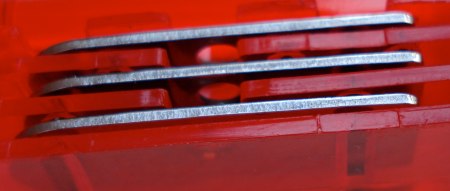
In the photo are some replacement blades (the KUM Standard 530S) that I ordered from the highly efficient Cult Pens in the U.K. Yikes – replacement blades from overseas. It is a shame that I couldn’t buy them locally. But I ordered them as part of a larger shipment, and now wish I had ordered more. It was the only realistic way I could see to keep some favorite sharpeners, like a DUX inkwell, usable over time.
Now some sharpeners truly are disposable – with no ability to replace the blade – but many are attached with a tiny screw, and will take this replacement blade.
Why aren’t replacement blades commonly available?
It’s a disposable world.
Just an FYI…I bought a bunch of KUM pencil sharpeners at Pearl Paint in NYC and picked up bags of replacement blades there also. I can’t remember the cost of the replacements but they were inexpensive and the bag comes as a 12 pack with three different sizes.
Pencilthings.com carries replacement blades for Alvin and KUM sharpeners. They ship to Canada.
Indeed. I’ve got a saved cart at Pencilthings.com with a bunch of replacement blades in it. One of these days, I’m going to keep a tally of how many sharpenings I can get out of a blade before it degenerates to uselessness.
The bag o’ blades Patrick mentions sounds great as long as the blades fit whatever sharpeners you have lying around. As long as they’re the same manufacturer they should all fit, I suppose.
I’m actually pretty impressed with the performance of most sharpeners over time. A poor quality pencil won’t sharpen well in any case, but I have a couple of inexpensive sharpeners that still give a nice point after years of regular use.
That said, can anyone can recommend an good, portable non-blade sharpener?
I’d also like to add that for a two-blade sharpener like the KUM Automatic Long Point, rotating the blades between 1st and 2nd stages can increase their lifespan considerably, on the order of 50% in my experience.
I’m just going to mention that Bob Slate in Boston has replacement blades in stock. I heart Bob Slate.
I actually have picked up a flyer from one of the drawing pencil companies that recommends replacing the blade on your pencil sharpener when it begins to tear, instead of shave, the wood. I have been looking for replacement blades for a while now — with absolutely no luck. If they don’t want us to replace them, why make them replaceable? It’s easy to find X-Acto knive blades, this should be just as easy…. Grrrrrrrrr.
I use exclusivly Dixon Ticonderoga pencils, and therefore bought a rather expensive electric sharpener which performed well to begin with, but it has declined over the year plus I’ve had it. I have tried sharpening the circular blade piece, but it is rather difficult, so I have been looking for somewhere to buy a replacement blade piece, but have been unsucessful. If anyone has any ideas where I might be able to find a replacement I would be greatful.
Nothing quite as nice as putting a point on a pencil with a sharp penknife!
Where can I buy replacement Dux blades in the UK?
Yes, I agree with Saumiq !
Great pleasure can be gained from using a penknife to sharpen a pencil. It requires of course a sharp knife, a decent quality of wooden pencil, and skill.
The skill lies in avoiding crude ‘whittling’. You need to cut three long deep ‘shaves’, equally spaced round the pencil end being sharpened. Then three shallower shaves between these, each taking off one of the three ridges between the deep shaves. The hexagonal faces of the pencil make the spacing easy to achieve.
The ADVANTAGE of using a knife in place of a pocket ‘twist’ sharpener is that each of the three shallow shaves leaves a thin wooden ‘buttress’ that serves to reinforce the graphite point; and the resulting graphite point itself can give ‘character’ to one’s writing, rather in the same way as an oblique ink-pen nib.
Thanks for the comment, Jake. So what type of knife do you recommend for the six side technique?
I have used many different pocket knives, but now have what I think is the ideal knife. Burgon & Ball Classic Pocket knife; you can see it on their website, under gardenning tools. It is a regular folding penknife; described as ‘classic’ in an English sense; I guess an American pocket knife would be more rugged and heavy.
Particular features are its handle and its blade. The handle must give control and leverage. Consider the movements of the blade like those of a boat on the sea. The handle is 10 cm long, fitting the average hand size; it has wooden scales making it easy to grip; and it is medium broad. Thus it is easy for the user to control the blade and make it pitch, roll and yaw.
The blade is 8 cm long, giving the user a good choice of which section of the blade to use; it is made of hardened steel that takes a very good edge and retains it. It measures 0.25 cm thick at the ‘back’, and 1.5 cm deep from back to edge. These dimensions mean the angle at which the faces (sides) of the blade meet as they converge to the edge is not too ‘thin’; the blade is top quality Sheffield steel anyway, but this angle makes it even less likely the blade will flex or bend. Sharpening the blade makes this angle slightly larger still; although we are talking micro-degrees of angle, it does result in an inflexible blade that will not only take a lethally sharp edge, but will retain it too.
Sharpening a pencil takes practice, and here are some tips. The broad deep strokes are to cut both wood and graphite; they should be made with the middle section of the blade; their purpose is to sharpen the pencil ! Rather than setting the length of the blade at right angles to the length of the pencil, turn the back of the blade backwards slightly towards your body, giving an angle of about 70 degrees with the pencil axis. The shallow cuts are to cut mostly wood only, and should be made with the section of the blade nearest the handle; their purpose is to ‘fine tune’ the pencil point, and to reduce the ridges slightly so that the wood doesn’t hide part of the point when the pencil is in use.
I discovered your website by chance; you have a new and dedicated reader !
Jake, thanks for the detailed instructions! I am so glad you didn’t claim just any knife would do. I will have to look for a Burgon & Ball. Glad you like the website.
I have had the idea to sharpen the blades myself using a knife sharpener. Has anyone tried this? I am a school teacher and the sound of an electric sharpener is like nails on a chalkboard to me. Not to mention that the blades in electric sharpeners generally won’t last an entire school year so there is still a lot of waste. But as you can imagine, kids burn through even the finest handheld sharpener. I too have been on the search for replacement blades, but thought it would be even better to actually sharpen the blades it comes with. It seems like it would be pretty easy to remove the blade, sharpen it and then put it back. I haven’t tried it yet though.
One piece of advice for making a blade go a little longer is to try a little rubbing alcohol. Especially if you are trying to use colored pencils which leave a waxy residue. Sometimes it’s not that the blade is dull but there is residue.
Eileen,
The steel they’re made from is pretty hard and difficult to sharpen in a domestic knife sharpener. They’re also fantastically difficult to keep hold of.
I’ve tried an oilstone (the kind you use to sharpen chisels), holding the sharpener blade in a clamp.
Perhaps I lack the skill but the results were not worth the effort.
I use a knife on my drawing pencils to get the variety of lead shapes,
Eileen & Michael have hit on the principal problem with the hand-twist pencil sharpener, ever since its prototype invention in 1847: the blade gets blunt ! Pencil sharpeners have gone through some evolution to deal with this, but in vain. In early sharpeners the blades were intended to be removed and sharpened, with the holding screw able to be undone by hand or using a coin; some were intended to be reversible and had double edges; and some were intended to have their blades replaced, and had one or two spare blades attached on the side; it used also to be possible to buy spare blades. The solution to this problem of over 163 years may now be simply to treat the small pencil sharpener as disposable; maybe that is why there are so many cheap and aesthetically unappealing sharpeners available nowadays !
regarding pencilthings.com They do have blade, but they are 1.00 and up plus then you are looking at shipping I suppose.
guess I should just accept the disposable .99 cent ones at staples.
Hi
Can anyone tell me where I can get replacement blades for ordinary plastic sharpeners with blades screwed on to them??
Thanks in advance
Maz
Mazhur
You really should read through all the previous interesting and informative messages.
Or pick up a penknife !
Good luck
I liked your comment best.It says history about sharpeners.
I am looking for information about making sharpener blades but can’t find any, not even a hint about who can supply me the tools to do it. Can you possibly assist in telling me how sharpener blades are manufactured??
My thanks in advance
Whoah !!! I have no idea, sorry.
It would mean obtaining properly-tempered steel, cutting it to size, and grinding an edge. It simply would not be worth the cost compared with chucking out the old hand-twist sharpener and buying another one to be treated again as ‘disposable’.
I collect this kind of sharpener, and analyse the technical aspects of each variation in them; a tiny niche area of interest, about a simple device that has become an icon in our lives.
Although it began life as a prestigious and expensive device to buy (first in 1851 in Britain & I think in the same year in the US), it evolved within 5 years (1856 in the US) into a mass-produced and relatively cheap through-away device. You can guess why: a frenchman invented it, it was then designed to a very high quality specification, manufactured to an equally high level of production, and the idea ‘high-jacked’ by an American with a much simpler and cheap-to-make device that I assume did not infringe the original patent. As with many inventions, Europeans have an idea, put it on the drawing board, and leave it there. Americans take it off the drawing board and get it into manufacture and use it !! Have a look at http://www.officemuseum.com and go to pencil sharpeners then small sharpeners. It is a good read ! Now go and buy a new “throw-away” sharpener and enjoy the sharp blade for a week !!
There’s got to be a way to get into the wholesale chain of blades manufacturers, to get my hands on a bag of 1,000 high-quality, screw-on blades for those disposables. If it’s time to go bag-free (disposable plastic bags), then maybe it’s high time to stop this cycle of highly disposable item.
Are you one who’d forgo the $1 disposable in favor of a high-quality $8-10 which sells $1 replacement blades?
http://www.PencilThings.com/category-s/64.htm
Found same Kum sharpener ($8+ at pencilthings.com) for just over $4:
http://www.dickblick.com/products/alvin-kum-long-point-pencil-sharpener/
I can’t believe I’ve just spent 10 minutes of my life reading comments about pencil sharpener blades- and more so, replying..however, there is not much worse than a blunt or badly sharpened pencil, hence my search for a quality replacement blade for my lovely DUX sharpener. I will make a foray into the jungle of pencil sharpener blades, and report back..
Hooray! This is just the thread I needed after flinging my cheapo pencil sharpener across the room in frustration, having chewwed up two of my lovely Derwent pencils. I looked for blades as well, and you can buy them in bulk, but it seemed cheaper to buy the disposable sharpeners in bulk instead and fling them in with the recycling when they inevitably go blunt.
I wonder if you could keep them sharper for longer by treating them in the same way as a razor (of the beard shaving variety). I see there are all sorts of tips as to how to keep your shaving razor sharp; obviously our sharpeners are not getting wet, but maybe a little oil from time to time would help?? Or would that just make it worse? And then I see that people suggest running a razor blade backwards across a leather strap, to knock out any little dinks. This is rather like the leather strap used in old skool barbers shops to keep their cut-throat razors sharp. You’d have to do some daily maintenance I think to keep them sharp for a bit longer, and I wonder if it would be worth the effort.
Also I’m thinking a block with some fine sandpaper / glasspaper stuck onto it. I saw one one artists blog that they use that set up to keep the tip nice and sharp, and then harvest all the graphite powder (useful to a graphite artist, to make smooth ‘washes’ of graphite).
I used to sharpen with a knife in my youth, but now I have kids and I think it would be too hazardous to have a sharp knife floating about the house. You never can be too careful with boys. No hiding place is secure enough. It’s a very satisfying thing though as long as you’re not wasting too much pencil away with your efforts. Practice on something cheap! I don’t recall using anything more complicated than a standard DIY style retractable knife. And I think unless you’re a connoisseur like the gentleman above (I think you’re great btw) it will probably do very nicely.
I think for now I will order 24 metal sharpeners of eBay, and be prepared to fling them all away after 24 weeks, but at least I can recycle the components.
Here are the sharpeners that I bought; http://www.ebay.co.uk/itm/24-QUALITY-BRANDED-METAL-PENCIL-SHARPENER-/280566265221?pt=UK_BOI_Office_Office_Supplies_Stationery_ET&hash=item41530d7585#ht_649wt_1298
I hope they are good….
Thank you Nadia – I have just ordered a big pack of blades and hope they fit my Dux sharpener.
Even if they are incorrect – I like trying to be a bit green by avoiding buying armfuls of throwaway items.
Elinor life is not wasted by reading comments on sharpening pencils, on the contrary it is enriched
Mmm.m.m.m
Big Al (I’ve given you caps) has got me thinking again.
Methinks you will end up throwing away lots of blunt blades in place of throwing away lots of useless (plastic) sharpeners. Which is better ? For the environment perhaps the blades; for your pocket, and for the time you spend fiddling about screwing in a new blade each week, maybe the whole sharpener.
My conclusion ? As this website is essentially about pencils, rather than sharpeners, we should each make our own choice whether to use hand-twist sharpeners and accept their disadvantage of the blade getting blunt; or we should get whittling with a sharp penknife and develop our skill in making a good point.
May I introduce a new thread for discussion ? My interest in the evolution of the hand-twist pencil sharpener depends essentially on the continued use and survival of the pencil itself. What are the prospects for the pencil’s future ? Why do we love the pencil so much ? It is by far my favourite instrument for writing.
Hi, I’ve got some pure graphite pencils – just the lead, no wood. Am scratching my head how to sharpen them – don’t think a knife will do the job, as the lead seems really brittle. Also loathe to use a circular sharpener, for the same reason – hate to lose a large proportion of the lead to inadequate tools. What do you recommend? Fine grain sandpaper? An emery board? I’m totally at a loss.
Barry, could you please say what shape cross-section your graphite pencils are; and their diameter too ? I am intrigued, because pencils have wooden casing for two reasons: to strengthen the “lead”; and to prevent your fingers from blackening. So do you know why your pencils have no casings ? And what type of work specifically do you use them for ?
Hi jake, you can see some here – it says use a pencil sharpener. http://www.greatart.co.uk/FABER-CASTELL%20PURE%20GRAPHITE%20PENCILS-graphite-lead-pencils.htm
Barry’s graphite pencils are a slight puzzle. The Faber-Castell website says they can be “sharpened as normal”. It also lists four hardness grades, calling into question the meaning of the word “pure”, as different hardnesses are achieved by mixing the graphite with a clay mixture to bind the graphite powder during manufacture. Maybe they could be sharpened, or rather ‘re-pointed’, by gently grinding the blunt end against a VERY fine metal rasp or file laid flat on a newspaper on a table. Get the angle right and twist the pencil whilst rubbing it against the file, and you may find you can re-point the pencil without breaking the length. Finish off the process by ‘honing’ the end in a similar way on a piece of unpolished cardboard. Good luck !
I have a PMP pencil sharpener battery operated. I want to replace the blade, but cannot reach at the same time the screw and the nut. Does any body know how to do it? Any tutorial file? Thanks in advance.
I buy sharpener blades at Dakota Art Pastels. They fit most handheld sharpeners.
I think there are ten per box, and they are very good quality, made in Germany, I believe.
Re the earlier question on Dux blades:
http://www.manufactum.co.uk/replacement-dux-sharpener-blade-p838456/?category=193719
This I find fascinating, I’d never have guessed such a thing was made:
http://www.manufactum.co.uk/dux-precision-pencil-sharpener-p838455/
Way too expensive for me though :)
I am a middle school teacher in search of a solution. It seams as though I can’t find a pencil sharpener that they can’t break. I buy the industrial electric pencil sharpeners and they break them to the point of not working. I don’t think I want to go to the hand held, because I am afraid of them walking off with them or breaking them. Any ideas on how to handle the sharpening of pencils in a middle school classroom? I have up to 45 students in a classroom at a time, 5 students to a table.
Here is an idea for Nancy. This depends on the age and responsibility of your pupils: appoint one person per table per day (or week) to be “the pencil-sharpener”, in charge of the small hand-held hand-twist sharpener, and in charge of the sharpening for any pupils not wishing or able to do it for themselves. This will give them the chance to develop a few skills and duties that you would otherwise retain yourself. If in fact your pupils ARE students, they should be carrying their own pocket sharpeners and so able to fend for themselves. Worth trying ? Good luck !
I have a (now empty!) 12-pack of replacement pencil sharpener blades. No info on the blue plastic box, but the blaces are marked “M+R Quality” and might be from German company Moebius-Ruppert. The source has gone, but the MerriArtist site has a box of 10 M+R blades (product code MG100-6050) for only $3.59 (+ $5.60 shipping): I will try & hope these fit my four unbranded aluminum sharpeners… thank you!
Bit of an odd one chaps. Really want to find stats for the import numbers of pencil sharpeners into South America. This is the nearest I can find – http://www.indexmundi.com/trade/imports/?country=gy&commodity=821410 – which only covers Guyana and is more than sharpeners. Anyone got any tips?
LOL well, I sure am late to the party.
However, one possibility is the varying widths, depths, and lengths of the blades being used. I’ve come to own a huge assortment of hand held sharpeners in my quest for that perfect “golf pencil” point.
… Ahem, admittedly, it’s a bit of an obsessive compulsion for me. However, that said, with the huge assortment of essentially disposable sharpeners I’ve got (for one reason or another, I just don’t like them) .. I’ve taken to cracking open the most abhorrent of ones to cannibalize them for spare blades. Some times they’re the right fit, other times they’re so grossly out of spec that I just trash them.
Aside from that, I can also say that technique has a lot to do with it too. One of the things I’ve learned from finer wood working is; “Steel is a lot harder than wood”. Which sounds pretty obvious at face value yeah? However, for example, one of the mistakes people make when using a hand saw is to just drag the teeth back and forth, pushing and pulling with considerable strength. Instead, you just much more accurate (and clean) cuts by essentially letting the teeth “float” over your work and remove a tiny bit at a time. It’s surprisingly faster too because you’re letting the steel’s natural hardness do the work for you. Another example of this is a chisel. A properly sharpened chisel should stay sharp for quite a few uses before needing to be retouched on the oil (or water, or sandpaper) stone. One should never have to use a mallet on it as a matter of general practice x3 ~~~ Anyway, looonnng way around, if you apply the same philosophy to a manual sharpener, I find you get much, much cleaner results. I find using an extremely light touch works the best, and seems to keep sharpeners working as advertised a whole lot longer with more repeatable results.
Hhhhmmmm.m..m.m. Aluminium Foil puts some interesting thought into his use of sharpeners.
The problem remains however that the blade in handtwist sharpeners “addresses” the wood ACROSS the grain and so tears it as it cuts, whilst a penknife blade cuts it DOWN the grain. Compare rowing a boat across a river with rowing it downstream.
In my daydreams I try to design a sharpener with its blade set at roughly 30 degrees to the grain. This is the MOST EFFICIENT setting mathematically both for cutting the wood neatly and for minimising the physical effort of twisting.It is the reason British troops were so successful in the Napoleonic wars where they used curved blades with devastating effect on the limbs of french soldiers. Users of penknives to whittle their pencils will always find it less effort if they turn the edge of the blade to make an angle of about 30 degrees with the axis of the pencil when they whittle, and of course slope it inwards slightly towards the graphite core.
Jake, if this forum had a ‘like’ button I’d be clicking it for that post. Very interesting. :-)
Am I allowed to thank Nadia for her compliment ?
I have basked in secret pleasure on her earlier compliment she made on June 15 last year !
How about someone picking up the new thread I suggested on October 20 last year ?
I wish thee were more traffic on this site; I always enjoy the ideas people raise.
Does anyone else collect antique (1844 – 1940)brass hand-twist pencil sharpeners as I do ?
I think my collection is now complete but I am still looking for new examples. I think the evolution of this device is now complete; the remaining question is: will the device ever become obsolete ?And that question depends on knowing whether the pencil will remain in use. Any visionaries out there ?
jake: “Hhhhmmmm.m..m.m. Aluminium Foil puts some interesting thought into his use of sharpeners.”
(Off topic bit: Hie! Her, actually <3
The name comes from my Second Life (SL) account (In shortest possible terms, a "social game" :), which has eventually just become my usual online handle; It's weird I know <3.)
On topic: I think I'm getting your concept!
Essentially, the blade would be engaging the pencil shaft at an oblique angle (eg, diagonally)?
It's kind of tough to wrap my head around the specific geometry of this.
But I agree, engaging the grain in a stepped "diagonal cut" kind of fashion would make it easier, and probably yield better results.
But, there's a problem. if you just angle the blade (given the usual cone-shape of a manual sharpener), only a narrow point of the blade would come in contact with the wood (I think). ~ Could then, perhaps putting a parabolic curve in the blade address this problem?
Not putting a swoop (or curve) on the -edge- of the blade. But imagine looking at on a flat plane, and making it curved (like a rainbow, or C shape, only not as exaggerated)? Some kind of screw and mandril/anvil aproach, that as you screw the clamp down, it puts a proper parabola in the blade? ~ I dunno, just kind of speculating outloud.
~~~~~~~~~~~~~~~~~~~~~~~~~~~~
Also! Regarding the original post.
I've actually stumbled across replacement blades for a specific kind of sharpener!
I am not trying to promote this brand, or this website (in other words, I'm not an adbot lol), But, I found this. http://www.artsupplywarehouse.com/prodDetail.php?id=17601
Granted, these blades are replacements for a very specific brand of sharpener (although I've seen the rounded edged blades in other ones too), it should still fit with a lot of the manual sharpeners I've seen. Perhaps a test (and review?) is in order?