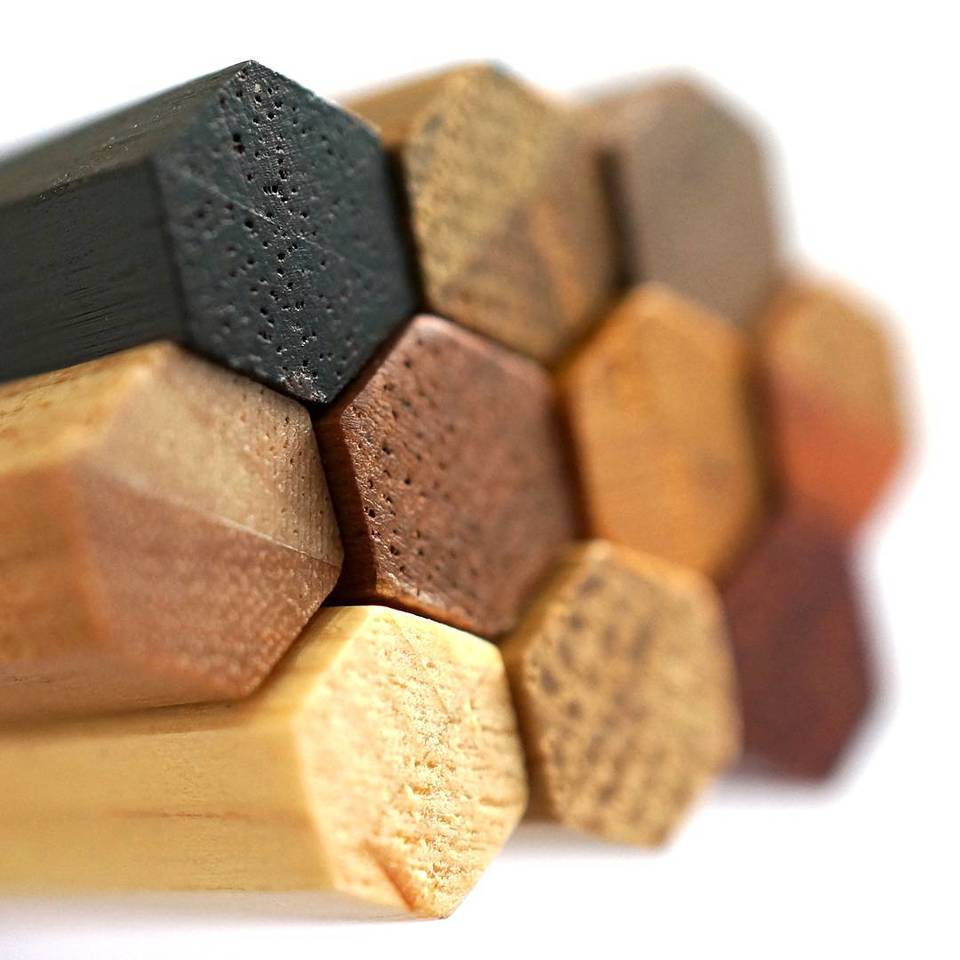
Faber-Castell 1117 pencil

Faber-Castell 1117

Natural finish pencils have deservedly earned a following. Today we’ll take a look at Faber-Castell’s offering in this market segment, the 1117.

This pencil has a ferrule and eraser, untypical of Faber-Castell pencils, and possibly suggesting that it’s aimed at the North American market. But it seems to be sold mainly (solely?) in Europe.

The pencil isn’t all that “natural”, and doesn’t reveal that much of the woodgrain, in comparison with a Musgrave HB for example.

There is a silver-coloured ferrule and white eraser – the same ones used by the erasered version of the Castell 9000. The ferrule is quite nice, possibly one of the nicest on the market today.

Faber-Castell 1117

Markings are minimal, in white ink:

Side 1 (Obverse): GERMANY SV 1117 2=B [logo] FABER-CASTELL
Side 2: blank
Side 3: blank
Side 4 (Reverse): blank
Side 5: blank
Side 6: blank

The wood resembles that of the Castell 9000, and not the Grip 2001, so I suspect it is cedar.

The box says “Eco-friendly water-based varnish.”

The pencils in my box ranged from 4.1g to 4.6g, with a 4.4g mean. This is the narrowest range that I’ve yet seen. The weight puts them below the Musgrave HB, and just above modern eraser-less pencils.

The grip is matte and just slightly rough. I’m a little surprised that Faber-Castell would sell a pencil in this format, as it contradicts their general design approach, which tends towards the finished and refined end of the spectrum.

Faber-Castell 1117

So what does “2=B” mean? They seem to use this scheme with the Grip 2001, but not the Castell 9000. For a given vendor, an HB and a B pencil will only be different by a minor gradation. Anyhow, this lead may be a ‘B’, and is dark and rich, certainly better than most pencils.

It’s a good pencil, and I can imagine the 1117 becoming popular.

Pencil shavings collage

Pencil shavings collage

Last week, I received a beautiful gift from a very creative person. It’s a collage which uses pencil shavings as material.

Pencil shavings collage

A glass frame made it challenging to photograph, but I hope that some of the essence is conveyed. In person, it is quite wonderful to behold.

Books on Pencils (I)

Sorry for the delay since the last post. The entire editorial staff was under the weather this week.

Following up on the excellent contributed list of children’s books on pencils, we’re going to take a look at three adult-oriented books on pencils.

Marco Ferreri, Editor. Pencils. Mostre Georgetti, Milan, 1996.

Bill Henderson, Editor. Minutes of the Lead Pencil Club. Pushcart Press, Wainscott, NY, 1996.

Henry Petroski. The Pencil. Knopf, New York, 1992.

Books on Pencils

Pencils is a beautiful and inspiring tribute to the pencil.

Alessandro Ubertazzi writes in the introduction:

One of the reasons for the pencil’s appeal is a latent analogy with the human existence – it’s inevitable end. The pencil is used, it gets sharpened, consumed and disappears.

The volume is a catalogue of an exhibition that occurred in Milan in 1996/1997. It has not just beautiful prose, but stunning, amazing photographs of the pencils in the exhibit.

My favourite photo shows a set of 24 pencils, each made from a different wood. I would love to own this set of pencils!

Every category of pencil is given tribute as part of an exhibition that promoted the “minor arts”: note taking pencils, non-writing pencils, yellow office pencils, black pencils, pencils with rulers, pencils with names, Mussolini’s pencil, unfinished pencils, decorative pencils, advertising pencils, indelible pencils, working pencils, red/blue pencils, Marotte pencils, compass pencils, pencils with caps, mechanical pencils, precious metal pencils, 4-colour pencils, Mordan pencils, celluloid pencils, vulcanite pencils, mechanical pencils disguised as woodcase pencils, pencils that look like pens, aluminum pencils, and many others, all with beautiful photos.

The book mixes photographic tribute with contemplation of this everyday implement.

The ritual of sharpening is of paramount importance since it embodies the concept of regeneration. The point of the instrument becomes sharp once again, the wood dirtied by hands and time regains its natural colour and releases a vague but enticing smell of resin.

As essay in pictures, accompanied by words, Pencils is very adept at probing the fascination of these special bits of wood and graphite.

Children’s Books on Pencils

January 27th will be Family Literacy Day. As a small contribution, pencil talk is delighted to present this guest post, a researched list of children’s books that feature pencils and other writing implements. The books are arranged by readership age range.

Title: Let’s Make Rabbits
Author and/or Illustrator: Leo Lionni
Age range: Babies and toddlers
Description: Scissors and a pencil “make rabbits”. The pencil draws, the scissors cut. When the rabbits are hungry, the scissors cut out a carrot from orange paper and the pencil draws a carrot.

Title: Simon’s Book
Author and/or Illustrator: Henrik Drescher
Age range: 2-5
Description: After going to sleep, a boy’s dip-pens and inkwell take a character he has drawn out on an adventure.

Title: If You Take a Pencil
Author and/or Illustrator: Fulvio Testa
Age range: 4-6
Description: A fantasy counting story, told by a pencil.

Title: Magpie Magic: A Tale of Colorful Mischief
Author and/or Illustrator: April Wilson
Age range: 4-8
Description: A child’s hands draw a bird and the mischief it gets into, using pencils including pencil crayons.

Title: Harold and the Purple Crayon
Author: Crockett Johnson
Age range: 4-8
Description: The classic and much-loved children’s picture book about a little boy who is lead on a grand adventure by his purple crayon one moonlit night. (Celebrating it’s 50th year).

Title: Grandfather’s Pencil and the Room of Stairs
Author and/or Illustrator: Michael Foreman
Age range: 5-9
Description: A pencil writes about its experiences and memories along with the house, floorboards and the table that all originate from the forest.

Title: I am Pencil
Author and/or Illustrator: Linda Hayword
Age range: 7-9
Description: How a pencil is made, distributed and used.

Title: The Good Luck Pencil
Author and/or Illustrator: Diane Stanely, Bruce Degen
Age range: 9-11
Description: A magic pencil brings a young girl more luck than she wants. The pencil helps her write a biography for a school assignment that she then must live up to. She trades her pencil in for a more apt instrument that truly reflects her life.

Title: Marianne Dreams
Author and/or Illustrator: Catherine Storr
Age range: YA
Description: Marianne’s drawings come alive in her dreams. Adapted into the film “Escape into Night” and an operetta by the author, reviews list it a bit on the scary side.

Schoollocker squared index cards

Schoollocker squared index card

Schoollocker is an Etsy store. Etsy is a large online marketplace of hand crafted items, almost akin to Ebay, though items are not sold by auction. An offering I noticed was a quadrille/squared/gridded/graph paper index card. I love this type of index card, and can’t find any close to home.

If the Exacompta cards I mentioned last week are the fashionable boutique high end, these are the practical though dowdy department store edition.

In a 4″ x 6″ version, one side has square ruling, and the other side is blank. The ink is loud, bright, public school blue.

Schoollocker squared index card

The problem is – and these cards are not alone in this aspect – the application of the ruling is random. So the vertical line closest to the card’s left edge might be touching that edge, or it might be several millimeters away. This rules out certain uses of the card.

The paper is also a step down from the high table Exacompta. Yet – the cards are still great fun, and very usable.

This blog rarely mentions prices, but at $US5.50 for 55 cards shipped to Canada, the cheaper and higher quality Exacomptas become an easy choice.