Unfortunately, this isn’t a huge surprise. It looks like pencils are now on the list of items recalled due to unsafe lead levels. The ones in question are a novelty brand aimed at children.
Links:
exploring the art and science of pencils since 2005
Unfortunately, this isn’t a huge surprise. It looks like pencils are now on the list of items recalled due to unsafe lead levels. The ones in question are a novelty brand aimed at children.
Links:
This blog has been in a personal domain the last couple of years, but I think it is time to graduate to digs of it’s own. If all went well, all previous links should work, redirecting to the new domain.
Welcome!
Some thoughts about the pencils we’ve looked at this past month…
It’s great that Australia still has a pencil manufacturing plant (Staedtler). There were a number of pencil plants in Canada some years ago, but they have all since departed. Going way back, Thoreau’s pencils used Canadian graphite for a while. Today, the Pink Pearl eraser seems to be the only Canadian made pencil item I can find. Papermate sells a “Canadiana” pencil – but it’s imported.
All the branded pencils are offered by German companies – Staedtler, Faber-Castell, Stabilo. I’m not sure what that means, but I’m somehow surprised.
The Tradition 110 would easily be my choice as the best of the lot. Most of the pencils are average.
I like the idea of a series of reviews, but the average pencils were challenging to write about, so I’ll be more selective before trying this approach again.
And for anyone who has read this far – the server stats tell me the blog readership grows monthly, and it is among the top results in many Google searches – but the comments and discussion don’t reflect this. Would anyone be interested in either a mailing list or forum devoted to pencils? Another format might be better at preserving some of the accumulated knowledge and opinion, and encouraging discussion.
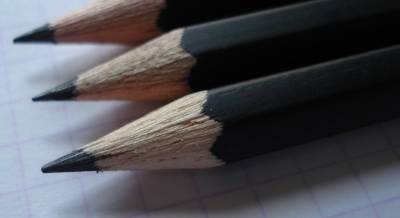
This is the final pencil in this August series on the pencils of Australia and New Zealand. Thanks again to Dave for sending me these pencils.
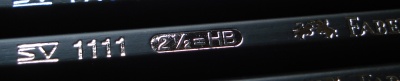
The Faber-Castell 1111 is an uncapped hexagonal pencil in matte black, simply marked:
SV 1111 21/2=HB Faber-Castell
It definitely looks nice in all black with minimal markings.
As a pencil, it’s like others in this series – not bad, but not exceptional. The lead is slightly scratchy, but on the plus side seems to hold a point unusually well. After a page of writing, it seems just as sharp.
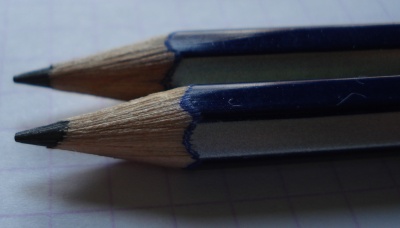
The Goldfaber brand is definitely marketed in North America – but it’s more known as a student or craft line of pencils. I’m not sure if one can actually buy this specific pencil here – I’ve certainly never seen one in person.
The 1222 is a real sleeper in the New Zealand/Australia series.
The only branded pencil in the series with an eraser, it is a sleek alternating Royal Blue/Silver combination, with gold and white stamping. It has a silver coloured ferrule with a white eraser. No country of manufacture is indicated.
It certainly has a finished appearance. Unlike other pencils in the series, whose colour schemes may be equal or superior as palatte choices, the 1222 is unique in having a high quality varnished finish, absolutely smooth and bright.
For what I suspected was a B-line pencil, the lead is good – not nearly as nice as the 110 – but still rich and dark.
The eraser, though white, is rough, not a smooth vinyl, and a disappointment.
Browsing around various national Faber-Castell sites, it seems the pencil may originate in Indonesia, though it is cedar rather than jelutong.
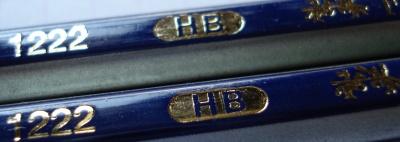
It is a very interesting pencil, and I am glad to have a couple of them.
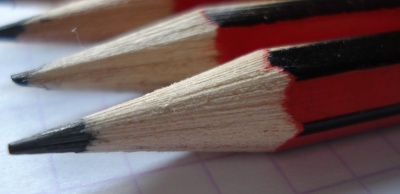
It was a real pleasure to discover the Staedtler tradition 110. Like the pacific, it is also made in Australia.
With red paint on four sides, black on two, and gold lettering, it does look different than a North American pencil. This is a pencil colouring I’ve seen in many photos and illustrations, but never previously in person.
The winning grace is the lead. In HB, it is easily the smoothest of the pencils of New Zealand and Australia that we’ve looked at so far. Other grades also handle themselves well. It is made in fourteen degrees, so it constitutes an entire line.
The only flaw I can see is the varnish, which is very thin. Without much scrutinizing, one can see a multitude of grain lines and dimples in the wood.
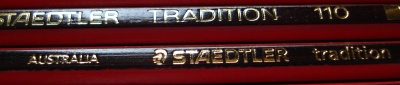
This pencil is definitely recommended.