So what is a “leadholder”? The shrine is at leadholder.com. My abbreviated nutshell summary is that they are simple mechanical holders for wide diameter leads. Wide usually means 2 millimeters (mm) or more. Today, there are three common wide lead diameters – 2mm, 3.15mm, and 5.6mm.
If you aren’t familiar with these writing implements – and there is good reason to not be, since they won’t be found easily – it is my recommendation to try one if you are interested.
The simple part is the “clutch” – which clamps a lead with three jaws. Other variants are essentially mechanical pencils, which have an internal clutch, and a button to expel the lead.
2mm is the same lead diameter as most woodcase pencils. 3.15mm is a larger variant. Both are used in traditional drafting, architectural, and mechanical drawing disciplines. Since most of these professions switched to computer based drawing one to three decades ago (with notable holdouts), these pencils today are probably more in the domain of students learning traditional drawing methods, and artists. They are of course both perfectly useful for general writing.
5.6mm is definitely in the sketching and arts realm. At this diameter, various chalk and charcoal media can also be used. I like the sanguine and sepia refills that these pencils accommodate.
While thin lead (meaning 0.2mm though to 0.9mm) mechanical pencils may be the trend or norm – and many have sophisticated internal mechanisms to support their very fragile leads – wide lead pencils are the antithesis. Wide lead pencils are simple, and can be used freely in one’s hand, without any fear of lead breakage. And a thick lead can be used to create marks with considerable line width variations, or in a soft grade, to just sail across a large piece of paper! If you want to sharpen the point, there is no shortage of methods!
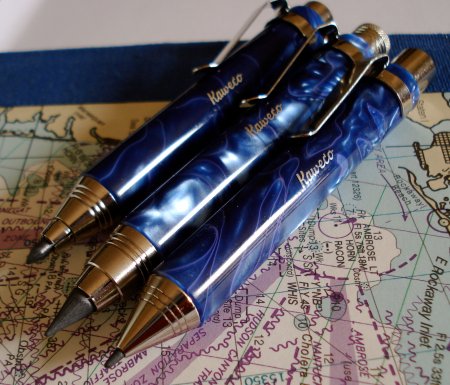
Kaweco, a brand of Gutberlet, recently introduced a new line of pencils. What makes this line special is that Kaweco is embracing all three wide lead diameters!
Sold in five basic colours, the blue series is shown here. I bought these at retail, and they are a great example of the benefits of the brick and mortar store. Online, all the colour variants seemed good to me – yet thank goodness I didn’t buy them online, because some were not at all appealing to me when I saw them in person.
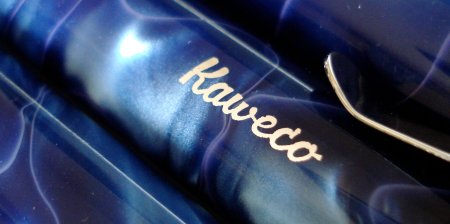
The 2mm version is a cap button advance mechanical pencil, while the 3.15 and 5.6mm versions are clutch leadholders. The 5.6mm pencil additionally has a sharpener inside the cap.
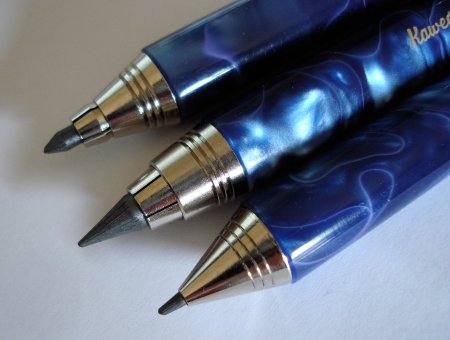
The pencils are highly unified in appearance, yet each differs – the tip, the cap, and of course the lead.
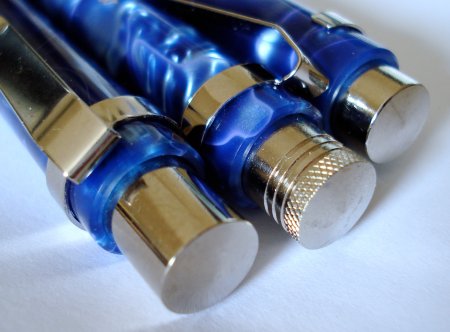
They are budget priced writing implements which perform without problem, and have a finish just as sophisticated (excepting the removable clip) as far higher priced alternatives.
Highly recommended.