The gift I received in February seems to have presaged a trend.

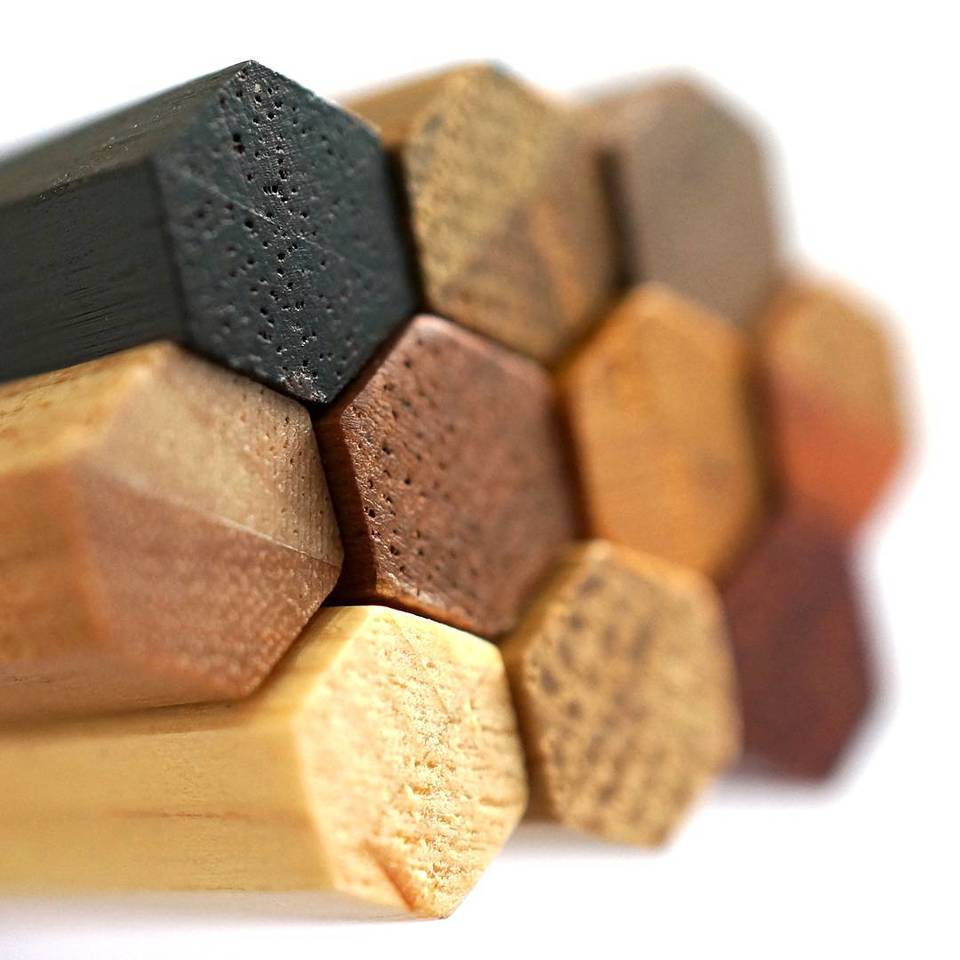
A Rorschach test of pencil shavings
Further: Shavings by Eric Klemm
exploring the art and science of pencils since 2005
The gift I received in February seems to have presaged a trend.
A Rorschach test of pencil shavings
Further: Shavings by Eric Klemm
Apart from stenography and carpentry, I’ve often wondered about what other professions use specialty pencils. A post at Lexikaliker about a historic pencil for cartography prompted me to pursue this exploration a bit further.
One finding – the Steinhauerstift, which seems to exist only in Germany at present. “Steinhauer” means stone mason. (Or it could mean quarryman, as a commenter on my blog pointed out. But in current usage, and to my ear, that term has an association with the quarry – but a stonemason isn’t necessarily performing their craft at the stone excavation, or working at the quarry.)
A Zimmermanstift is usually called a “carpenter’s pencil” in English, so a Steinhauerstift probably should be called a “mason’s pencil” or “stone mason’s pencil”. Still, it is usually translated as a “masonry pencil”, which isn’t wrong, but doesn’t agree with “carpenter’s pencil”, which we don’t typically call a “carpentry pencil”.
So what is a Steinhauerstift? Today, it seems to be an oversized pencil in oval or rectangular shape, with a rectangular lead in an extremely hard degree, such as 6H.
Where can they be found?
Bleispitz of Oberhaching make two models. If I am reading their descriptions correctly, these pencils are much longer than usual. A standard pencil today is about 175mm in length. Bleispitz make an oval version that is 300mm long, and a rounded rectangle version that is 240mm long. This in itself is a unique offering for a non-novelty pencil.
They have a similar offering for their carpenter’s pencils.
They identify the wood as “lime wood”. Hmmm, what is that? The German page says Lindenholz – which is more familiar. I’m not an arborist, but it seems that lime wood, linden, and basswood are the same species.
Lyra of Nürnberg also manufacture these pencils (Scroll down to item 331). The Lyra version is also green, and is “extra hard, oval shape”. (I see they also make a carpenter’s copying pencil!)
So at least with this sample of two, there seems to be a standard in terms of shape, finish colour, and lead degree.
Though masonry is not mentioned, Derwent offers their hard lead Rexel Blackedge carpenter’s pencil in green. (Dixon also offers carpenter’s pencils in more than one degree, but all are the same red and black varnish.)
So, here is another specialty pencil that is still in production.

The edelweiss 341 is the student line graphite pencil from Caran d’Ache.
The pencil varnish colours represent different lead degrees:
2H – Green
F – Blue
HB- Red
3B – Grey
Probably many of us would associate a scheme like this only with higher end products.

The pencils additionally bear the FSC (Forest Stewardship Council) logo.
They are hexagonal, with an unfinished cap – the only arguable compromise.

The pencil isn’t in the same quality league as the top offerings from Caran d’Ache, such as the Technograph 777. Also, the grading seems to differ by a two degrees or so from many other pencils – the HB seems like a 2H to me, while the 3B – well, it’s more my style.
The 341 is a good pencil, and very good relative to many student pencils. Those liking a soft dark lead are advised to try the 3B.
Coming soon to a pencil blog near you:

Our last look at erasers got some good feedback, so I thought I’d try four more erasers, though in a much more limited way.

We’ve established that erasers have to be judged in context, and this time we’ll narrow that context – one type of graphite on one type of paper. In particular, our reference pencil, the Staedtler Mars Lumograph 100 in HB, on an 80g/m2 Rhodia pad. Though not the cheapest brands, Staedtler and Rhodia have near-global distribution, so they seemed appropriate choices as references.
The four erasers are the Faber-Castell 7081 N Vinyl Eraser, made in Germany, the Pilot Foam Eraser, made in Japan, the Tombow Mono Plastic eraser, made in Vietnam, and the Sanford Magic Rub 1954, origin unstated.

All erasers were purchased new. The Magic Rub came loose, and the others were wrapped in cellophane. The three cellophane wrapped erasers also have paper sleeve holders.
Appearance wise, the Magic rub seems to have many air bubbles, and is a greyish off-white. The other three were variations of white.
On the Rhodia pad, I drew ovals from an Acme template, and shaded in a diamond pattern.

I’ll admit my expectation – I thought these erasers would all be roughly the same. All did well, but there wasn’t any doubt for me about which were best and worst.
At both lines and shaded areas, the Magic Rub was clearly the worst. Also fairly clearly, the Faber-Castell was the next to worst eraser in both tasks.
At lines, the Pilot Foam seemed best, with the Mono close behind. The positions were reversed with shaded areas.

I made some additional marks for an overtime round, and the Mono came out ahead. The differences are subtle, and hard to capture without professional equipment.

The description at Dick Blick suggests that the Magic Rub isn’t a paper eraser – which might explain the performance.
Further reading: Effects of eraser treatment on paper, American Institute for Conservation, 1982.
An old friend was just forced into mandatory retirement. Though still sharp as ever, he was deemed to be worn down. But we know he’s still got some lead left in him, and we’ll no doubt hear more from him in a future role.

There’s also a new cohort just starting. Also triangular, they have unfinished ends, and act like they were made for work.

Hailing from the venerable Mitsubishi Pencil Co., the 4563 in 2B lays down an incredibly rich, smooth, dark line. The shape is a rounded equilateral triangle, and if the pencil went back to complete its cap and get a more sophisticated colour, it would be able to compete with the best in the field.

Arriving half green and half yellow, they quickly impress, and will no doubt get the sort of use that will also push them towards retirement soon enough.

