Musgrave Choo-Choo pencil

Musgrave Choo-Choo pencil

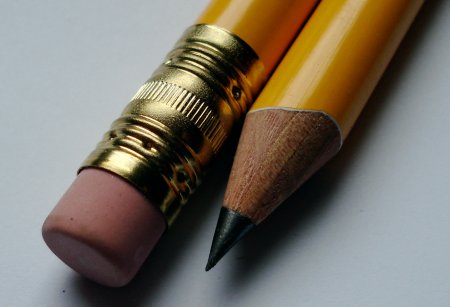
The Musgrave Choo-Choo pencil is an oversize round pencil for children.

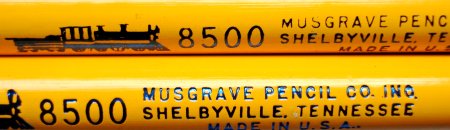
Made in Shelbyville, Tennessee by the Musgrave Pencil Co., it is finished in yellow with a gold ferrule and pink eraser.

Musgrave Choo-Choo pencil

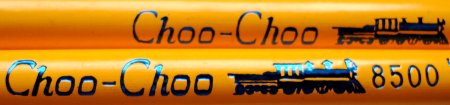
The type and graphics are delightful. Made of cedar, sharpening (which I would think is important in a children’s pencil) is a breeze. Unfortunately, the lead, though okay, doesn’t seem to be up to Musgrave’s usual high standard.

Musgrave Choo-Choo pencil

Overall, it steams ahead of the competition in the category.

Last large American pencil factory to close in 2009

And Then There Were Three??, a new post at Timberlines, a blog by pencil industry leader WoodChuck, reveals that the last large American based pencil manufacturer – Sanford – will be closing their US manufacturing facilities in 2009, moving production to Mexico.

The closures were announced in early November.

Two newspaper reports:

Sanford closing; 355 jobs to be lost Marshall County Tribune, November 12, 2008

Sanford regrouping to cost Shelbyville jobs Shelbyville Times-Gazette, November 11, 2008

In other relocation news, Woodchuck also noted here this morning that Lyra (Germany) will be moving production to China. (Lyra joined Dixon as a FILA acquisition earlier this year.)

Pencilpages.com has some nice photos of the Sanford plant in Lewisberg.

When I read about pencils being packaged by hand, I suspect that the factory wasn’t “modern” by any means. The mainstream Sanford pencils – the Mirado and Mirado Black warrior – have their fans, yet there seem to be many who feel the product lines have been allowed to deteriorate in quality over the years.

I also wonder where this leaves the remaining small independent manufacturers – General and Musgrave. Will the departure of their large competitor impact their own supply chain?

Though the story still has time to unfold, and could surprise us, it seems like an era is coming to an end. What are your thoughts?

Stabilo Trio 362 pencil

Stabilo Trio 362 pencil

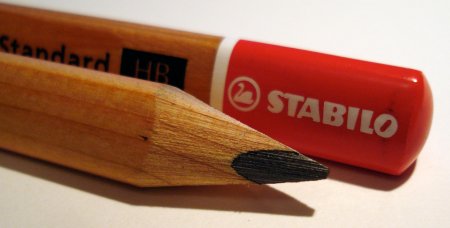
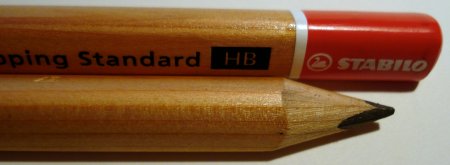
The Stabilo Trio 362 is an oversized triangular pencil in a natural finish with a splash of colour on the cap.

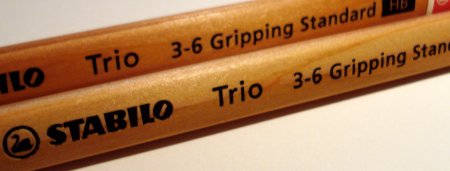
The pencil is marked “3-6 Gripping Standard”. The packaging reveals the meaning. Can you guess? That’s right, this pencil is meant for three to six year olds!

Stabilo Trio 362 pencil

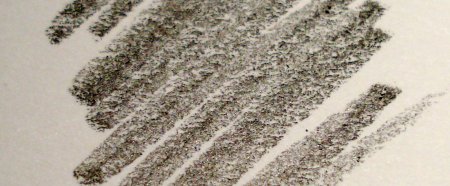
The core is an oversized 3.8mm. The line seemed somewhat light, though with more pressure it was able to leave a dark line.

Stabilo Trio 362 pencil

What’s really noticeable is the cap. This type of painted pencil end seems to be a feature associated with European pencils. The term I hear in English is “dipped”. But in German, there is more specific terminology. The white ring is a “Lackring” and the red cap a “Lackkappe”. This site translates Lackkappe to “patent tip” or “patent toe cap”. Maybe patent as in patent leather – shiny – but I think the terms more mean lacquer ring and lacquer cap. Corrections/additions to this understanding are welcome!

Stabilo Trio 362 pencil

The bright red and white cap is a nice contrast to the natural finish pencil. Overall, a nice pencil.

General’s Cedar Pointe 333 pencil

General's Cedar Pointe 333 pencil

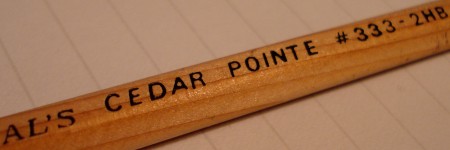
Here is a pencil that I know many pencil talk readers already know and like – the General’s Cedar Pointe 333 pencil.

It is a “natural finish” unlacquered pencil that emphasizes the pencil’s cedar origins in both name and appearance. Note how prominent the woodgrain appears. And for anyone who enjoys the traditional cedar aroma of pencils – the way they used to be – this pencil delights.

General's Cedar Pointe 333 pencil

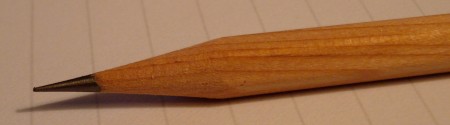
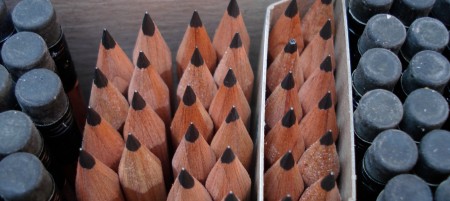
The HB lead seems strong, and lays down a relatively dark line, though it is not the smoothest. The eraser, in black (from Factis?), is quite effective. The pencil sharpens easily.

I’m not sure if this pencil can be purchased at retail. Has anyone seen it in a real brick and mortar store? Online, it sells for a relatively modest price. You may want to get a few.

General's Cedar Pointe 333 pencil

Overall, quite a nice pencil.

Mitsubishi 10B pencils: the brush pencil (fude enpitsu) and the Hi-uni

Congratulations to the venerable Mitsubishi Pencil Company (founded in 1887) on the occasion of the fiftieth anniversary of the Uni pencil brand!

This anniversary was publicly marked last month with press releases and some new products – a pencil holder that we’ll look at in a future post, and an extension of the range of the Hi-Uni pencil to twenty-two degrees – 10H to 10B!

The Hi-uni 10B is especially interesting because Mitsubishi just introduced another 10B pencil – the brush pencil (fude enpitsu)! See more at Dave’s Mechanical Pencils.
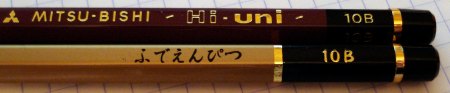
Mitsubishi 10B pencils

So what is the difference between the two? Let’s take a look.

Weight

The Hi-uni may weigh more. We are using a small sample size here (basically one or two), and past experience indicates that individual pencils, containing organic elements (wood) can have some weight variation. But, this Hi-uni is fractionally heavier than the brush pencil.
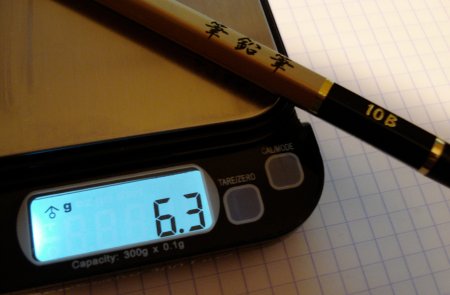
Mitsubishi 10B pencils

Mitsubishi 10B pencils

Diameter

The side-to-side length of both pencils, measured by a micrometer, is 7.25mm. They are indistinguishable in this aspect.
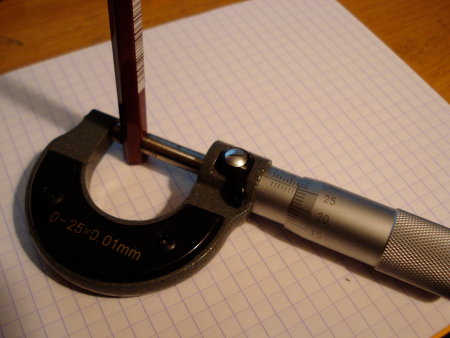
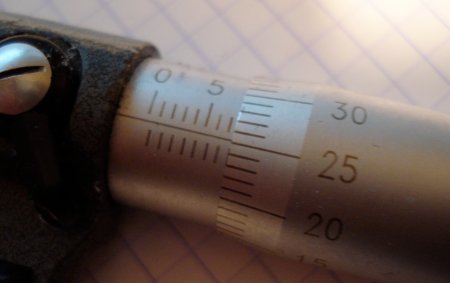
Mitsubishi 10B pencils

Mitsubishi 10B pencils

Lead core

I don’t know a way to remove just – and only just – the wood, so as to place the core in the micrometer. Viewing a ruler by eye has led me both ways – the cores are the same – or – they are not the same.
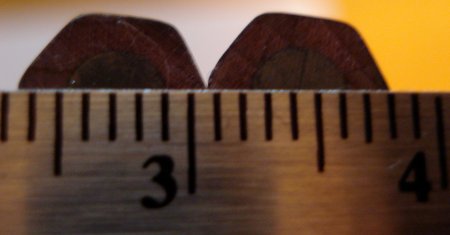
Mitsubishi 10B pencils

On paper

The darkness difference between the pencils – if it exists – isn’t anything I can reliably distinguish.

The drawing experience favors the brush pencil – they are waxier and smoother, in my estimation.
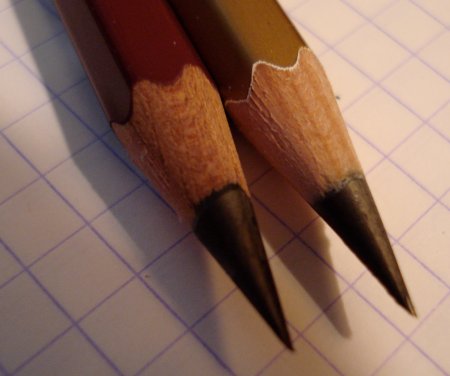
Mitsubishi 10B pencils

10B is an extreme grade for some, yet I hope it will be tried by those who are interested.

Overall, these pencils are great contributions to the world of graphite arts. While some proclaim the pencil dead, Mitsubishi Pencil Co. is investing in extending the product – and succeeding.

My thanks to isu of the uncomfortable chair for sending me the fude enpitsu!
General’s 206H Jumbo Clutch Holder & Layout Stick

General's 206H Jumbo Clutch Holder & Layout Stick

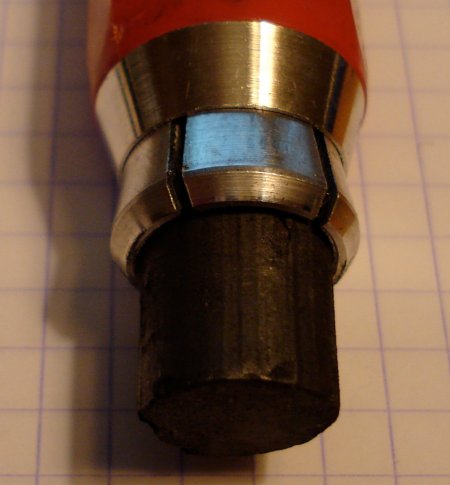
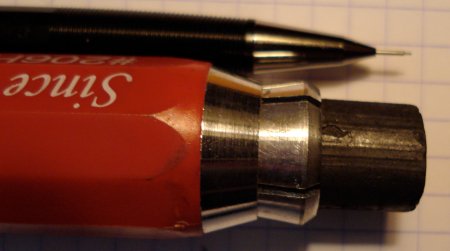
We’ve seen that mechanical pencils and leadholders can use graphite in a wide range of diameters. Here is one of the extremes, the “Jumbo Clutch Holder & Layout Stick” from the General Pencil Company in the U.S.

General's 206H Jumbo Clutch Holder & Layout Stick

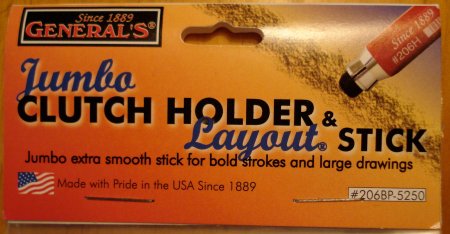
The packaging says this graphite stick can be used for “drawing, sketching, creating negative space and for covering large areas.” We’re also informed that the clutch holder will “keep your hands clean.”

General's 206H Jumbo Clutch Holder & Layout Stick

The holder is made in Germany – the only non-U.S. made product bearing the “General’s” brand name that I am aware of. (General distributes the Spanish Factis brand, but the products are not rebranded.) Lyra is also in the large clutch pencil market – perhaps they (or a common supplier) is the source.

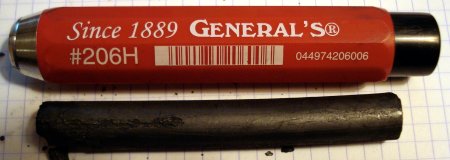
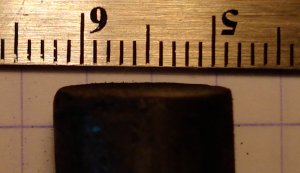
Using a new pencil can be messy. The leadholder as it arrived was covered in graphite dust that doesn’t easily rinse away. The graphite stick itself (in a plastic box) has some loose fragments and a lot of surrounding dust. It measures about 13mm in diameter.

General's 206H Jumbo Clutch Holder & Layout Stick

Though plastic, the leadholder seems sturdy, and the five-jawed clutch is easy to manipulate. (Smaller diameter clutch leadholders usually have three jaws.)

General's 206H Jumbo Clutch Holder & Layout Stick

It definitely works at laying drown broad lines, and is a very interesting drawing implement.