A few years ago, I made contact with some pencil bloggers in Japan. They have always generously shared their knowledge and enthusiasm.
It is a joy and relief to report that those linked to in the “From Japan” sidebar are all well.
exploring the art and science of pencils since 2005
A few years ago, I made contact with some pencil bloggers in Japan. They have always generously shared their knowledge and enthusiasm.
It is a joy and relief to report that those linked to in the “From Japan” sidebar are all well.
About eight months ago, Sharpie announced a new product, the “Liquid Pencil”. As soon as I learned of it, I was excited to see what it might offer.
Of course, I have heard of the former Parker Liquid Lead Pencil through Penhero’s excellent article, and noted the similarity of the marketing, though fifty-five years apart:
1955: “A lead that never breaks!”
2010: “Eliminates broken pencil leads”
1955: “Rolls words on paper smooth as silk!”
2010: “Writes as smooth as a pen”
Parker and Sharpie are now both brands of conglomerate Newell Rubbermaid, so it is entirely possible that the techniques of the original process are part of this revival.
The product launch had a lot of interesting elements, as well as some controversy.
First, it garnered considerable media attention. A few samples:
TIME: Sharpie’s Liquid Pencil Becomes Permanent After Three Days
Engadget: Sharpie Liquid Pencil, the aftermath: it’s ‘permanent,’ not permanent
Wired: Sharpie Reinvents Pen with Liquid Pencil
Now if you look at those articles, you’ll see the controversy. The original “Becomes permanent like a Sharpie marker after three days” statement was withdrawn by Sharpie. See the timeline of reactions in these three Engadget articles.
On stationery blogs, I saw reviews at Office Supply Geek and The Pen Addict. The product didn’t seem to be winning over either of these reviewers. Yet, I still wanted to see what this pencil might offer. I told myself that I’d wait until it turned up locally. That day just arrived.
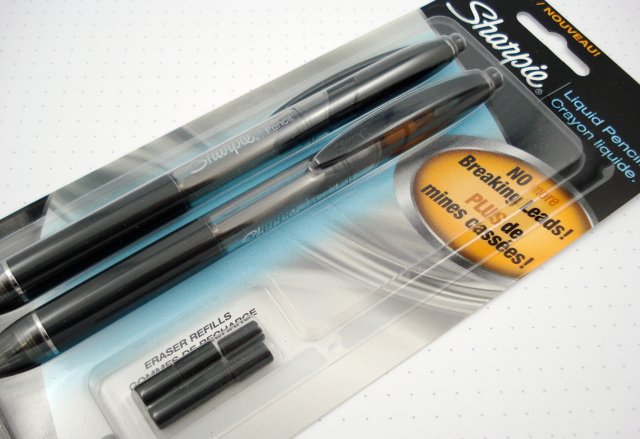
The package contains two pencils and six minuscule eraser replacements.
The package claims (front):
No more breaking leads!
And on the back:
Smooth like a pen, erases like a pencil
Sharpie’s Liquid Graphite Technology eliminates broken leads
No. 2 lead equivalent
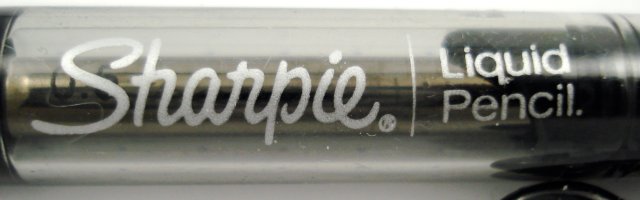
I won’t say much about the form factor or appearance. The product looks like a cheap ballpoint pen, and has some sharp ridges where the cap meets the body. The cap clicks to extend or retract the pencil point.
To my eye, the mark made doesn’t at all look like any graphite or pencil deposit I have ever seen. It has none of the luminescence or texture of graphite – ceramic, polymer, or water soluble. It simply looks like a ballpoint pen mark.

Writing with it, the problem is that the pencil barely functions by conventional standards. It just doesn’t leave a consistent line. The mark starts to dry up after a word or two (and that word or two isn’t rendered very well). It cannot render the dot in an “i”. Any woodcase pencil can do a better job.
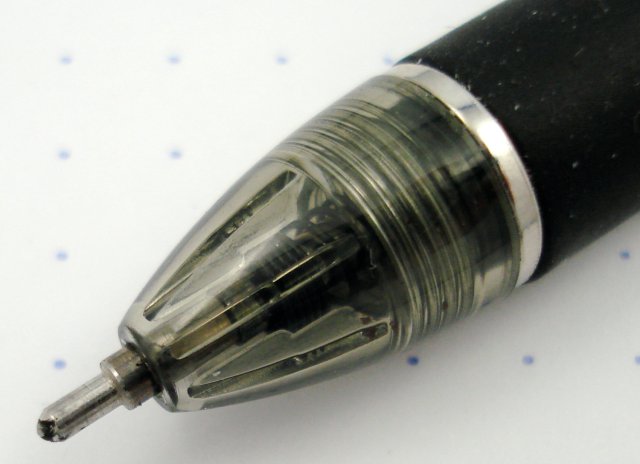
It does erase well, but that seems moot given the overall problem. It is hard to understand how this product was released to market.
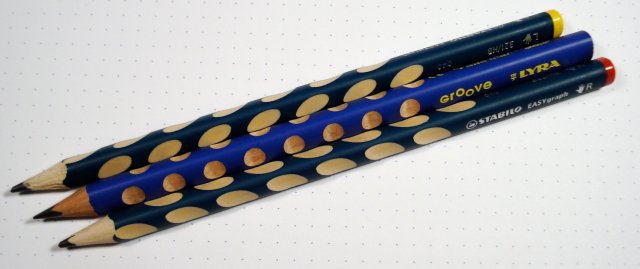
A new pencil trend – scallops or grooves cut into finished triangular pencils, exposing the underlying wood. Seen here, the Stabilo EASYgraph (right and left hand versions) and the LYRA Groove. Lexikaliker reports that Koh-I-Noor will be introducing a similar product in 2011.
Aimed at children, the idea is that the grip is improved, facilitating a good grasp and writing technique.
I wonder, what do the manufacturers do with the excavated pieces?
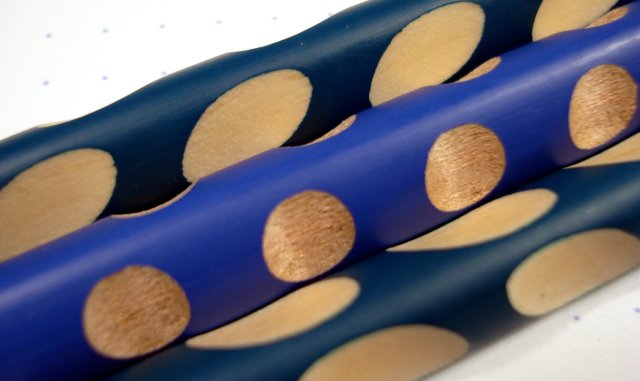
Comparing the two pencils, the Groove seems relatively simple – round scoops. The EASYgraph comes in two versions, right and left handed, with oval indentations matching the “correct writing grip”. The EASYgraph did feel much more comfortable in my hand.
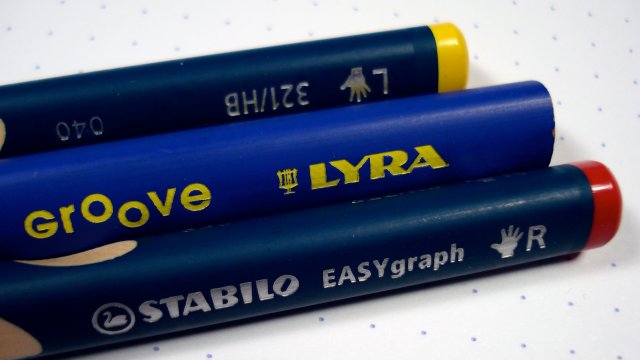
The EASYgraph also has something very unusual – the lettering in different orientations according to the handedness of the pencil:
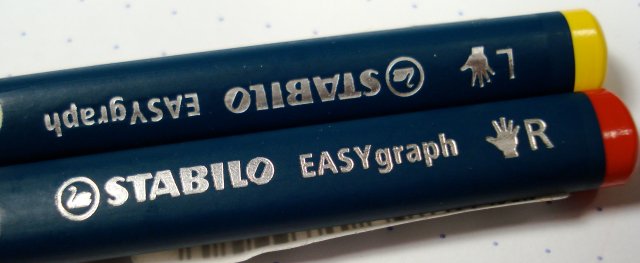
For writing, the Groove seemed quite rough and scatchy, while the EASYgraph was comparatively smooth.
My sincere thanks to Gunther from Lexikaliker, who sent all three of these pencils to me eons ago.
 |
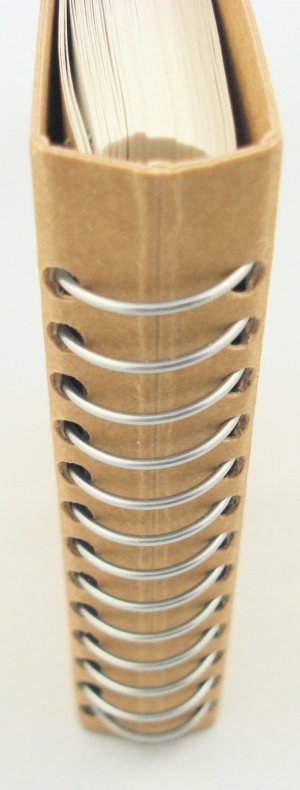 |
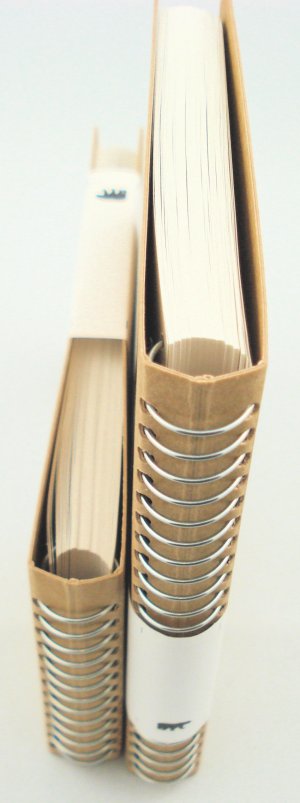
The globe is shrinking – recently found locally (Ontario, Canada) – Midori notebooks.
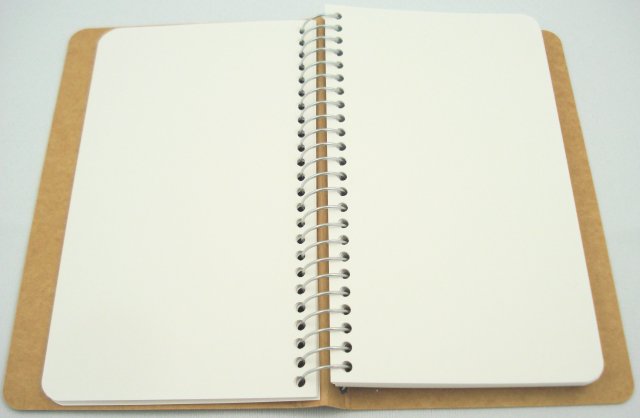
Plain and simple, yet high quality. Nicely finished. No visible cutting or processing artifacts or residue.
Relatively expensive, but their reputation preceded them.
The Midori paper loves graphite, and graphite loves this paper!
Isometric graph paper is still manufactured and sold in 2011, and has become an expensive specialty item.
I recall seeing engineering notebooks from decades ago that had isometric patterns, often facing a ruled or blank page. The tasks that require isometric graph paper (along with polar graph paper) long ago transitioned to computer software.
So, let me state that it was an immense surprise to see pads of a new isometric graph paper for sale at a brick and mortar stationer.
Alvin, who might be considered a traditional drafting and engineering supplier, claim isometric graph paper is “Ideal for mechanical drawing or design needs, especially machine design, architecture, and patent office drafting.”
Whitelines, the Swedish stationer known for using white ruling on grey backgrounds, are the creator of this new product, and state that “isometric graph paper helps you visualize ideas and draw in 3D for design, mathematical illustration and just sheer play.” It sounds like a slightly different market segment.
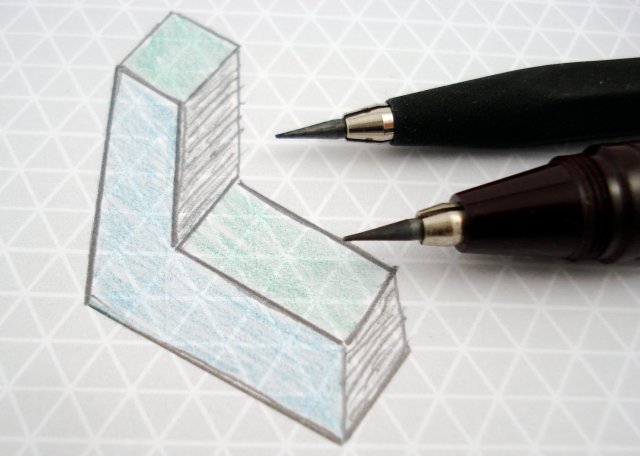
Shown with two of the most technical drawing leadholders I could find: a Caran d’Ache Fixpencil 22 with roughened grip (purchased at Phidon Pens) and a Rotring compass pencil.
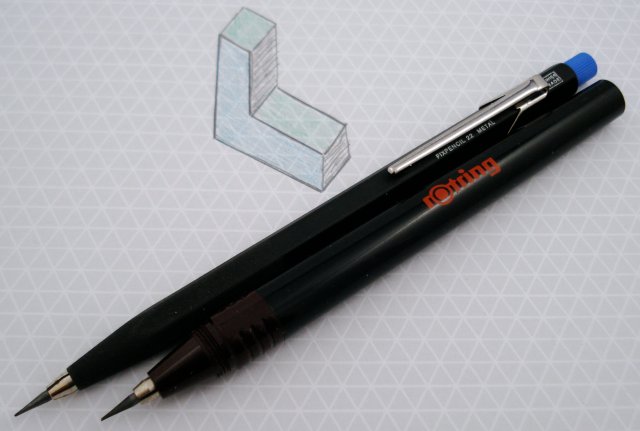
I’d like to also see the Alvin paper – it is about the same price per sheet as the Whitelines paper.
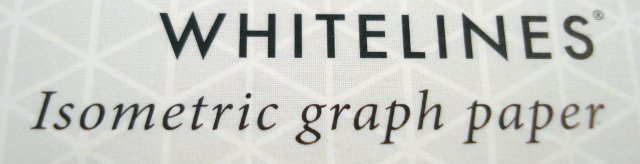
The “sheer play” purpose seems just right!
The J. R. Moon Pencil Company was founded in 1961 by James R. Moon. Moon was a pencil industry veteran, having previously worked at both the Linton and American pencil companies, following a career as a school teacher.
Some background information on the company:
Mr. Moon (born in 1912), passed away in 2002, and a scholarship in his name at Columbia State College is a testament to the mark he left on his community.
In 1999, the company name changed name to Moon Products, Inc., possibly reflecting the wider range of writing implements and supplies being sold at the time.
In 2003, crayon maker RoseArt Industries Ltd. of New Jersey purchased Moon Products Inc., claiming to become the second largest pencil manufacturer in the US. It isn’t clear how such a calculation was made, as Dixon and Newell Rubbermaid’s Sanford division were widely acknowledged as being the largest American pencil manufacturers of the time.
In June 2005, Mega Bloks Inc. (a predecessor name of Mega Brands) acquired RoseArt for $350M.
(In March 2008, Mega Brands announced they might sell the unit.)
Today, Dixon (acquired by FILA of Italy) and Newell Rubbermaid (who seem to have dispensed with the Sanford name in the US, in favour of the Paper Mate, Parker, etc. brands) have both moved US manufacturing abroad. Due to the historical prominence of the Dixon Ticonderoga and Paper Mate Mirado brands and products, the two companies are still the most associated with recent American pencil making.
Some industry followers and pencil aficionados, and probably many pencil talk readers, are aware that two smaller family owned companies, General and Musgrave, continue to operate in the US.

Yet there is another manufacturer. This manufacturer has no website, garners no press, and seems to operate in a stealth mode, with no brand or identity management. That manufacturer is Moon Products, which today operates in Lewisburg, Tennessee as a division of international toy conglomerate Mega Brands.
With great thanks to Pencil Me In, who supplied the pencils shown here, let’s take a look at the offerings of Moon Products and the larger Mega Brands organization.
The first possible surprise is in the branding – the “J. R. Moon” name still exists on a product, as do “Moon Products”, “RoseArt”, and “Mega Brands”. It gets even better – the company appears to use original imprints on some products, producing delightful new pencils that appear vintage. Lyra (in Germany) is also known for this practice.
Try-Rex B21 and B23
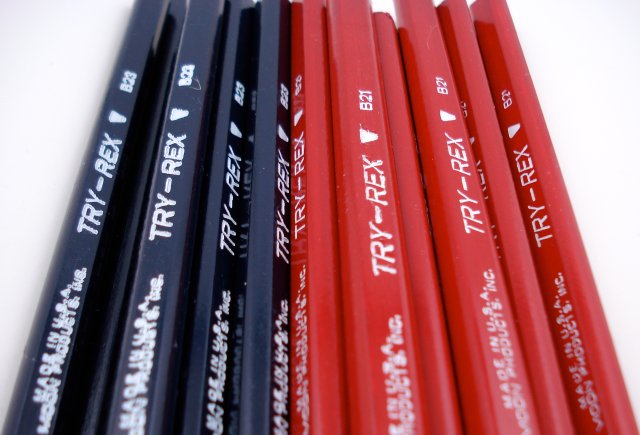
The Try-Rex is distinguished by an unusual shape – an equilateral triangle with rounded corners. This in contrast to other triangular pencils which are more like a three sided curve of constant width or a Reuleaux triangle . The shape comes from the Richard Best Pencil Company, which was purchased by J. R. Moon.
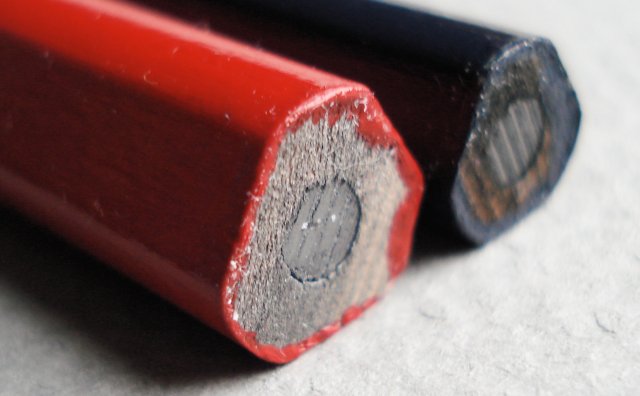
This pencil format is surprising similar to Mitsubishi’s triangular “Penmanship” pencil.
The Try-Rex B23 is just a bit larger than a modern standard pencil, and wouldn’t fit in some sharpeners I tried. It has a white imprint on a very dark navy blue finish. The B21 is an oversize pencil in the same shape with a red finish. Both share an oversize 4mm graphite core.
“Big-Dipper” 600
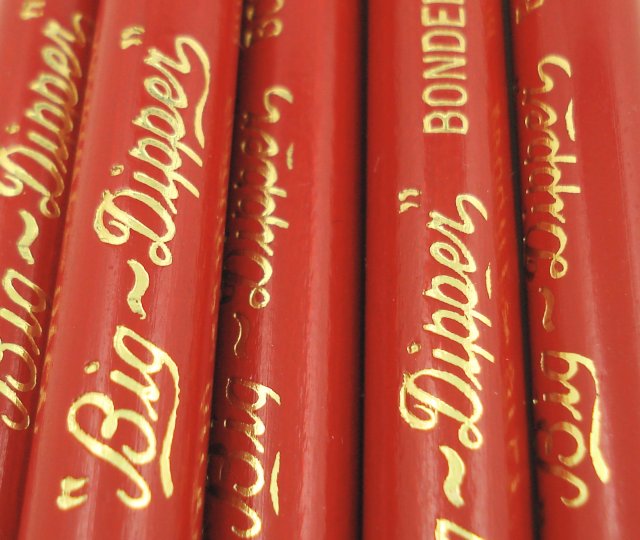
The “Big-Dipper” brought to mind the Musgrave Choo-Choo – delightful jumbo sized pencils for learners. This pencil includes the text “J. R. Moon Pencil Co.” Round, it is topped by a gold ferrule and ruby eraser.
Crown Cedar
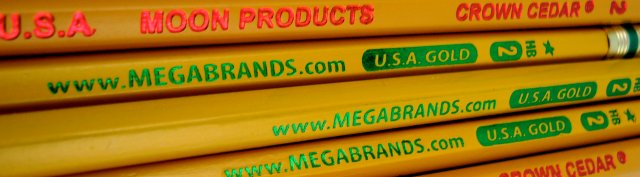
Simply marked “U.S.A. Moon Products Crown Cedar 2”, this appears to be a standard yellow office pencil.
USA Gold
Please see an interesting comment by WoodChuck about this pencil’s background. The packaging says “Made in the USA” and “Made from American Cedar.” The pencil is labelled “www.megabrands.com U.S.A. Gold 2 HB” and also appears to be a standard yellow office pencil.
USA Green
We mentioned this pencil here. It appears to be a sibling of the USA Gold.
Recycled Denim
A fun pencil, we previously saw it here.
Recycled Newsprint
A rolled newspaper type of pencil. Included for completeness.
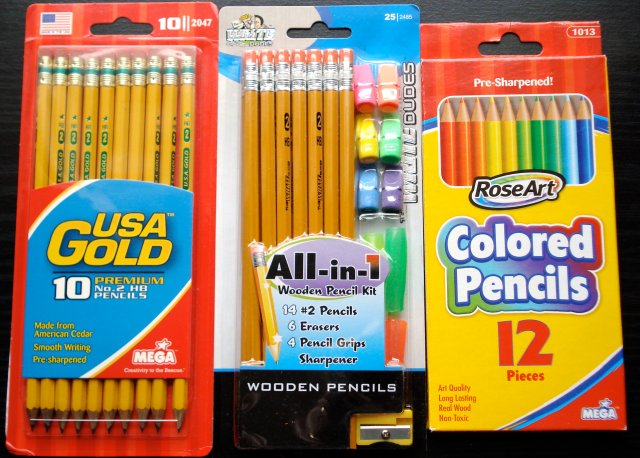
RoseArt Colored Pencils
Made in Indonesia, these represent the RoseArt name, though Mega Brands is mentioned on the packaging.
The Write Dudes #2
Made in Vietnam, this appears to be a “deep discount” pencil.
The colour pencils won’t be evaluated today, but the breadth of the graphite pencil offerings from this little known company is compelling. I can say that there were some distinctive differences between the products in terms of performance.
Sharpening
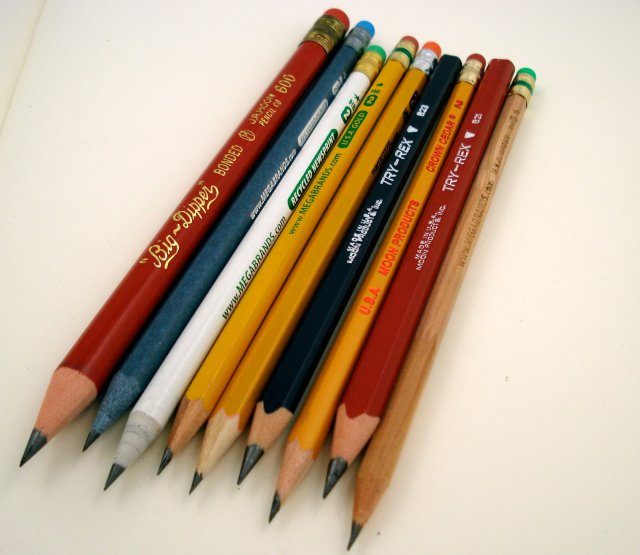
I used a new Faber-Castell Contour sharpener for the test. There was no trouble distinguishing that the three pencils with the old imprints, the Try-Rex B23 and B21, and the “Big-Dipper”, use a different and superior type of cedar. They all sharpened exceptionally well. The Crown Cedar, USA Green and USA Gold, were in a second tier, and noticeably less pleasant to sharpen. The Write Dudes (presumably basswood) pencils were distinctly rough.
Writing
The two Try-Rexes are both nice writers. Very smooth with moderately dark, rich cores. I couldn’t decide if the two ungraded pencils were the same or not. Perhaps as a side effect of the greater weight, the larger seemed to leave a darker mark.
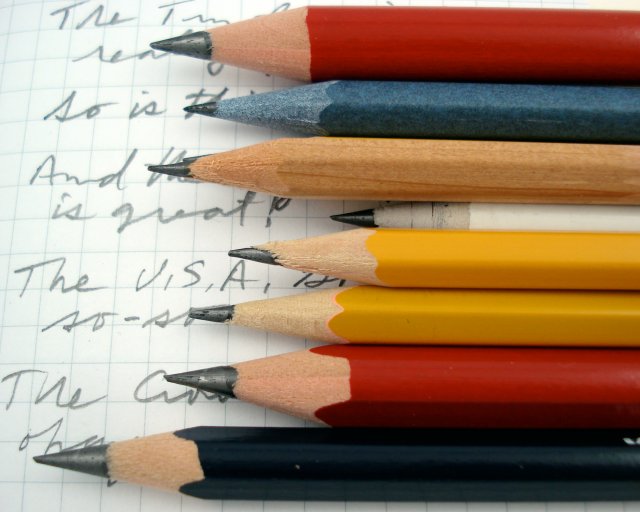
The “Big-Dipper” was a welcome surprise. Musgrave’s Choo-Choo, as an example, does not use the same quality lead as that company’s standard sized pencils. Fortunately, Moon Products didn’t skimp, and the “Big-Dipper” is a great writer.
The USA Gold and Crown Cedar seemed so-so – I doubt they would be anyone’s first choice. I have to note that samples of both were slightly warped, perhaps (sadly) par for the course from today’s office pencil. The Write Dudes pencil is a disaster – gritty, scratchy, almost not writing.
Overall

The Try-Rex and “Big-Dipper” are almost worth buying just for the style of their imprints. But the quality of the wood and graphite is superior, and makes them recommended items.
The USA Gold and Crown Cedar, which probably deserve some regard for their last ditch stand against cheap imported competitors, are rather disappointing.
My thanks to Pencil Me In for her kind support of pencil talk, and considerable work in assembling this amazing collection from a little known manufacturer.