Caution. Avert your eyes! This is a joint post, and you should first head on over to Dave’s Mechanical Pencils to learn about Ancient Kauri wood. Then head back here.
It isn’t too often that a letter carrier arrives at my door bearing a package with the markings of the New Zealand postal authority.
I’ll admit that I knew in advance about this parcel, and was eagerly looking forward to receiving it.
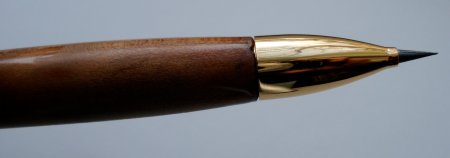
There was said to be some magic inside – ancient Kauri wood. And not in the form of a swamp log – but transformed into a mechanical pencil.
The pencil is indeed quite something – made from an ancient and historic wood that is important in traditional Maori culture.
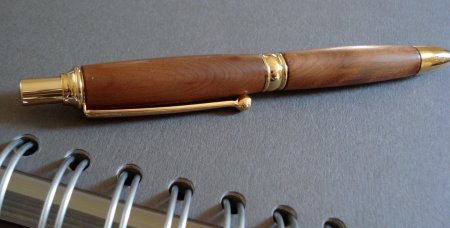
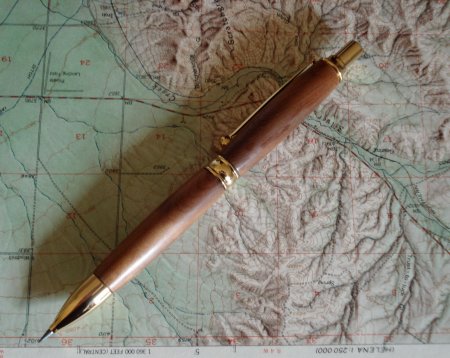
It is now winter in Canada, and sunlight can be scarce. On a bright day, the wood just gleams and shines. Some surfaces have three dimensional aspects, and the entire surface is engaging. Bits of sap are translucent and shiny. The patterns call for twirling the pencil and careful examination. Different aspects of the wood are revealed in different light conditions.
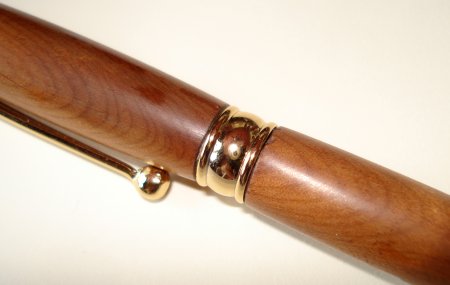
The pencil itself is 137mm long, with Kauri body and gold plated metal accents. It weighs a modest 24.4g with the included lead. It takes a 2mm diameter lead – and is in the format of a mechanical pencil, with the cap acting as a lead advance button.
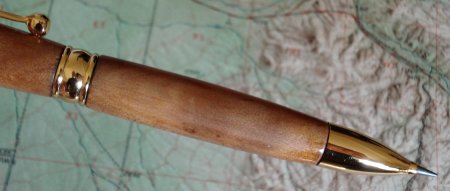
The clutch leadholder format is more common for 2mm leads. Yet recent years have also brought wide lead (defined as 2.0mm and greater) mechanical pencils such as this to the market.
This particular pencil has a nice advantage – some mechanical pencil style wide lead pencils don’t have sufficient rotational grip to support the use of sharpeners – but this pencil easily meets that goal. A minor disadvantage is that this pencil cannot accommodate a standard 130mm refill from manufacturers such as Mitsubishi or Staedtler, and about one third of a refill lead will have to snapped away to be made usable.
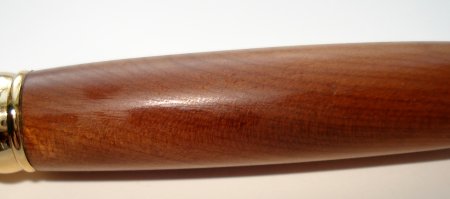
The advance mechanism requires a forceful click, but functions in a reliable manner.
The cap contains a basic lead pointer, functional in an emergency.
The grip and shape seemed visually “not quite right” to me, but have been completely fine in practice.
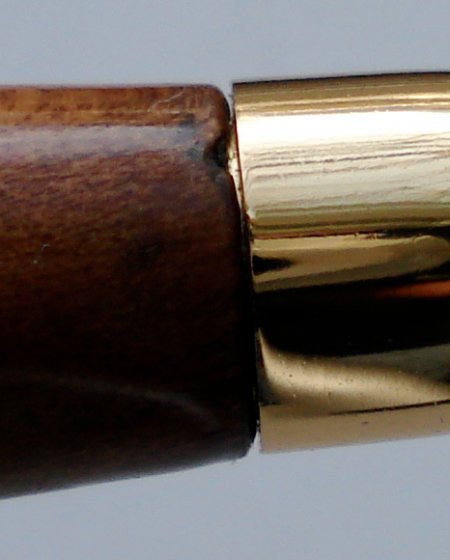
I’ll try to quickly mention the one flaw in my view – the appointments. The cap, clip, mid-section, and tip, though plated in gold, are generic and of inferior design. The Kauri seems to have no relationship with the trim. The appointments detract from the history and majesty of the pencil. No serious manufacturer could actually offer this level of quality at retail. Unfortunately, pen turners seem to have access only to extremely generic kits such as this.
The pencil writes nicely, and even if it isn’t one’s standard grip, holding the pencil on the Kauri area is irresistible!
The unique origins are another intriguing aspect – for me, contemplating the history in this pencil is very engaging.
Overall, this pencil has a fascinating history, and I am thankful for Dave’s generosity in commissioning it and sending a specimen to me.