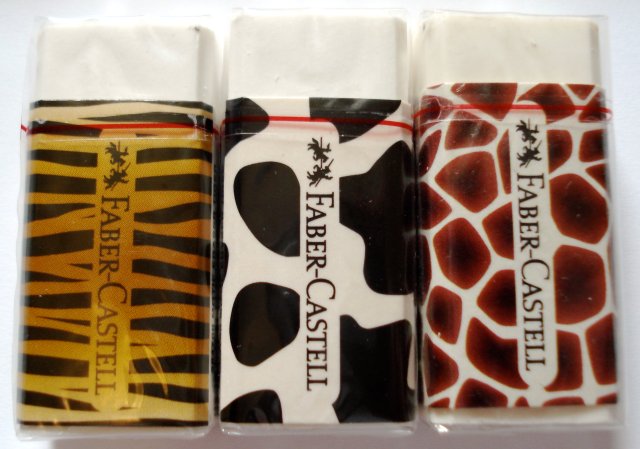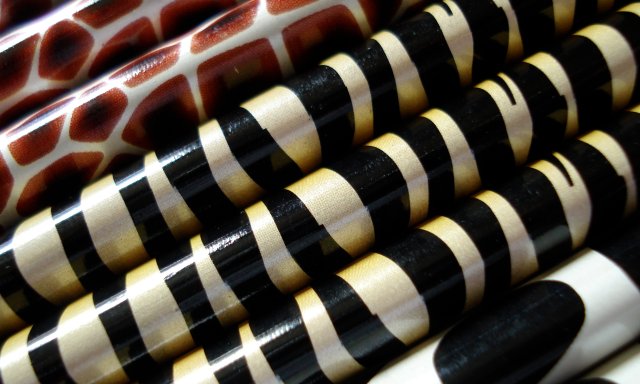
Pencil manufacturers in the news

Pencil manufacturers have been receiving some major media attention recently.

Behind the scenes, I would guess that Faber-Castell’s capable public relations staff have been very active. Faber-Castell’s 250th anniversary is next year, and the celebrations are starting. See this YouTube video for a behind the scenes view of how the “250” human logo was formed and photographed.

An article in the Wall Street Journal suggests some local tensions in Nürnberg, with a friendly rivalry between Faber-Castell and Staedtler. The article mentions a 1995 lawsuit against Staedtler regarding Staedtler’s previous claim to have originated with their namesake Friedrich Staedtler in 1662, rather than J. S. Staedtler’s company founding in 1835.

Speaking of Friedrich Staedtler, a Nürnberg school was recently renamed in his honour.

There was also an article on Faber-Castell in the Economist, a periodical we’ve previously mentioned for their coverage of the pencil industry.

The Economist mentions a different lawsuit, a century earlier. There seems to be a thread between the past and present – the Faber company has long appreciated a good court battle. This case is the overturning of the Hyman erser patent in the US Supreme Court in 1875. I learned about this at The IPKat blog.

The ruling by Mr. Justice Hunt can be found here. I love the careful language, and daresay it is one of the finest contemplations of a pencil’s function that will be found. The ruling’s conclusion:

In the case we are considering, the parts claimed to make a combination are distinct and disconnected. Not only is there no new result, but no joint operation. When the lead is used, it performs the same operation and in the same manner as it would do if there were no rubber at the other end of the pencil; when the rubber is used, it is in the same manner and performs the same duty as if the lead were not in the same pencil. A pencil is laid down and a rubber is taken up, the one to write, the other to erase; a pencil is turned over to erase with, or an eraser is turned over to write with. The principle is the same in both instances. It may be more convenient to have the two instruments on one rod than on two. There may be a security against the absence of the tools of an artist or mechanic from the fact that the greater the number, the greater the danger of loss. It may be more convenient to turn over the different ends of the same stick than to lay down one stick and take up another. This, however, is not invention within the patent law, as the authorities cited fully show. There is no relation between the instruments in the performance of their several functions, and no reciprocal action, no parts used in common.

We are of the opinion that for the reasons given, neither the patent of Lipman nor the improvement of Reckendorfer can be sustained, and that the judgment of the circuit court dismissing the bill must be affirmed.

From the product side, we are still waiting to see what Faber-Castell’s 250th anniversary may bring. There does appear to be a limited edition case of art supplies in the market. (Search for “Alexander Vethers” to see a similar limited edition.)

This eBay seller is kind enough to enumerate the contents: hundreds of pencils, pastels, and other supplies – a complete set of Faber-Castell’s top tier of art supplies. The price (€1250 – about $US1725) is actually in line with what one might pay for these items individually.

There is no doubt more to come in 2011, and I’ll admit that I am hoping for something special in the lead pencil category. I also notice no official press release for this first anniversary offering – Faber-Castell is letting their vendors get the buzz, which sounds like a smart strategy to me.

~~~~~~~~~~
My thanks to David O., via a blog comment, and John, via an email, for mentioning one or more of these news stories.
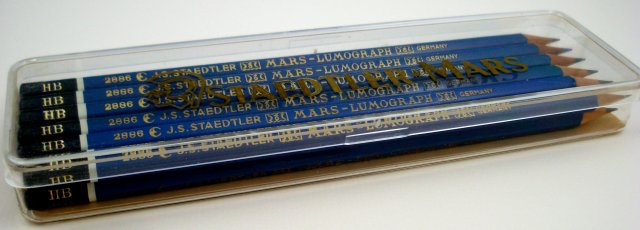
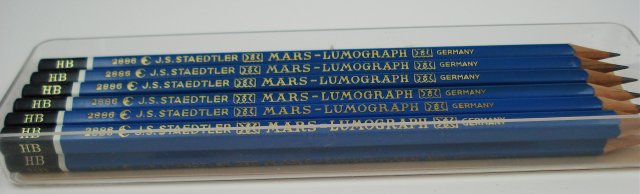
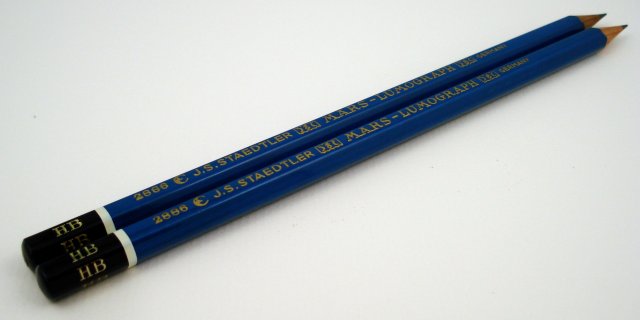
Staedtler Mars Lumograph 2886 pencil

The predecessor of Staedtler’s iconic Mars Lumograph 100 is the Mars Lumograph 2886. According to leadholder.com, this particular box may date from the late 1950s.

Staedtler Mars Lumograph 2886 pencil

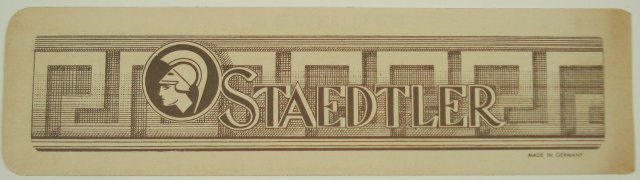
The lid has some compelling graphics:

Staedtler Mars Lumograph 2886 pencil

Half a century old, only the design indicates the age of these pencils:

Staedtler Mars Lumograph 2886 pencil

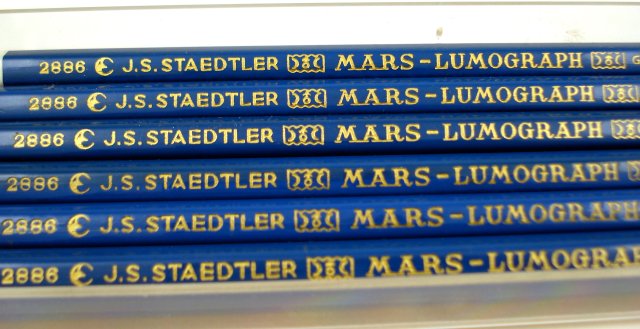
The “A” in “STAEDTLER” appears to be formed like a compass. As well, reflecting the manufacturing processes of the era, there are slight surface differences between specimens.

Staedtler Mars Lumograph 2886 pencil

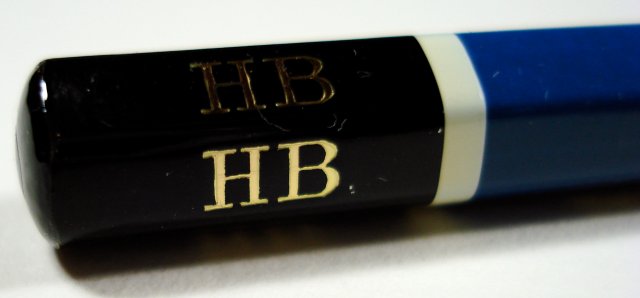
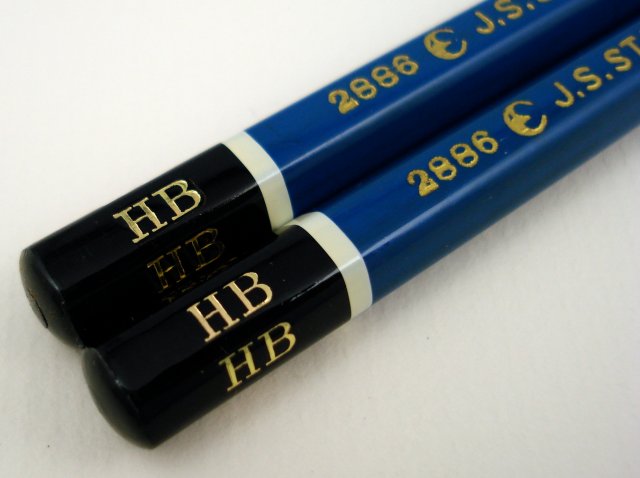
An element I love is the HB grade mark in vibrant gold colour. It is serious but not fanciful, like the painted gold markings that were once typically applied to wood surfaces such as office doors and library card catalogues.

Staedtler Mars Lumograph 2886 pencil

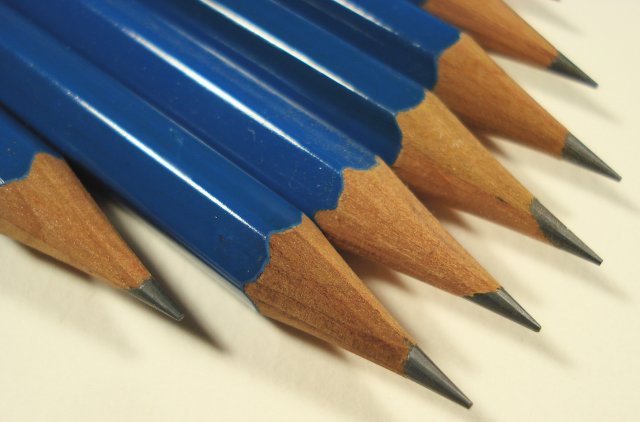
The factory sharpening, just like the modern version, is the best in the industry, with no “scrape marks” along the wood.

Staedtler Mars Lumograph 2886 pencil

Take a close look. Even the smallest graphical details are impressive.

Staedtler Mars Lumograph 2886 pencil

Overall, a classic pencil.

Staedtler Mars Lumograph 2886 pencil

Staedtler Mars Lumograph 2886 pencil

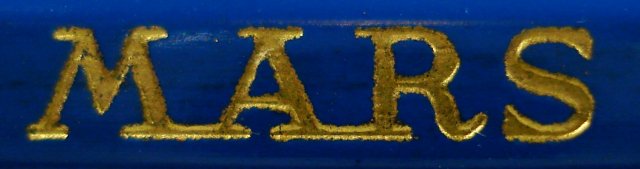
Are “MARS” and “LUMOGRAPH” rendered the same way?

Staedtler Mars Lumograph 2886 pencil

For me, the caps are a continuing delight:

Staedtler Mars Lumograph 2886 pencil

A comparison with the modern version. In case you didn’t notice, this photo should make clear that the 2886 is a “left-handed” imprint, in contrast with the standard “right-handed” 100.

Staedtler Mars Lumograph 2886 pencil

Does anyone prefer the modern look?

Staedtler Mars Lumograph 2886 pencil

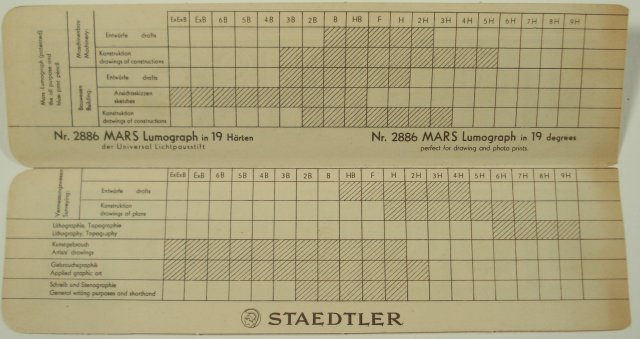
A small delight after all these years is to find a paper insert.

Staedtler Mars Lumograph 2886 pencil

Slightly withered, it presents pencil grade recommendations for eleven different professions.

Staedtler Mars Lumograph 2886 pencil

I have tried and tested the 2886, and find it to be extremely similar to the modern 100 in graphite function and erasure. Given the half century between the manufacture of the two pencils, this demonstration of Staedtler’s ongoing commitment to their product excellence is remarkable.

Berol Handwriting pencil

Berol Handwriting pencil

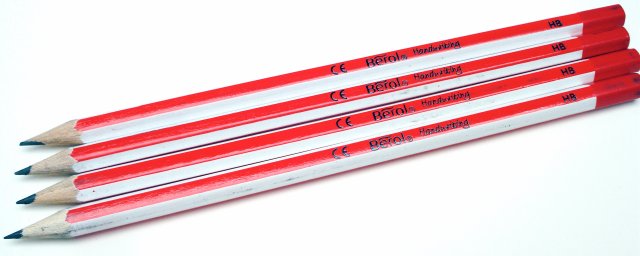
The Berol Handwriting pencil come to us from Sanford UK, a division of Newell Rubbermaid. The Berol name remains active in the UK and other countries. The Berol history at that link is a worthwhile read for anyone interested in pencil and fountain pen corporate history.

Please see Handschriftbleistift (a great name) at Lexikaliker to see another UK “Handwriting pencil”.

The name is intriguing – why so specific? Differentiation from drawing pencils is all I can guess.

Berol Handwriting pencil

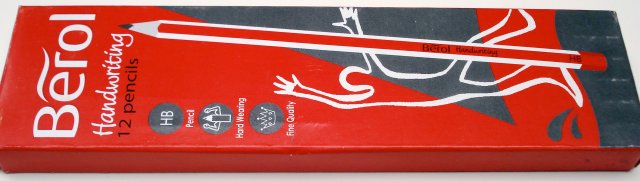
The official product page indicates an official price of £0.80 for 12 pencils – well into discount territory.

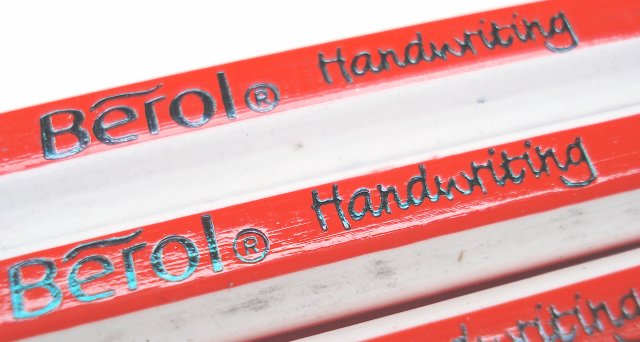
The choice of pencil finish is very interesting – alternating red and white sides, with a red cap. The white sides in particular seem thinly painted, and rather prone to revealing flaws or any stray graphite dust.

No place of manufacture is mentioned.

Alas, the pencil has a very hard and scratchy lead. While the statement made on the box, “Hard Wearing,” is no doubt true, the Handwriting pencil seems a poor choice for handwriting. Whether child or adult, I can’t really see any extended use of this pencil being very pleasant.

Berol Handwriting pencil

Tombow 8900 pencil and Victorinox pen knife

Tombow 8900 pencil and Victorinox pen knife

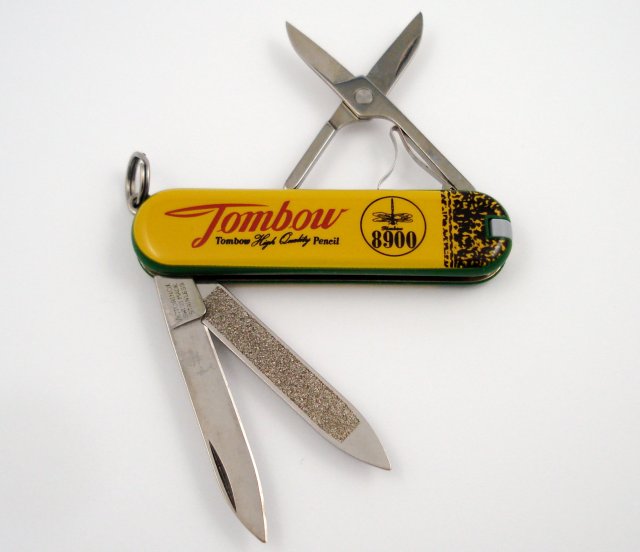
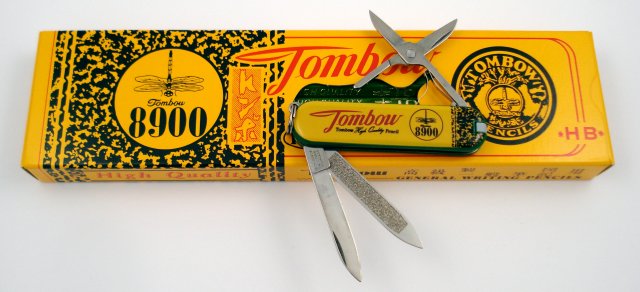
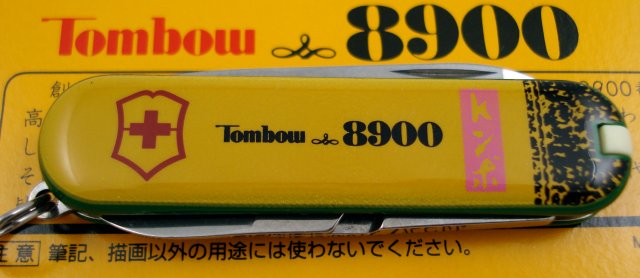
A delightful accessory, this pen knife by Victorinox sports the colours of the Tombow 8900 pencil.

Tombow 8900 pencil and Victorinox pen knife

The 8900 is a general purpose pencil whose packaging continues to use traditional graphics.

Tombow 8900 pencil and Victorinox pen knife

What a great idea! Tombow was founded in 1913, so they have a big anniversary approaching – I’m sure we’ll see more special products from them.

Mitsubishi Natural pencils

Mitsubishi Natural pencils

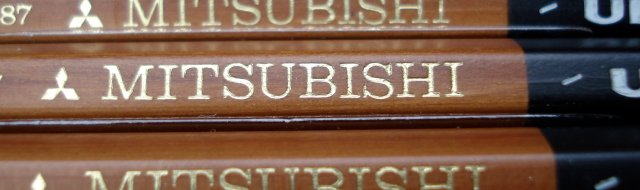
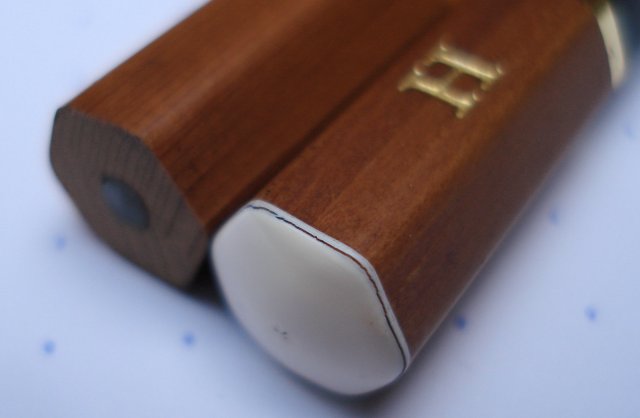
Some beautifully finished Mitsubishu Uni pencils. Called “Natural”, they have a rich and appealing woodgrain.

My eye can’t discern this, but over time, at least one pencil’s cap has begun to show a hairline crack in the paint:

Mitsubishi Natural pencils

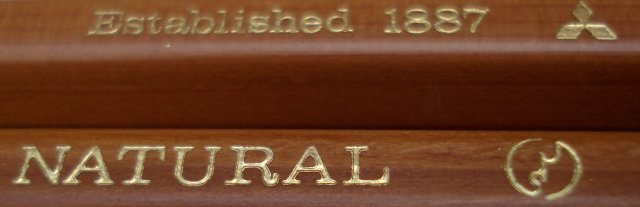
The circled JIS mark attests to these being older pencils.

Mitsubishi Natural pencils

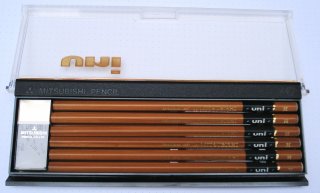
The box of twelve came with an eraser, and looks great wherever it finds itself, but especially on a wood desk.

Mitsubishi Natural pencils

Faber-Castell animal print pencils

Faber-Castell animal print pencils

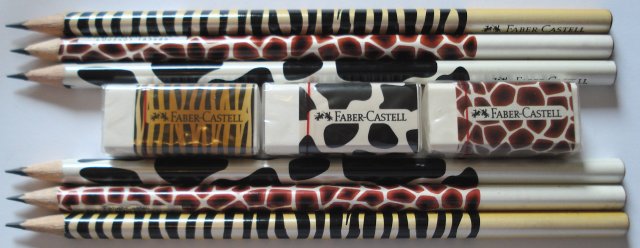
From Faber-Castell, we have some interesting novelty pencils in animal prints.

Faber-Castell animal print pencils

The packaging indicates the pencils are FSC certified and made in Indonesia, while the erasers hail from Malaysia.

The triangular shaped pencils write reasonably well, and the matching eraser is a nice bonus. They could be a nice gift for a child.

Faber-Castell animal print pencils