We have Stationery Fever

Stationery Fever is a recently published hardcover book that explores the modern stationery scene. The book is lavishly illustrated, and unique in featuring dozens of contributed essays and photos.
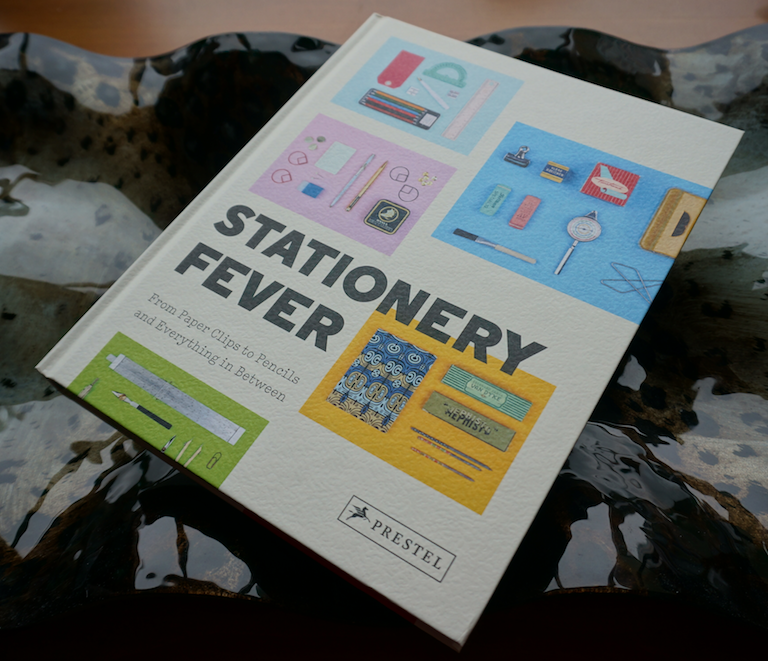
Stationery Fever

Title: Stationery Fever
Author: John Z. Komurki
Publisher: Prestel Verlag, Munich
Format: Hardcover, 208pp
ISBN: 978-3-7913-8272-2

The book has nine chapters on stationery subjects (pencils, pens, etc.) and thirty-one separate brief essays, mainly on brick and mortar stores and products.

The author’s name is not on the book’s cover (though is inside) and the multiple supplemental essays are largely written in the first person without attribution. Given the collaboration, it is little surprise that three full pages are required for just the copyright, credit, and acknowledgement pages. And even then, we don’t know the names of many of the essay authors. It also isn’t clear to me what parts of the content may have been published in translation.

The book is a delight, and nicely covers a lot of themes that I sympathize with. It correctly recognizes the pencil as worthy of contemplation. The multiple points of view are also a breath of fresh air.

There is an amazing unity in the viewpoints of stationers – whether in Asia, North America, or Europe, natural lighting (if possible) highlights white tables that display high quality artfully arranged stationery items. The preference is for goods made by hand, and locally if possible. The tactile is emphasized.

Product essays are devoted to the familiar – the Parker 51 (in 2005, when pencil talk started, the ’51’ was pretty much the online favorite writing implement), the Eberhard Faber Blackwing, and to the new – the Neri leadholder and the Faber notebook.

There is an essay by Gunther from Lexikaliker on the Grenade sharpener, and the Blackwing article appropriately interviews the Blackwing’s leading chronicler, Sean of the Blackwing Pages. I expect 2017/18 to offer more new published writing on pencils than we’ve seen in decades, and this book is a harbinger.

The book will appeal to anyone interested in the constituent subjects. I read it cover to cover on two weekend afternoons. Even subjects that weren’t particularly high on my radar, such as “Glue”, were really interesting. A comparison of the Pritt stick vs. the UHU stick, as an example. The intriguing story of the first adhesive tape (Dr. Horace Day, Surgeon, 1845) through to the Post-It Note (Dr. Spencer Silver, 3M Scientist, 1968). The only issue is the lack of citations, for those of us who would like to read further.

The book is a two-in-one – a nice review of many stationery topics/histories, plus an anthology of contributed essays and photos. It is a delight.
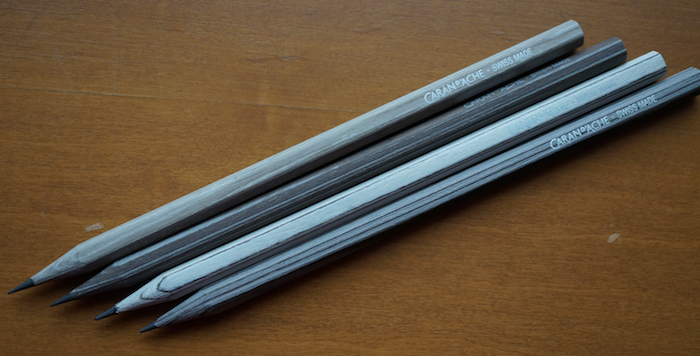
Les Crayons de la maison Caran d’Ache, Edition No. 6

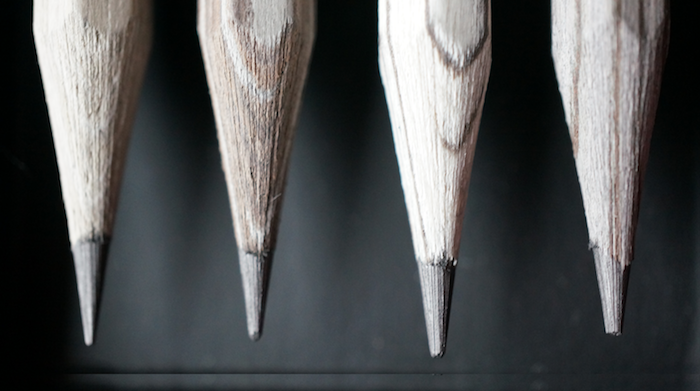
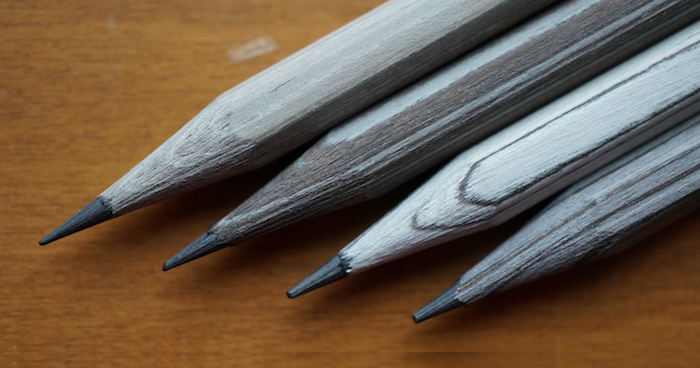
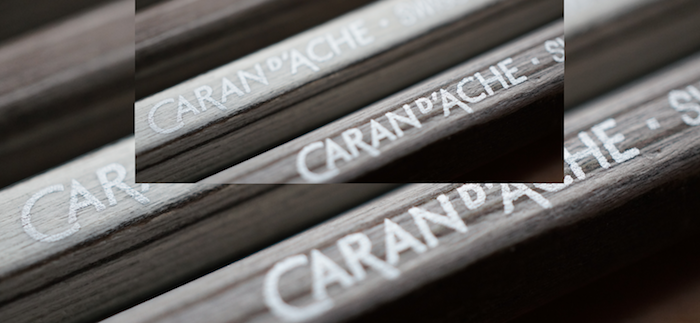
Caran d’Ache has continued their “crayons de la maison” series with a sixth edition. The pencils are a visual delight, and a bit of a construction mystery.

Les Crayons de la maison Caran d’Ache, Edition No. 6

The appeal is obvious – rich, amazing wood patterns from exotic species. They echo the 1990s Colleen Woods Pencils that are quite admired.

This set is somewhat monotone and features:

Western Hemlock
White Oak
Silver Teak
White Ash

Les Crayons de la maison Caran d’Ache, Edition No. 6

I wish the individual pencils had a small numeral or marking to note which pencil is which.

The pencils come in a sliding cardboard box, and an external sticker indicates:

Caran d’Ache 0361 414
Bar Code: 7 630002 334990
Made in Switzerland
FSC Mix wood from responsible sources FSC C005365

We can look up the FSC number. Nothing too interesting here. Sometimes we can discover a manufacturer or subcontractor’s name by looking up this code.

Les Crayons de la maison Caran d’Ache, Edition No. 6

A second sticker says, “Crayons Parfumés Par Mizensir”. In other words, these are scented pencils.

The scent is strong! In contrast with Viarco’s scented pencils, which require me to approach them closely before any olfactory warnings start signalling, I can detect the Mizensir scent from several feet away. Fortunately, it does seem to dissipate with time. (Mizensir is a Geneva perfumer.)

Since last featured, we know much more about this pencil series, and the vendor’s own description has been updated. Particularly informative are the comments at a 2014 post at Lexikaliker.

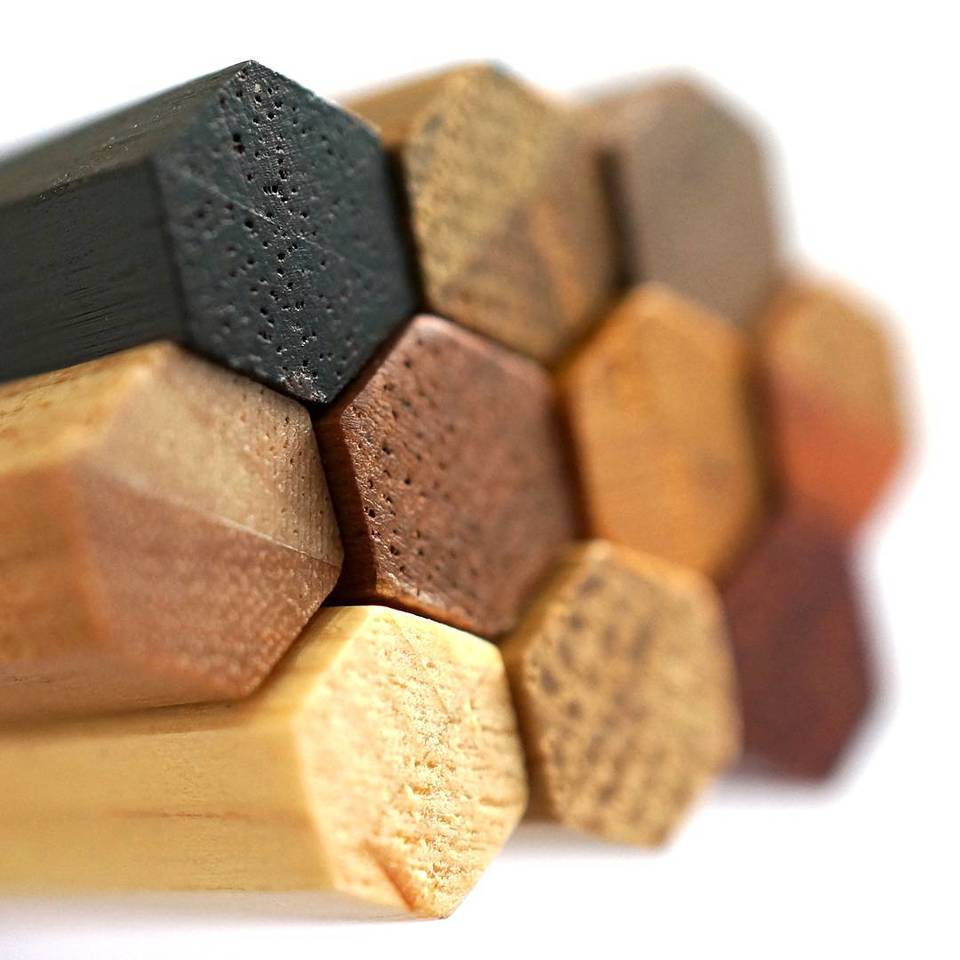
The pencil box notes that these pencils are made from “reconstituted wood” which they also call “essences”. ALPI is the manufacturer, and are a specialty firm in wood tasks such as creating an oak look from the woodchips of another species.

Les Crayons de la maison Caran d’Ache, Edition No. 6

The pencils are not made from the represented exotic woods. I think even using the word “essence” is going too far – ALPI is clear that they use Poplar, Limewood, or Ayous. There is no Hemlock, Oak, Teak, or Ash in these pencils. And they weren’t made from glued together pencil slats. It is some other process, perhaps extrusion, that constructed the pencils.

Yet, they’re nice, they are innovative, and they distinguish themselves quite well from ordinary pencils. It is also quite amazing that Caran d’Ache has continued the series over three years – there is obviously a market for innovation in pencils.

See also:

Les crayons de la maison Caran d’Ache

Les crayons de la maison Caran d’Ache, Edition No. 2

pencil talk 2.0

Hello all,

It has been three years since the ‘Final Post’ at pencil talk.

After announcing the end, I took the blog offline for several reasons. I don’t really like seeing blogs floating around that don’t function as blogs, with no new posts, no commenting, no interaction. The hosting costs seemed to only be going up. And, it just seemed appropriate to turn off the lights after leaving.

I’ve continued to keep in touch with many people interested in pencils, and appreciate the queries from readers. These interactions have been persistent enough that I feel the impact of the blog was quite significant. From the other side, going offline didn’t cause costs to decrease by much. Using a prominent hosting company, everything is metered, and maintaining virtual servers, storage, etc. seemed to cost more than the bandwidth – i.e. there were few savings found by turning the blog off.

The last three years have been an adventure. I’m from Toronto and started the blog there, but lived in nearby Kitchener many of pencil talk’s nine active years. In 2013, I accepted a job offer in the US, and lived in the San Francisco Bay Area until two months ago. I’ve just returned to Canada.

I brought the blog back online for a couple of reasons – I didn’t really want the content to be lost – it lived inside the WordPress database on an operating system too old to get updates – and, at some point, a revival would become unfeasible. But more importantly, the blog isn’t solely mine – discussion with and between readers was one of the things the blog did well, and the many thousands of comments deserved to live on. The blog never reached first place in search engines, but it always seemed the be the place for people to talk about pencils.

This post is about a revival – I want to bring the blog back. I’m still thinking carefully about this. The online landscape has changed. There are a lot more stationery blogs and websites now. Many are decidedly commercial. The three blogs I mentioned in ‘Final Post’ have all continued to thrive, and I’ll note in particular that Contrapuntalism has risen to unprecedented heights – featuring interviews with both the late Count A.W. von Faber-Castell and Eberhard Faber IV that have delighted and amazed me.

I want to carry on the exploration of the art and science of pencils, and hope you’ll join along!

Stephen

Final Post

November 1st will mark this blog’s ninth anniversary. It will also be the blog’s final day.

Nine years is a long time. Over this span, the blog has been a hobby, sometimes a burden, often a consuming passion, occasionally a second job, and always a great forum for those interested in exploring the art and science of pencils.

There have been wonderful discussions that I’ve truly enjoyed. I’ve met people who I’ll be keeping in touch with, and learned quite a bit about both blogging and pencils. There have been some fine fellow travelers in this journey, and I will mention Lexikaliker and Blackwing Pages as blogs whose passion and original research into pencils has regularly exceeded my own efforts.

The circumstances and costs of running an independent website have changed since 2005, and these are real factors, but in the end, the timing is right for this decision.

Thank you to the many readers, commenters, and correspondents who made this a special place.

Stephen

The Tombow Pencil Company’s 100th Anniversary (and Pencil)

Tombow Pencil Company's 100th Anniversary Pencil - Mono 100 Limited Edition

Congratulations to Tombow, who are celebrating their 100th anniversary in 2013. The company has a special site with many photos to commemorate the anniversary.

As part of the celebration, Tombow has issued a recreation of a vintage pencil, complete with packaging. The pencil is internally a Mono 100, possibly the world’s finest pencil, so there was no skimping on quality. In Japan, the product sells for about $15. Alas, the price in other countries reflects several additional costs. (As an aside – the top Japanese pencils are reasonably priced inside Japan. If only they had better global distribution channels!)

I initially balked at the price I first saw for this anniversary pencil, but read that only 100 boxes were made, so it really is a limited edition. Fueled by a love for Tombow’s pencils, I decided to indulge. (I’ve since seen that Tombow USA sells the set for $15 – I wish I had known.)

There is an outer sleeve with a graphite rendering (in progress) of the pencil box’s design. I think this is one of the best parts of the recreation:

Tombow Pencil Company's 100th Anniversary Pencil - Mono 100 Limited Edition

The metal box:

Tombow Pencil Company's 100th Anniversary Pencil - Mono 100 Limited Edition

Inserts, etc. all reproduced:

Tombow Pencil Company's 100th Anniversary Pencil - Mono 100 Limited Edition

The product is great – a tribute to the past while using modern production techniques. I am grateful that Tombow took the effort to create something for themselves and us – the citizens of pencil nation. (I cannot imagine that there is any financial return for such a small run of a specialty product like this.)

I am also pondering the number – 100 sets for 100 years? Or is 100 the realistic number of people who will purchase something like this? Or is a distributor who acquired 100 sets making an exaggerated claim? This blog has advocated for historical pencil recreations for years, and it was a disappointment that a major pencil company anniversary a couple of years ago didn’t give a nod to the past. But maybe they knew something?

And a note – despite what I’ve read from Tombow, this thing called the web informs me that a set in grade 4B has been issued in some Asian countries.