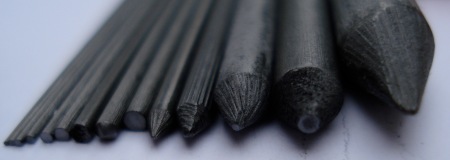
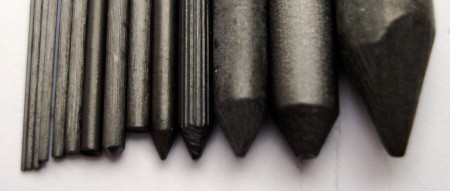
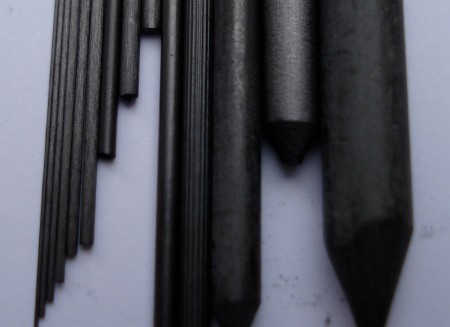
Photo (L-R): Leads in 0.2mm, 0.3mm, 0.4mm, 0.5mm, 0.7mm, 0.9mm, 1.18mm, 1.3mm, 1.4mm, 1.5mm, 2.0mm, 3.15mm, 3.8mm, and 5.6mm diameters
Mechanical pencil users have a lot of choice in lead diameters. Between thin leads used for drafting and wide leads used for sketching, most of us should be able to find something suitable.
0.2mm
That’s not a typo! Introduced by Pentel in 1973, the 0.2mm lead is used by the PG2 (or PG2-AD) Pentel pencil. It is extremely thin. Refilling a pencil with this lead is not unlike threading a needle. While I expected this diameter to be essentially unusable, I didn’t find any problems in practice. I’ll give some credit to Pentel here – it seems almost impossible to me that this lead wouldn’t continually break, but it didn’t.
0.3mm
For drafting, this is the thinnest lead made by a variety of manufacturers.
0.4mm
Also for drafting, this diameter is a Japanese specialty. Some ranges of drafting pencils are sold with this width in Japan, and without elsewhere.
0.5mm
The thinnest writing and general use diameter, it is also used for drafting.
0.7mm
A larger diameter also for writing and general use, as well as drafting.
0.9mm
Introduced in 1960, this was once the “standard” thin lead pencil diameter.
Today, it is used for drafting and a few general use pencils.
1.18mm
Prior to the 1960s, the standard lead diameter. Still used by Yard-O-Led, and a few others, including some companies that didn’t exist when this diameter was the norm!
1.3mm
Pentel and some other Japanese manufacturers have made light use of the 1.3mm diameter, and Staedtler recently introduced a pencil in the category.
1.4mm
The Faber-Castell Emotion was the only pencil using 1.4mm lead until Lamy changed their ABC from 3.15mm to 1.4mm. Still, an unusual lead.
1.5mm
The lead shown is a historical variant. (This example from Faber-Castell.) Fedra and others once made 1.5mm leadholders, but I’ve not been able to find one.
1.6mm
(Not Shown.) One of two in production diameters that I’m aware of that aren’t shown here. Faber-Castell Brazil makes 1.6mm pencils. (Brazil is also where the 1.4mm leads are made.)
2.0mm
The diameter of the lead in a standard woodcase pencil, 2.0mm is the beginning of ‘wide’ rather than ‘thin’ lead in many definitions. The standard for many drafting clutch leadholders made around the world, and carried in ‘big box’ stores, it is possibly the most available lead width apart from 0.5mm and 0.7mm.
2.5mm
(Not Shown.) Koh-I-Noor is the only modern manufacturer of this lead that I am aware of.
3.15mm
The outer realm of drafting lead diameters, this lead is today mainly used for sketching, though some drafting-syle clutch leadholders are still sold. The quite amazing Lamy Scribble introduced many of us to this format.
3.8mm
Used by Pilot, Caran d’Ache, and Koh-I-Noor, this diameter is also inside many art pencils (graphite, colour, and other). Strictly for drawing.
5.6mm
The largest standard lead that will be found in an art supply store, there are 5.45mm and 5.5mm subvariants. Very useful for sketching, pencils in this diameter continue to have a market.
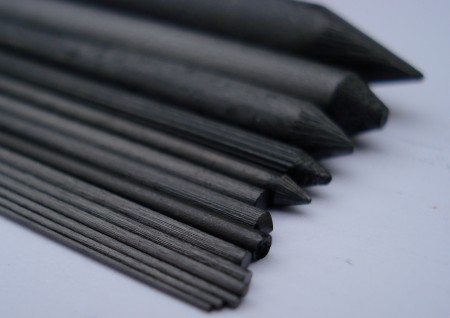
There are a number of historic diameters not mentioned, but I think this list is correct at present. Let me know if I’ve missed something!
So, which lead diameter do you use?
3 lead diameters are not mentioned, .05, 0.1, and 1.0. If you want to find out about these go on Wikipedia and search “Mechanical Pencils.”
Does anyone know where 2.5mm leads can be found? Czech Art Supplies has 3B, Artway in the UK has 2B. I’d be interested get hold of other degrees of lead hardness.
This company looks to make them, but you’d need to buy a huge quantity:
http://tidbit.en.alibaba.com/search/product?IndexArea=product_en&SearchText=2.5mm
You could contact them to see if they can share retailer information.
I checked good old Autopoint Inc., but they just supply up to 1.1mm.
Thanks for your trouble, David. Those folks in China came up on a search I did. Their minimum order of 110 lbs of 2.5mm graphite is a bit of a drawback – would probably last me a few lifetimes. I’d have to do a lot of drawing to pay off the shipping charges. Maybe I’ll ask them about retailers – I mean, they can’t extradite me for being a time-waster, can they?
reqiure 1.18 leads. can you supply or assist
Try: http://www.autopointinc.com/
(no affiliation)
Hello, great blog… I recently acquired a victorian mechanical pencil that my gf fell in love with. Alas, it did not have any leads in it. It is stamped “V. S.” On the barrel, which i am assuming corrsponds to a lead size of 1.5 mm.
Considering how popular this size seems to have once been, I can’t seem to locate any keads to fit this holder. I would so appreciate it if anyone out here can point me in the right direction….. Thank you in advance…
Hi, this is my first comment in your blog. Great job!
Most of these diameters are practically impossible to find here in Chile. The usual 0.5mm is the most prevalent, but I prefer 0.7mm as a standard for everyday writing with my F-C Grip pencil. I also use a 2mm TK4600 I bought from the UK. Luckily I bought several boxes of leads in different grades, since they are becoming increasingly hard to find around these parts. When I feel like drawing, my preferred leads are the 3.8mm and the 5.6mm.
Cheers.
I have a few mechanical pencils by Autopoint. These are from the late 1960’s. The lead is thicker than the .9 that Office Depot had on the shelf. I have an old package from Autopoint marked “No. 43-N HB Medium.” The lead that I have is very old and very hard. Any ideas on correct diameter and where I can purchase refills? The pencils themselves are made like tanks and will be here for years. All I need is the lead to fit them.
For those looking for Victorian lead sizes — 1.0mm, 1.5mm (VS), and 2.5mm — I recently managed to buy a good supply, and they are listed here: http://www.vintagepens.com/catill_nibs_parts.shtml#lead
Also got creative with my lathe and made a little device to turn down 2.0mm leads to other nonstandard sizes, such as 1.6mm
I have purchased Paper Mates’ 1.3mm mechanical pencils for my students(2nd graders). I have used mechanical pencils for years with a .9mm lead, but the 1.3mm is a lot more effective for my young writers. Now I find that the 1.3mm lead is nearly impossible to find. When I have found it the price is so high. I use my own money to purchase these supplies and cannot afford to pay 41¢ or more per piece of lead for 24 students. The reason I have gone to mechanical pencils is two-fold…first, pencils do not sharpen easily anymore and usually they are such poor quality that the lead breaks right away…second, all a student needs to do is click one or two times and they have a fresh pencil tip. A time saver to be sure. Paper Mate has not been very helpful when I have contacted them. Even they do not know where to purchase lead refills for their own product. If anyone can tell me why this size lead is so difficult to find, I’d appreciate it.
Hello Sheri, I was not previously aware that PaperMate made 1.3mm pencils. Here is one possible source. 12 leads for $1.51 is 13¢ per lead.
I recently bought a mechanical pencil from Staples that took 1.3mm size – can’t recall whether they sold the lead separately.
i use o.5 and 0.7 mm lead pencils
Good info, I am searching for 1 3/8 long, thick (.16mm) yellow lead for an Autopoint Twinpoint, Red/Yellow in thick lead. Or even a Scripto(?) and snap it to size. Thanks, Jerry
I have an old Mont Blanc mechanical pencil which uses round 1.18mm lead.
Do you know where I can buy these refills?
Here, for example
https://www.jetpens.com/1.18-mm-Leads/ct/1612
Hi just been given some faber castell 1.8mm leds in 2b hb and f but can’t find a pencil they will fit in. Any help would be appreciated
P. S no not a typo 1.8mm
I have about 200 OFREX 1.18mm leads 4″ long and need to find a clutch pencil to suit. Anyone know of a 2mm pencil that may accommodate this size? In the UK preferably.
I need to find a 1/4 inch diameter, number 2 lead pencil. Can anyone help with this?
Dear people,
My name is Amin and I am looking for the best Korean, Brazilian and Chinese color lead producers as I am running my pencil production factory in Germany. Could you please help me?
Amin, I’m from Germany. May I ask curiously where your production is located?
I like writing with an old Keen Point DUR O LITE pencil. I would like to purchase lead refills but I don’t know the size. It’s a simple lead pencil, yellow in color.
Thank you for your assistance.
Robert, I recommend checking with the Legendary Lead Company.