The J. R. Moon Try-Rex pencil


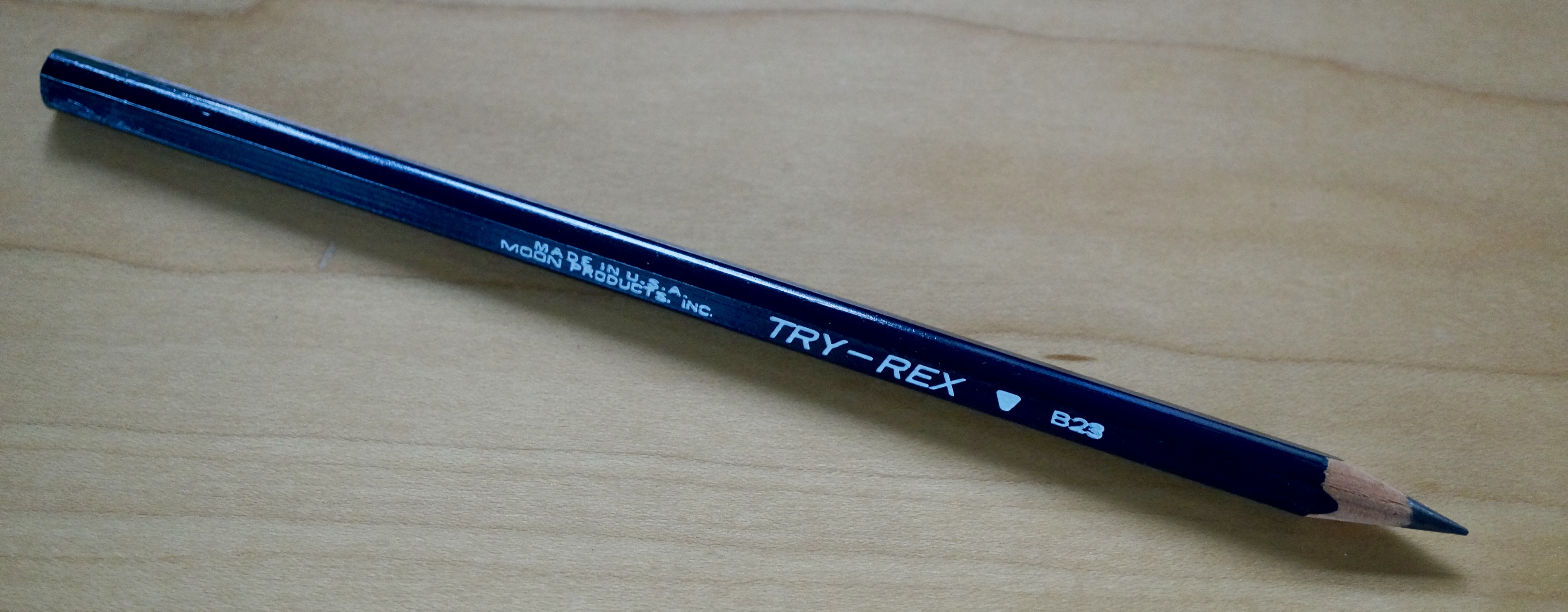
The J. R. Moon Try-Rex B23 pencil made an appearance at this website in 2011 as part of a larger look at J. R. Moon. Let’s take a look at this unusual pencil, and update the 2011 article!

The pencil

There are three things that immediately set this pencil apart: the typography, the shape, and the history of Moon and the pencil’s general vintage appearance and presentation.
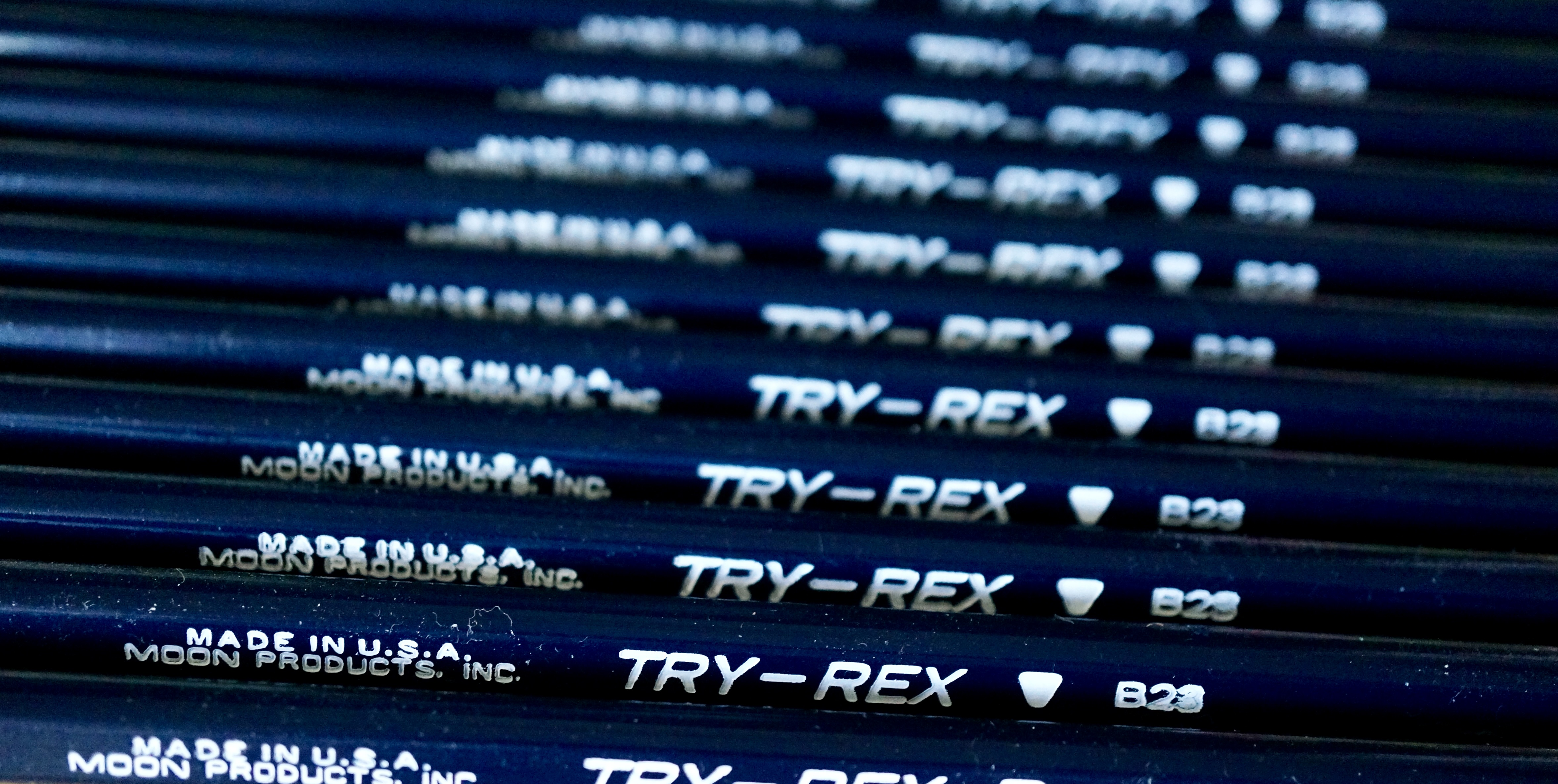
First, the imprint and typography are clearly vintage in appearance. “Moon Products Inc.” is an operating name adopted possibly in 1999, so the pencil imprint may be ~25 years old. This pencil, the slightly larger cousin B21 pencil, and the Big Dipper are the last brand name products referencing Moon that I am aware of. (There is also an unmarked Moon pencil available in bulk.) They also have products under more modern corporate names.

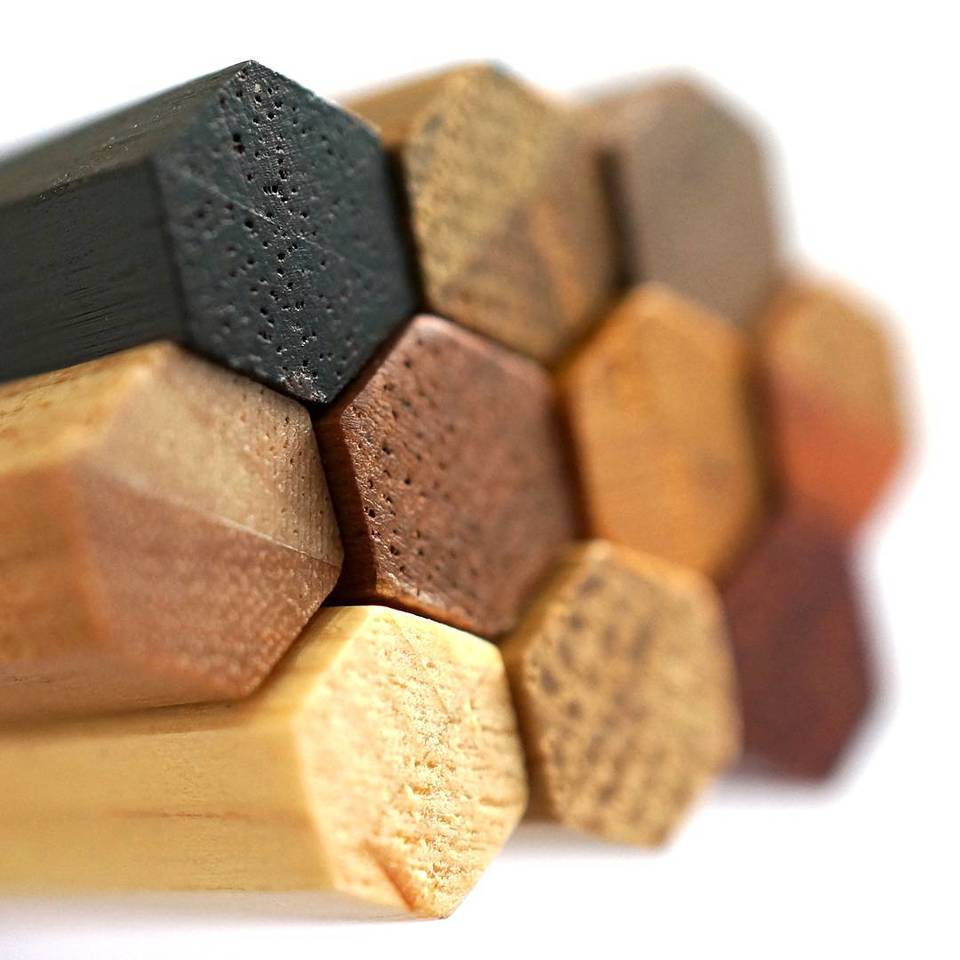
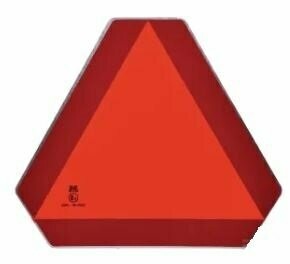
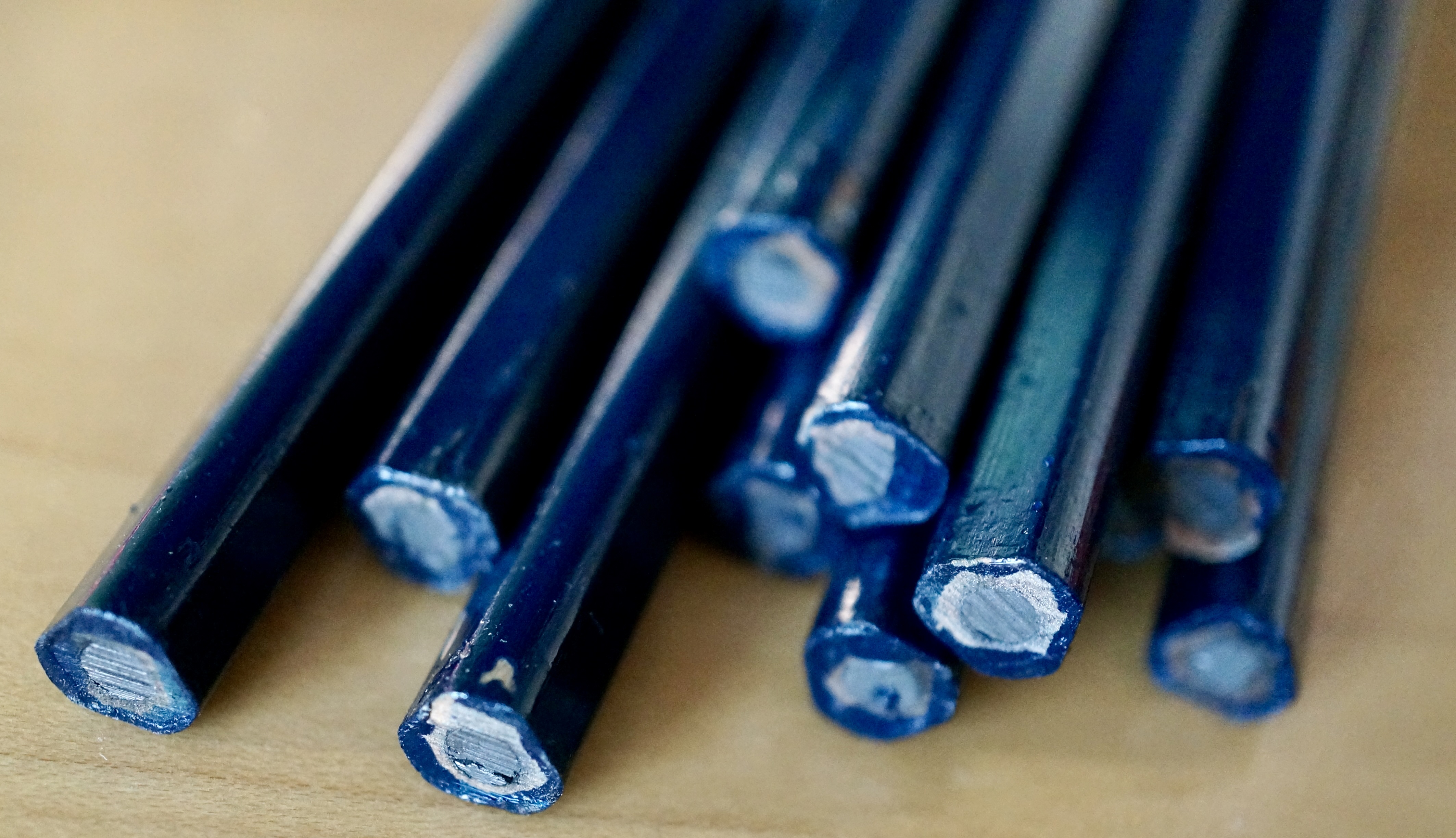
Now the shape. In 2011 I wrote that the shape was “an equilateral triangle with rounded corners.” Please let me correct that. A quick view might lead one to think that, but having sharpened and used this pencil the last two weeks, the pencil is definitely a truncated triangular shape, which is a type of non-regular hexagon with alternating long and short sides. It is this shape:
This unusual shape creates a very interesting artifact when sharpened:
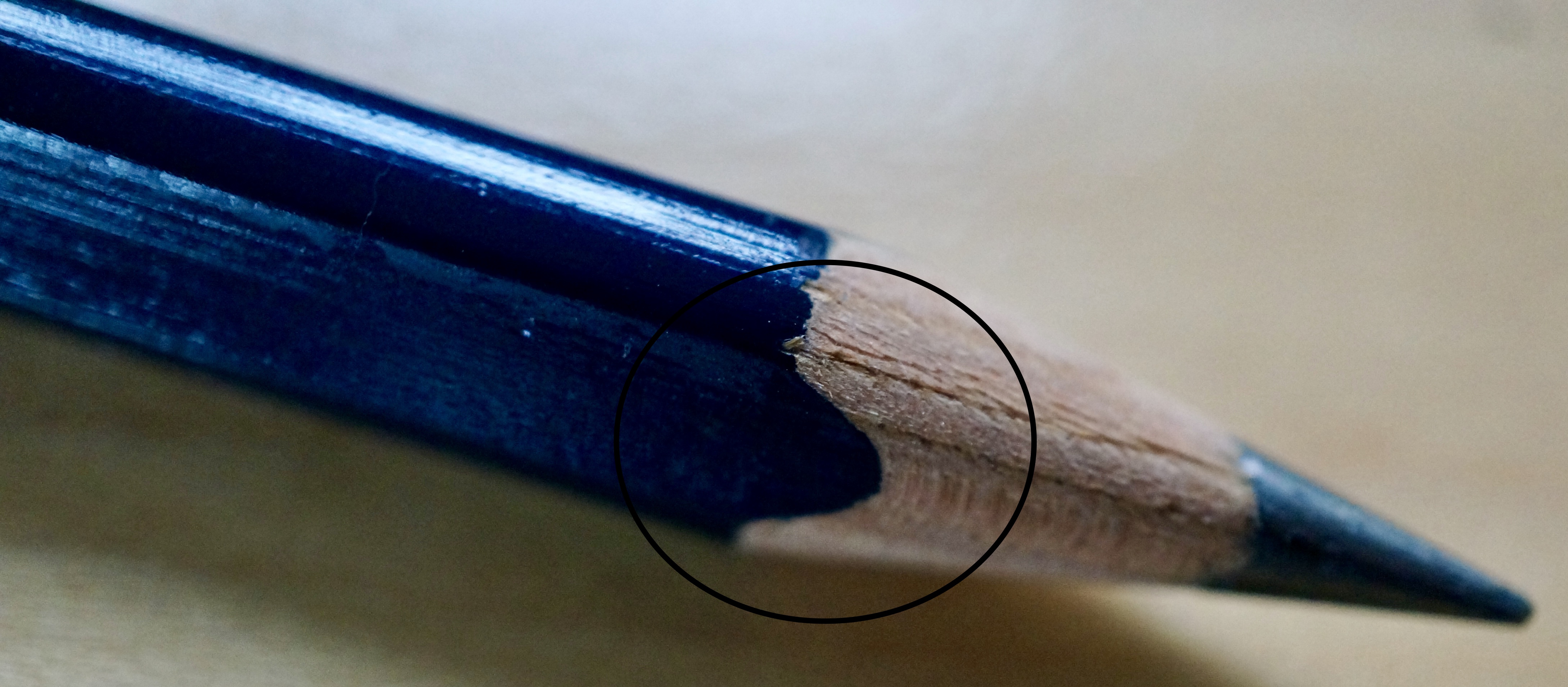
There are online assertions that the shape is patented, but I can not locate such a patent. Please let me know if you have a reference.

I agree with what I wrote in 2011 about the pencil overall. It has a superior cedar wood casing, the paint is thick, and the lead is a smooth delight. Maybe a notch less dark than a Japanese HB, but very nice on smooth Clairefontaine paper. And the core is an oversized 3mm (a standard pencil is 2mm). It’s really a pencil meant to be used. Whether you like the shape will be a personal decision.

The ends are unfinished with paint spilling over. Perhaps one of the last pencils in the world made this way?
The manufacturer

To review the history of this company (much more detail in the 2011 article):

1961 – J. R. Moon Pencil Company was founded by James R. Moon.
1999 – the company became Moon Products, Inc.
2003 – crayon maker RoseArt Industries Ltd. purchased Moon Products Inc.
2005 – Mega Bloks Inc. (a predecessor name of Mega Brands) acquired RoseArt
2008 – Mega Brands announced they might sell RoseArt

Since that article, there have been many events. In particular, in 2014 toy giant Mattel acquired Mega Brands. Then in 2021, Mattel sold RoseArt to LaRose Industries. LaRose is owned by the Rosen family, the original owners of RoseArt. LaRose had been using the commercial name Cra-Z-Art, which exists alongside RoseArt. You can see their pencil products on this page. The most famous product is definitely the USA Gold pencil.

Two interesting things about this manufacturer. First, the size of the company. With the major US brands having moved overseas, there is only a small group of remaining manufacturers: General, Musgrave, Moon, Wagner. When RoseArt bought Moon in 2003, they said Moon was the second largest US manufacturer – and Dixon and Sanford were around. And when LaRose bought Moon from Mattel in 2021, their press release referred to “the Rose Moon factory in Lewisburg, Tennessee, America’s largest pencil factory. Wow, that’s news. Is Moon actually at Dixon/Sanford scale, and much larger than General or Musgrave? Certainly the USA Gold pencil has a major retail presence, something I don’t believe the others have achieved.

ZoomInfo says General has 11-50 employees and revenue under $5M. They claim Musgrave has 51-200 employees and revenue of $16.2M. And they put Cra-Z-Art at 51-200 employees and $21.7M in revenue. Broad ranges and not conclusive, but still interesting.

The second interesting thing is that Moon has also been in the news for a trade dispute. Cedar Alliance is disputing that Moon/RoseArt/Cra-Z-Art pencils are really made in the USA. The issue has been referred to the US Federal Trade Commission (FTC).

“Cedar Alliance challenged Larose Industries’ advertising claims about the country of origin of its pencils, arguing that despite using phrases like “Proudly Made in USA” and using American-themed imagery, the pencils are made from components sourced from China and involve foreign manufacturing and assembly.”

Let’s see what happens.

And – what is “Cedar Alliance”? I am guessing that anyone still reading may already know – it seems to be a new business owned by members of the same family that owns CalCedar. Their website states, “We distribute wholesale pencil slats made from Incense Cedar, Basswood, and Poplar to manufacturers worldwide, including GIUSA pencil slats sourced from American Basswood and Yellow Poplar grown in the United States.” I will leave it there for now – there is other pencil industry news that we’ll save for future posts.

J. R. Moon pencils

The J. R. Moon Pencil Company was founded in 1961 by James R. Moon. Moon was a pencil industry veteran, having previously worked at both the Linton and American pencil companies, following a career as a school teacher.

Some background information on the company:

Mr. Moon (born in 1912), passed away in 2002, and a scholarship in his name at Columbia State College is a testament to the mark he left on his community.

In 1999, the company name changed name to Moon Products, Inc., possibly reflecting the wider range of writing implements and supplies being sold at the time.

In 2003, crayon maker RoseArt Industries Ltd. of New Jersey purchased Moon Products Inc., claiming to become the second largest pencil manufacturer in the US. It isn’t clear how such a calculation was made, as Dixon and Newell Rubbermaid’s Sanford division were widely acknowledged as being the largest American pencil manufacturers of the time.

In June 2005, Mega Bloks Inc. (a predecessor name of Mega Brands) acquired RoseArt for $350M.

(In March 2008, Mega Brands announced they might sell the unit.)

Today, Dixon (acquired by FILA of Italy) and Newell Rubbermaid (who seem to have dispensed with the Sanford name in the US, in favour of the Paper Mate, Parker, etc. brands) have both moved US manufacturing abroad. Due to the historical prominence of the Dixon Ticonderoga and Paper Mate Mirado brands and products, the two companies are still the most associated with recent American pencil making.

Some industry followers and pencil aficionados, and probably many pencil talk readers, are aware that two smaller family owned companies, General and Musgrave, continue to operate in the US.

Moon Products factory.

Yet there is another manufacturer. This manufacturer has no website, garners no press, and seems to operate in a stealth mode, with no brand or identity management. That manufacturer is Moon Products, which today operates in Lewisburg, Tennessee as a division of international toy conglomerate Mega Brands.

With great thanks to Pencil Me In, who supplied the pencils shown here, let’s take a look at the offerings of Moon Products and the larger Mega Brands organization.

The first possible surprise is in the branding – the “J. R. Moon” name still exists on a product, as do “Moon Products”, “RoseArt”, and “Mega Brands”. It gets even better – the company appears to use original imprints on some products, producing delightful new pencils that appear vintage. Lyra (in Germany) is also known for this practice.

Try-Rex B21 and B23

J. R. Moon pencils.

The Try-Rex is distinguished by an unusual shape – an equilateral triangle with rounded corners. This in contrast to other triangular pencils which are more like a three sided curve of constant width or a Reuleaux triangle . The shape comes from the Richard Best Pencil Company, which was purchased by J. R. Moon.

J. R. Moon pencils.

This pencil format is surprising similar to Mitsubishi’s triangular “Penmanship” pencil.

The Try-Rex B23 is just a bit larger than a modern standard pencil, and wouldn’t fit in some sharpeners I tried. It has a white imprint on a very dark navy blue finish. The B21 is an oversize pencil in the same shape with a red finish. Both share an oversize 4mm graphite core.

“Big-Dipper” 600

J. R. Moon pencils.

The “Big-Dipper” brought to mind the Musgrave Choo-Choo – delightful jumbo sized pencils for learners. This pencil includes the text “J. R. Moon Pencil Co.” Round, it is topped by a gold ferrule and ruby eraser.

Crown Cedar

J. R. Moon pencils.

Simply marked “U.S.A. Moon Products Crown Cedar 2”, this appears to be a standard yellow office pencil.

USA Gold

Please see an interesting comment by WoodChuck about this pencil’s background. The packaging says “Made in the USA” and “Made from American Cedar.” The pencil is labelled “www.megabrands.com U.S.A. Gold 2 HB” and also appears to be a standard yellow office pencil.

USA Green

We mentioned this pencil here. It appears to be a sibling of the USA Gold.

Recycled Denim

A fun pencil, we previously saw it here.

Recycled Newsprint

A rolled newspaper type of pencil. Included for completeness.

J. R. Moon pencils.

RoseArt Colored Pencils

Made in Indonesia, these represent the RoseArt name, though Mega Brands is mentioned on the packaging.

The Write Dudes #2

Made in Vietnam, this appears to be a “deep discount” pencil.

The colour pencils won’t be evaluated today, but the breadth of the graphite pencil offerings from this little known company is compelling. I can say that there were some distinctive differences between the products in terms of performance.

Sharpening

J. R. Moon pencils.

I used a new Faber-Castell Contour sharpener for the test. There was no trouble distinguishing that the three pencils with the old imprints, the Try-Rex B23 and B21, and the “Big-Dipper”, use a different and superior type of cedar. They all sharpened exceptionally well. The Crown Cedar, USA Green and USA Gold, were in a second tier, and noticeably less pleasant to sharpen. The Write Dudes (presumably basswood) pencils were distinctly rough.

Writing

The two Try-Rexes are both nice writers. Very smooth with moderately dark, rich cores. I couldn’t decide if the two ungraded pencils were the same or not. Perhaps as a side effect of the greater weight, the larger seemed to leave a darker mark.

J. R. Moon pencils.

The “Big-Dipper” was a welcome surprise. Musgrave’s Choo-Choo, as an example, does not use the same quality lead as that company’s standard sized pencils. Fortunately, Moon Products didn’t skimp, and the “Big-Dipper” is a great writer.

The USA Gold and Crown Cedar seemed so-so – I doubt they would be anyone’s first choice. I have to note that samples of both were slightly warped, perhaps (sadly) par for the course from today’s office pencil. The Write Dudes pencil is a disaster – gritty, scratchy, almost not writing.

Overall

J. R. Moon pencils.

The Try-Rex and “Big-Dipper” are almost worth buying just for the style of their imprints. But the quality of the wood and graphite is superior, and makes them recommended items.

The USA Gold and Crown Cedar, which probably deserve some regard for their last ditch stand against cheap imported competitors, are rather disappointing.

My thanks to Pencil Me In for her kind support of pencil talk, and considerable work in assembling this amazing collection from a little known manufacturer.

Want to buy a pencil company?

Richard Best Royal Scot pencils

Want to buy a pencil company? Mega Brands announced that they are considering selling their stationery division, possibly back to the original owners of RoseArt Industries. Mega Brands may be in financial trouble.

In case the names aren’t familiar – Richard Best was an independent New Jersey pencil maker, purchased by J. R. Moon (Moon Industries). Moon was in turn swallowed by crayon maker RoseArt Supplies. And finally, Canadian based Mega Brands bought RoseArt in 2005.

A few years ago, Mega Brands got news for their lawsuits with Lego. Today, the news is about ongoing recalls of their unsafe Chinese supplied toys.

The pencil line includes the “USA Gold”, which I’ve never seen, many novelty pencils, and still, the “Try-Rex” triangular pencil.

(The photo above shows relatives of the Try-Rex, two vintage Richard Best Royal Scots, made in Springfield, N.J.)