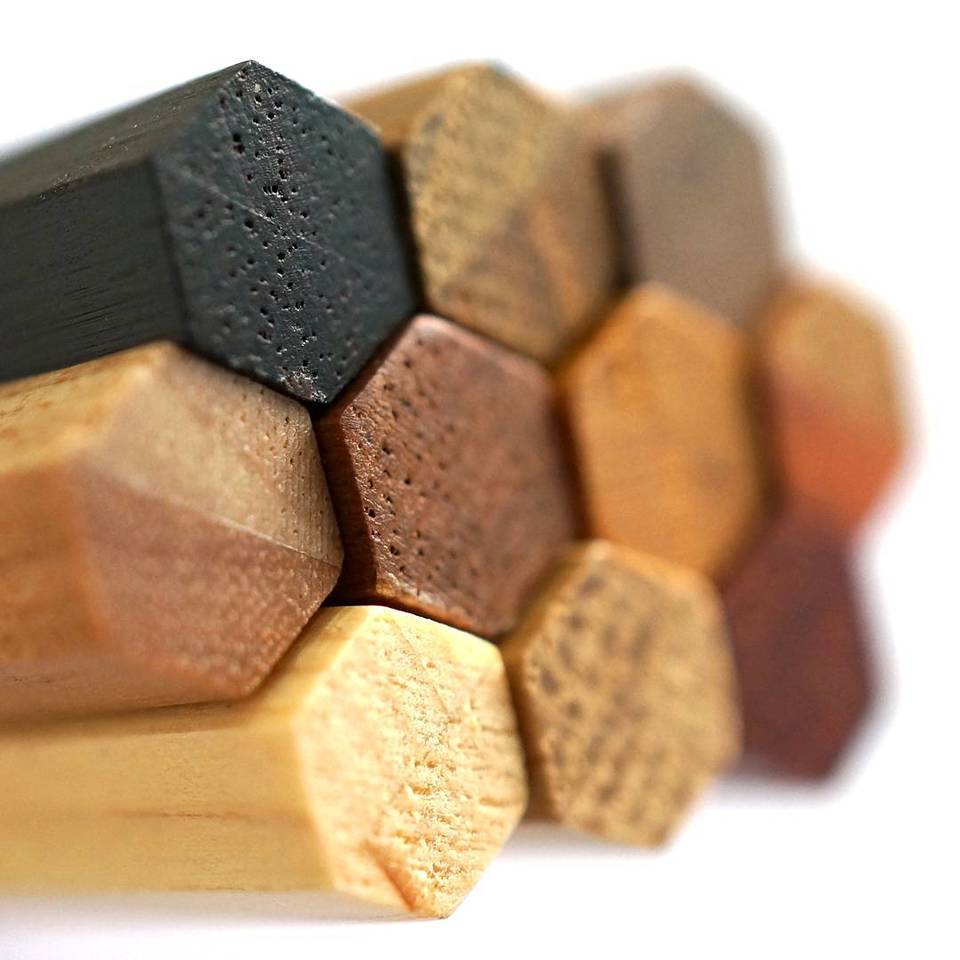
“A pencil that is right some days is no good another day. For example, yesterday, I used a [Blackwing] soft and fine and it floated over the paper just wonderfully. So this morning I try the same kind. They crack on me. Points breaks and all hell is let loose.”
-John Steinbeck on his search for the ideal pencil
The Blackwing 602 was not a commercial success – despite praise from novelist John Steinbeck and mentions in Henry Petroski’s The Pencil, Sanford discontinued the pencil in 1997 due to lack of sales.
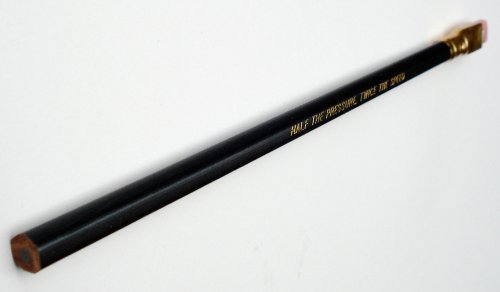
The story of the pencil’s demise is in a 2004 article at The Pencil Pages. The eraser clasp machine broke, and supply ran out. Why not fix the machine? At sales of just over a thousand boxes a year, the Blackwing had become a marginal brand, and was allowed to lapse.

It’s hard to get a fix on current supply and demand. They seem be regularly for sale on eBay, year after year. A modern pencil, out of production for only a decade, the Blackwing has become highly collectable – selling for $20 to $50 (or even more) per pencil.

A gentleman (and pencil user) from Missouri kindly sent me a Blackwing for inspection this past week. My thanks to him.
The pencil has an unusual ferrule. Up to the 1940s, pencils had more variety in ferrules/erasers (many examples at Brand Name Pencils), but modern production techniques have standardized these interesting varieties. The Blackwing’s ferrule has a gold colour, and presents a rectangular wedge. A family member who paints immediately thought it was a paintbrush clasp.
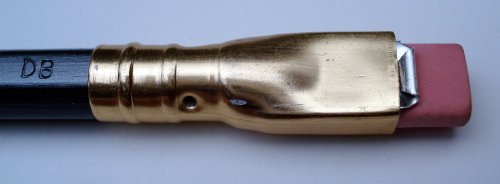
The wedge allows the insertion of a small block eraser. I won’t test the original (and now dry) decade old pink eraser, but the format does allow one to slice replacement pieces from a regular block eraser – an idea I like.
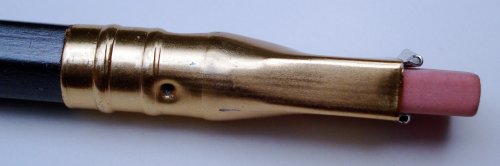
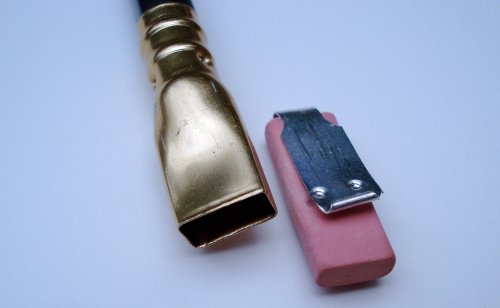
As charming as the novel ferrule/eraser looks, it seems a terrible idea. First, it distorts the pencil’s natural dimensions. Standard pencils, from the 19th throught the 21st centuries, are about 175mm. The Blackwing is about 200mm including the eraser.

Possibly even worse – the Blackwing’s balance point is quite wrong for a pencil. A standard quality pencil’s point of balance is at the halfway point. But for the Blackwing, it is about 70% up the pencil’s length. As the pencil is sharpened, that proportion will become more extreme.


The reason is that the pencil weighs 5.3 grams – with the eraser/clasp weighing 1.1g. 20% of the pencil’s unsharpened weight is at the cap – and increasing as a percentage as the pencil gets sharpened.
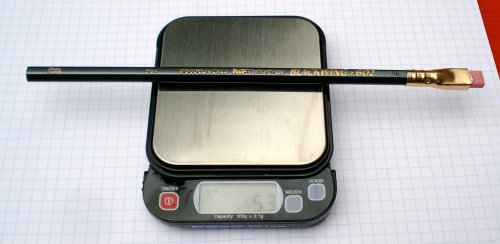
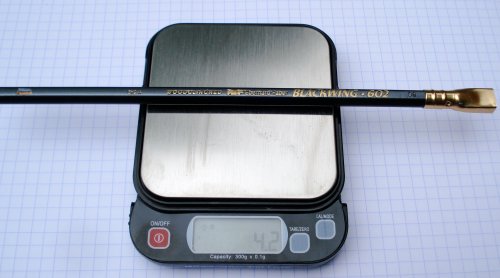
Unless the Blackwing is your only pencil – it is too different from standard pencils to make an easy adjustment to the odd balance.
The pencil is a smoky grey. I like it, and see why others agree.
The obverse is labelled:
USA Woodclinched EF logo Eberhard Faber Blackwing 602
As well , “DB” is impressed into the wood. Any idea what this code refers to?
The reverse has the great slogan:
Half the pressure, twice the speed
I sharpened the pencil in the Carl Decade DE-100. As much as I love pencils, I don’t love most pencil sharpeners, and Carl’s products are great exceptions.
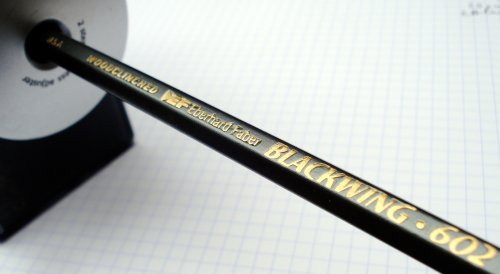
The Blackwing sharpens very nicely, as expected.
On paper, I tried the pencil on a Rhodia pad.
I’ll admit my first surprise – the blogosphere’s perspective on pencils is that that dark rich lines are the best – and the Blackwing seemed quite middling in the category. Okay, mabye not middling – much better than the vast majority of pencils – yet as a pencil that some claim should rest on a throne – it seemed to leave a lighter mark than other top pencils.
The smoothness category may be the key to understanding the Blackwing – the pencil is not smooth – it is more like slippery – floating on paper without tension, but not creating an appreciably dark line. The wax content in the pencil is a main feature.
I also tried erasure – with a Staedtler Mars, it seems to outperform other pencils, erasing very cleanly.
Some darker pencils like to draw outside the lines – emitting crumbles and residue – but the Blackwing excels in staying put!
The Pencil Pages article mentions the Blackwing’s putative successors, and I thought I would try them out as well.
A distinction to be noted – we are told that the Blackwing is a 4B grade lead – but quality pencils ranges today vary the lead diameter with the lead grade – softer lead grades having wider diameters – so these other pencils may have an advantage.
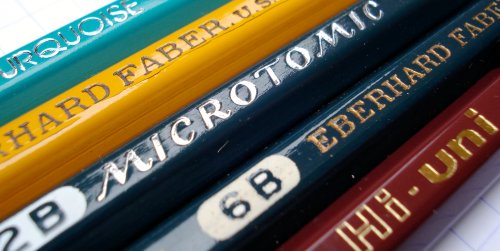
The Turqouise 4B is good, but it doesn’t strike me as being of the same calibre in any sense.
The Blackwing’s lead apparently carried on in the Microtomic (another lapsed label/brand). There are various ‘Microtomic’ pencils – some principally labelled as Microtomic, and some from another principle brand, with “Microtomic” used as an adjective. Some research on the name is here.
I have a few laying around – they typically have have attractive packaging, and I have variants in 2B, 5B, and 6B – but not 4B.
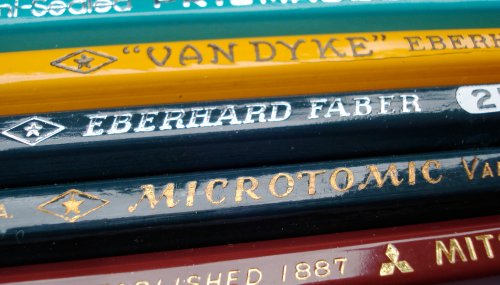
This test left me wondering why I hadn’t previously sharpened them. The Microtomics lay down a superb pencil line. The 2B is exceptionally smooth, and capable of reaching extremely deep shades. The Microtomic line seems perhaps less smooth and waxy than the Blackwing, yet is still an equally worthy pencil.
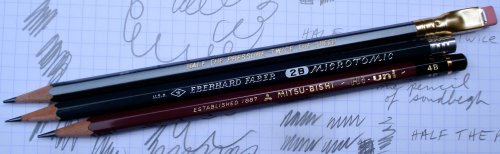
Another line of enquiry that of course occured was – how does the Blackwing compare with modern pencils?
Modern pencilmaking’s best efforts seem to occur in Japan, and I selected the Mitsubishi Hi-Uni 4B as the main comparison pencil.
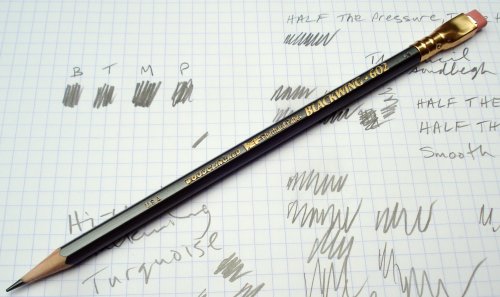
Tests were also conducted with the Tombow Mono Special 6B, Craft Design item 17 HB, Tombow Mono 4B, and Kitaboshi Hit 4B.
The Blackwing is in the middle at darkness, it excels at erasability and crumbling resistance, and is also in the middle at smoothness. It isn’t really a peer of the top modern pencils.
This test may be like comparing the automobiles of 1968 to those of 2010 – the past achievements are acknowledged and celebrated, but decades of engineering advancements just can’t be overcome.
The Blackwing 602 was great in the climate of it’s time, but died through lack of support. With Sanford’s pencil production leaving the US this year, the Blackwing is definitely not returning. If you love quality woodcase pencils, now is the time to support today’s Blackwings – the top products from Kitaboshi, Pentel, Tombow, and Mitsubishi.
Again, wonderful photographs accompanied by useful data. I would love to see a review of the Mars Lumograph HB and 2B by Staedtler. Pardon me if you have already done just that. Great work.
Wonderful and interesting review!
I’ve got a few of these Blackwings. They’re effortless to write with, but I can’t imagine paying $20 or more for one. For that price, you can get a dozen Hi Uni. I bought a gross of Hi Uni back when they were only available in Japan, but I’m glad they’re easy to get on the interwebs now … I hope I don’t end up paying $20 each for them at some point in the future!!
I seem to remember seeing lots of Blackwings strewn about on the conference room table in the movie “All the President’s Men.”
Very, very well done. I nice and informative review. For once an bit of criticism of the holy grail and a realistic view on the future Blackwing:
“….now is the time to support today’s Blackwings – the top products from Kitaboshi, Pentel, Tombow, and Mitsubishi”. Nicely put, I agree – but IMHO the Palomino Pencil is of this calibre too.
Regards
Henrik
While I agree that the Japanese pencils are first-rate and certainly the best pencils that are being made in our time, the Blackwing is nevertheless a unique and beautiful pencil, with its own special character. I do not have balance issues with it, and I love the eraser/ferrule design, which was shared, by the way, by versions of the Microtomics and Van Dykes (also much loved pencils). If this pencil were still made today and if it sold at an affordable price, it would be my pencil of choice. Its gliding smoothness and dark line make it perfect for swift writing. I can see why an author like Thomas Wolfe, who wrote very fast in huge script without stopping to revise, used the Blackwing chiefly. And that is something else that I like about the Blackwing: it was the favorite pencil of so many American writers—that is all about aura rather than performance, I know, but it embues the pencil with an extra magic. If Sanford were to bring this legendary pencil back, I am sure that it would sell at least as well as or better than the Turquoise. And the high prices on ebay would finally come down. I wish that the visionary leader at Palomino would buy the rights to the Blackwing and come out with a contemporary version of it. Or there could be historical reissues of famous pencils, like the Blackwing, the Microtomic, the Van Dyke, the Mongol and the Venus Velvet. What a great project that would be! At least the Mongol is still being produced in the Phillipines and in South America.
ayehartpinzils, we looked at the Staedtler Mars Lumograph in 2007. Please take a look here.
David O., thanks for sharing that observation. I’d like to see that film again.
Henrik, I agree – and since one of those named companies probably makes the Palomino, it is included even if not named!
Adair, thanks for a very engaging comment. I gather that Amspec in the Phillipines no longer use the Mongol name.
The following news may potentially fulfill one of your wishes – Sanford has let the Blackwing trademark expire (it was registered by Eberhard Faber in 1934) – and CalCedar has applied for the name – though they don’t yet have the registration. There may in fact soon be a CalCedar Blackwing!
A very thorough and well-documented review on such famous pencil. Hope people keep buying and supporting the Hi-Uni, for I would hate to see it follow in the same fate as the Blackwing 602 pencil.
Wow—the possibility about CalCedar and the Blackwing is amazing! That will be big pencil news if it comes through! Thanks for the peek ahead. Sorry to hear about Amspec, though.I guess that means that Pencilthings won’t continue to carry the Phillipine Mongols…Thanks for such an in-depth and realistic review.
Great review, very informative, I like the comment about the ferrule being a piantbrush holder.
As you say, “support today’s Blackwings – the top products from Kitaboshi, Pentel, Tombow, and Mitsubishi.”, but lets hope CalCedar can revive the Blackwing…hmmm, the Blackwing Phoenix perhaps?
Love the review and love the idea of the Blackwing. The gap in the analysis is that you appear to be talking about pencils as writing tools, but don’t highlight that. Someone like me, using pencils as drawing tools, might assess the Blackwing a little differently. For instance, since I regularly work with pencils from 7H through 9B, I don’t need Blackwing to be the darkest ever, just reasonably accurate about what it claims to be. And since I work with a lot of different drawing materials of varying lengths, weights and diameter, I never give balance a second thought. (There are actually gizmos, both homemade and commercially manufactured, for extending the length of a drawing tool. That’s because I want to get every last bit of goodness out of my short-sharpened pencils.)
But the feel, laydown, erasure and smudging — I care about those markmaking qualities a *lot*.
It looks magical. I bought one out of curiosity, and hope to see them on the market again — for writing, or drawing.
Thanks very much for the comments.
Linda, thanks for that detailed contribution.
I bought six dozen of these pencils from my local stationer (remember those?) after I read about them in Petroski’s book. I thought the erasers were worthless–all they would do is smudge.
After I read the story of the machine breaking, it occurred to my that Sanford could just leave the eraser off–the pencil would be even better!
Anyway, I ended up selling the pencils I had left to a designer or architect fellow for a very high price. He wanted them alot more than I did!
Very exciting! Thank you for that detailed review and the great photos.
I am happy to see that someone has evaluated the suggested successors to the Blackwing. As a collector, I am reluctant to sharpen any pencils just for evaluation, though I do have thousands of old sharpened stubs I could use for that purpose.
An addition to Linda Carson’s comments – virtually all of those mourning the demise of the Blackwing – in my experience – are artists.
It is a delight to get some feedback straight from the author of “The Blackwing 602 – the Final Chapter”. Your essay may be the most read online article on pencils, and has definitely helped keep the Blackwing in the public eye. (Mr. Martin is the force behind The Pencil Pages.)
Great review, thanks! I agree with Linda as well. It seems many of the blogs reviewing blackwings and successors are rating it as a writing utensil which would have slightly different characteristics than a drawing implement. I came upon this site the blackwing diaries which actually made me first aware of the blackwing, and takes on a look at the pencils from an animation perspective. I’d be curious to see a review/pencil successor article from a drawing perspective side by side with a writers perspective and see where the overlap occurs.
Also being a 4B i suppose i’d personally think of it as a drawing pencil, and would be curious to know the sales specs on other pencils of the type as you mention it’s sales being low. The mars lumograph? Perhaps in part that’s tied in with it being a specialty pencil vs a run of the mill bulk pencil?
thanks again!!!
Blackwings were the pencil of choice growing up in Pleasantville, New York. It’s what dad used at his office at Reader’s Digest, and when mom dropped by the office she’d help herself to a dozen or so. The removable eraser was unique so far as I knew then. As it wore down we’d extract it and pull out a bit more, biting the inner end of the clasp to crimp it. Believe me, when new the erasers worked fine. DeWitt Wallace brought the craze to RD, and the Blackwing was his pencil of choice. He would hand write short messages by the dozen, always in big bold script, signed either DW or Wally, as if somebody could possibly mistake his handwriting for someone else’s.
Gordon, thank you for this wonderful reminiscence.
If anyone’s interested a dozen new-in-the-box Blackwing 602 Pencils will be available in a charity auction on eBay starting Jan. 21, 2010 .
See here for details:
http://www.helpthehodges.com/2010/01/brand-new-one-dozen-blackwing-602.html
http://www.helpthehodges.com/
I’m glad to see a comparison of a cult item with some of the more popular high-end pencils today.
I think what amused me most was how you mentioned the CDT Item 17 HB. You tossed an HB into a test with a bunch of 4B? I’m not complaining about that, since I stick to the F-B range as a writer. 4B goes dull wayyyy too quickly for me, though the smoothness is great.
My guilty pleasure in writing is a Hi-Uni B, though my go-to woodcased pencil is the Hi-Uni HB or the CDT 17 now (I have yet to get some Mono 100s). I suppose it being one of my standard pencils is why I am curious about your choice to use it in comparison to the Blackwing.
I’d love to see CalCedar revive the Blackwing…if it’s designed/printed well, even with a finished/lacquered endcap instead of the traditional eraser (not a fan of any ferrule/eraser end myself), I’ll probably get some even though I’ve no need for a 4B.
The more i think about it, yes, I DO want the original ferrule/eraser…That defined the look of the pencil. Plus, I love the thin edge to the “crimped” eraser for fine erasures.
Also, I’m curious for more details about your testing. Which pencils in particular were darker, and which were smoother, in your opinion? I thought your synopsis at the end there was a little bit brief compared to some of your other comparisons.
It’s of limited consequence to me ultimately, since my writing is too fine and small for such a pencil, but I like seeing hype and mystique addressed realistically. There have been a few good posts on that, but I always felt there could be more detail.
I’d like to try a Blackwing. I’m pretty certain I had a few when I was younger, before I had any real appreciation for pencils. It’d be great to see for myself how it stacks up, but prices have gotten ridiculous.
Hi Robert, that post is from eleven months ago. Point noted, but I’m afraid that my original notes aren’t accessible.
All pencil lovers continue to talk about the Blackwing when it has been extinct for a number of years now. Well, I work for California Cedar Products (pencils.com) and we have bought the rights to the name and will be re-releasing the Blackwing in the near future! Get excited artists, writers, and animators because we will keep you updated on the progression of ‘The Best Pencil in the World’. E-mail me at jcentanni@pencils.com if you have any questions…you can also follow us on Facebook (The Pencil Page) and Twitter (pencilscom).
I wish we had Blackwing in Sweden! All we have here is German Steadtler. It’s nice to write with but you have to sharpen it very quickley and and Steadtler pen does not last very long. I use mine for crossword puzzles, which is how Swedish pensioneers keep their brain in order. Seriously!
Jan Sundberg:
I do not think the Blackwing is particularly famous for its point retention (one of the famous quotes regarding it is that it wears down quickly, so you feel like you’re getting more done).
The new Palomino Blackwing, which has been making the rounds recently, has been reported as even softer than the original Blackwing. I have been searching quite a bit for a good smooth pencil that keeps a point for a long time, and I still haven’t really found one. If I want to maintain a fine point, I either have a very convenient, clean, and quick sharpening method ready (on the go, this is usually a lead holder and a teeny-tiny lead pointer), or I just go with a 0.3mm mechanical. I have not come up with a good way to get a lot of point longevity out of my wooden pencils, or a convenient way to carry my rotary sharpener (pocket sharpeners just aren’t good enough).
I have some Staedtler Mars Ergosofts and Lumographs, and while Staedtler wears down a little faster than, say, a Faber-Castell, they keep points a little longer than a lot of the Japanese pencils of the same grade. I don’t think a pencil such as the Blackwing would help you solve the problem of blunting.
I remember writing some short stories using the Blackwing 602. I alternated among that pencil and the Dixon Ticonderoga #1 & #2. I thought the Blackwing had the best feel but became blunt the quickest; the Dixon #1 was smoother than the Blackwing and maintained its point a bit better, but didn’t make as dark a line; the Dixon #2, the pencil that just seems to be everywhere, was the one I went to when I became annoyed by the fast-wearing leads of the other two, but in comparison it felt like chalk on slate, and the line it laid down was just not dark enough. The Blackwing had the best feel and definitely the coolest look. I found a five-inch remainder of s Blackwing in my art box, and I take it out and use it v-e-r-y sparingly every once in a while. My pencil of choice these days is the Palomino HB and 2B, both orange and blue. The HB feels to me most like the 602 in side-by-side comparisons.
hello. i wonder how they compare to the Palomino BW… i mean, how they reeeaaaally compare!!! any one?
I purchased two boxes of the Palomino Blackwing 602 on the day it became available to the public–I am absolutely pleased with it. As a longtime fan of pencils, I have devised a “preference index” by which I determine whether a pencil merits a place in my stash: feel, soft,deep dark mark, clean erasure, ease of sharpening, elegant appearance, sturdy point.
The Blackwing 602 scores well on each of my preference index. Although I could do without the imprint, “HALF THE PRESSURE, TWICE THE SPEED,” this pencil’s overall performance has secured a spot in my stash.
Carl:
I think I can relate. I’m personally a little baffled at the nostalgia over the slogan, but it doesn’t particularly detract from the pencil, except in that it’s relatively easily damaged.
I can’t say with any certainty the new PBW602 is my most beautiful pencil, but it’s up there. I can’t say it’s the most distinctive, but it’s up there. I can’t say the graphite performance is the best, but it’s up there. I’m keeping one in my wrap with a Hi-Uni, a Mono 100, a CDT Item 17, and a Caran d’Ache 2mm Fixpencil (loaded with Uni lead). Doesn’t seem out of place at all.
I can’t wait for Stephen or John or Sean or one of the other well-known reviewers to go over the new offering with some comparisons to other top Japanese pencils.
Robert M., I can confirm the limited abrasion resistance of both imprints on the new Palomino Blackwing 602 – I would be happy if the relief printing was a little deeper and sturdier.
For five days now I am comparing the Palomino Blackwing 602 to other pencils but I have to admit that a comparison is too much for me (at least at the moment). The differences are minimal, and so is my vocabulary to describe it ;-)
By the way, I wonder which of the current pencils will be much sought-after when discontinued.
Gunther, your English is perfect, so no excuses! Start describing! (Smile…) But I too find that the differences seem small; frankly, I am impressed with the new PB 602.
As for your question, I think that most of the top German and Japanese pencils would be missed if they were to cease production; the Palomino and PB Blackwings would be lamented too, were they to vanish. Let’s hope that does not happen in our lifetime.
Thank you, Adair, but my English is far from perfect, and I even have problems to describe the very small differences in German ;-) Maybe I’ll post some notes on the PBW 602 but I’ll leave the full review to those who are competent. – I am impressed by that pencil too and enjoy using it.
You are probably right about the pencils that would be missed. To me, it is a pity that the Pentel Black Polymer 999 isn’t produced any more, even in view of its inferior finish – the lead is just too good, and I wonder why that pencil isn’t lamented more.
Yes, I was thinking of the Pentel Polymer, and of the Craft Design Technology pencil as well, both superb yet struck from production—I wonder why, as they seemed very popular in the blogs.
As for the language issue, I can only hope that my German someday becomes as good as your English!
I agree the loss of Pentel’s offerings should be mourned. I think the BP999 B is one of my favorite writers, and I would have loved to see someone take that lead and put it in a more premium casing, or even just offer it in 2mm sticks for leadholders. Sadly I only have 1 or 2 of them left. The CDT was a winner overall also and I’m happy that I have a decent stockpile.
I was thinking about writing an article myself about some of the different ways of interpreting “smoothness” of graphite writing tools. If I do that, I’ll probably give mention to the new CalCedar Blackwings as well as other top pencils and why some people might disagree on which of two pencils is “smoother”. I suspect there are connoisseurs out there much better attuned to the nuances than I am, but I don’t think there’d be much harm in me trying to initiate the conversation. I just don’t have a blog to do it on, so I may have to guest post somewhere.
My enthusiasm for the new PBW 602 has been tempered a little with use, but I still like it and I think it’ll probably remain one of my favorite woodcased pencils.
Thanks again, Adair!
I also mourn at the production stop of the BP999, and I wonder why it has been discontinued. But who knows – maybe it will reappear … Given its inner values a better casing would have been appropriate.
The differences between the top pencils are so small that other factors suddenly have an enormous effect: the pressure, the paper’s surface, the material below the paper, personal likings and even the daily mood. – I wonder how pencil manufacturers carry out objective tests – devices like that one have probably been sorted out ;-)
Robert M.: Yes, please write an article – I’d be happy to read it!
I agree with Mr. Gunther, Mr. Robert M. let us know where we can read that article “interpreting “smoothness” of graphite writing tools”, no matter if “some people might disagree on which of two pencils is “smoother”” and finally I think you can attuned some nuances about this topic. I would like that some ISO standardization (as Mr. Gunther wrote, “objective tests”) where applicable to pencils “smoothness” and “darkness” of graphite.
I’ve just saw the new “look” of the PBW602 and I think it looks better: the slogan, the eraser, the finish paint, sadly I don’t have a sample but I hope to get one in a near future abroad, since it is not distributed in South America.
Asking Was Blackwing 602 Made For Writing Or Drawing Or Was it Made For Both ?? all the other Pencils you test with the Blackwing 602 are mostly made For Drawing only
i hope to get a Blackwing 602 iam getting the New Ones Made By Palomino
Surprised more pencil users aren’t noticing the strange business practices of the folks putting out the Palomino Blackwings:
http://blackwingpages.com/facts-fiction-and-the-blackwing-experience/
http://blackwingpages.com/2012/04/26/work-on-display/
And the guy left holding the bag on the custom made 9′ long Palomino Blackwing props: they promised to purchase them, but not, then left the artist to try to sell them on Ebay:
http://www.ebay.com/itm/Giant-Blackwing-pencil-prop-/281104529969?pt=LH_DefaultDomain_0&hash=item417322ba31
Makes me like their pencils even less….seems they are just cashing in with a Japanese clone!