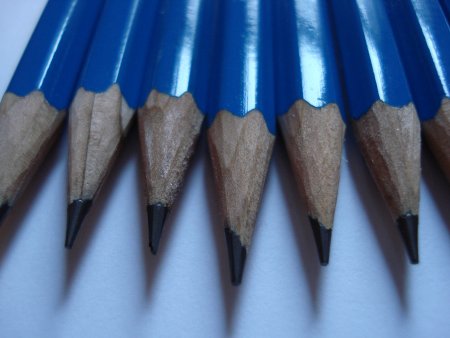
The Staedtler Mars Lumograph 100 is an icon of a pencil. When a movie depicts an artist sketching, often as not it’s the familiar blue Mars Lumograph 100 the actor is holding.
It’s also a marketing success. It’s sold in art supply stores, it’s sold at Staples, and it’s sold at the last independent stationer in my neck of the woods. Art supply stores typically stock two or three pencil lines – and one of them is always the Staedtler Mars.
Staedtler is a non-profit corporation, whose mission is to fund “German polytechnics and universities, in particular the Friedrich-Alexander University of Erlangen-Nuremberg“. (A famous graduate is Hans Geiger, inventor of the Geiger counter.) The company has ancient roots. Members of the Staedtler family are known to have worked in the pencil trade in the 17th century, and J. S. Staedtler founded a pencil factory in Nuremberg in 1835.
The Mars brand was registered in 1900, making this truly a pencil with a history.
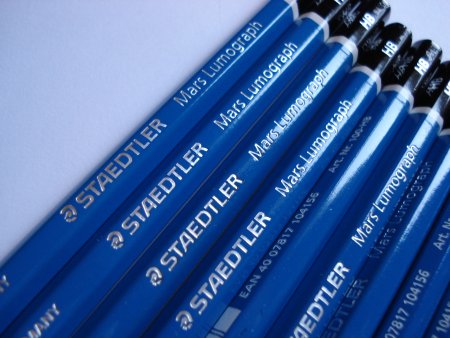
The pencils we’re looking at today are the current (2006) version of the Staedtler Mars Lumograph 100. We’ll look at the standard HB grade. I mentioned a couple of weeks ago that I wanted to move towards a more quantitative approach to discussing pencils. Well, I’ve already learned a few things that I’ll try and share.
First, and I don’t know why this surprised me, there is some difference in the weight of pencils from the same box. I’ll presume this is due to wood being a natural product, and different pieces of wood having slightly different densities. I tried to weigh each pencil with the same method, and label and re-weigh the pencils at different times to see if this was reproducible. It was. These pencils had a mean weight of 3.8 grams, and ranged from 3.6 to 4.1 grams. I tried other brands of pencils as well, and they had similar variations. (Incidentally, a few vintage pencils I weighed were all 5 to 6 grams. Pencils were more definitely more substantial some years ago.)
This amount of variation suggests that we had better be careful claiming that a particular pencil brand is heavier than another, unless a good number of samples have been tried. Since this may be the world’s most available quality pencil, I’m going to call 3.8g a reference pencil weight for comparison with other brands in the future.
The shape is hexagonal, the distance between opposite pencil sides is 7.45mm, and the pencil is a standard 175mm length. It is sold pre-sharpened.
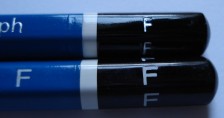
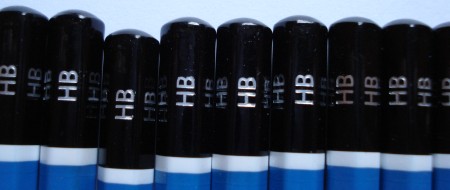
The exterior, blue with a white band and black cap, is marked:
Obverse (silver): MADE IN GERMANY STAEDTLER Mars Lumograph
Reverse (white): [bar code] EAN 40 07817 104156 Art. Nr. 100-HB
All six sides of the black cap have the grade, HB, written in silver.
The finish is a disappointment – the Mars is a classic, and the 2006 update weakens the depth of the blue finish, and narrows the white band. The famous white on black pencil grades on the cap have been replaced with smaller letters in silver. The bar code and long serial number on the reverse side also add design clutter. Compared with other top pencils, the lacquer seems just a bit thin.
(A Staedtler press release indicates that the pencil differs from the predecessor version in having improved break resistance.)
The micrometer and scale also reveal that the pencil is a fraction thinner and lighter than it was two years ago (approximately .1mm and .2g).
These particular pencils were C$1.69 each at an art supply store (a good price – they are typically $1.99 around here). Zellers, a discount chain just walking distance from the art supply store, offers 24 of their house brand for C$2.49 – that’s $0.10 each. I know they’re not by any means the same pencil, but that’s a huge price difference from a consumer perspective.
The pencil writes very nicely. I compared it with two other Staedtler offerings in HB – the Mars Ergosoft 150, and the Triplus Slim 118. It seemed similar to the Ergosoft in line darkness and writing smoothness, but much smoother than the Triplus, though similarly dark. Comparing it with a Tombow Mono 100, which many professionals would claim is the ultimate pencil, the lines are not nearly as rich or smooth. While rating good to excellent, it isn’t a real competitor to the Tombow.
Erasure testing led to the same ranking – a Mars plastic 528 50 eraser on Rhodia paper erased the Tombow lines most cleanly, and did the worst job on the Triplus.
I tried to look at smudging, but didn’t discern a noticeable difference between these pencils.
Sharpening with a Dux sharpener was trouble free. Like most good pencils, the lead did not crumble or break while writing.
The wood – let me know if you have any information. Staedtler is a global company, and does state that they use cedar and jelutong, but I don’t find anything stated about specific products. The pencils do not seem to have the red/pink hue of cedar.
The wide availability, plus the range of hardnesses, is a major advantage of this pencil. The problem with a specialty pencil is that a fresh supply may not be there when you need it. With the Staedtler, this will not be a problem.
The printing on the Lumographs is a bit of a let down. In particular the silver seems to rub off fairly easily as you use the pencil. But still, they are a good pencil.
I’ve gotten Mars Lumographs at Blick for $.99 each.
Diane, thanks for the tip.
Is the Mars lumograph pencil from Germany still available. I’m looking for them for an artist friend who says she likes the sheen the German pencil provides.
I am in dire need of someStaedtlerMars Lumograph pencilsthat are 100 LB EB. If anyone knows where I could find these I would be very grateful
@maggie: Yes, the Lumograoh is still available in Germany.
I would like to share a few details that I have learned from STAEDTLER Germany regarding the Mars Lumograph 100 (my favourite woodcase pencil, by the way): As from 1982, the Lumograph was labeled with all-capital letters and marked with the “S”, enclosed in irregular quadrangles; this “S” stood for “Sicherheitsverleimung” (“safety glueing”). At the end of the 1980’s the bar code was added, and in 2002 the lettering was changed from all-capital to the version that is still in use. — I don’t know when the diameter of the Lumograph was reduced.
Any one know where I can get Lumograph 6H and harder all the way to 10 H?
Thanks,
Wei – Like Diane said, try Dick Blick stores, they have a wide range of Lumographs. I bought a couple 3Bs there last year and saw that they had a really wide spread of them. Worth a shot.
Wei, the Lumograph goes only to 6H. You’ll have to use another brand if you want something graded 10H.
Hi, just to let you know I too have been using these for many years and have always found them consistently the most resistent to dropping onto hard floors/desks/ground etc; the lead rarely shatters/breaks. Great pencils! BTW, every Lumograph I use here in the UK seems to have the familiar red hue of cedar. I am unsure about Staedtler’s sustainability policies however…
I was surprised to find out that the Lumograph 100 is no longer available in the harder grades, specifically 7H, 8H and 9H. It appears that Staedtler no longer even manufactures these grades. Does anyone have any more info on this. The Lumograph 100’s have long been my favorites for the harder degree leads and I am sad to see them go. However I recently discovered the fabulous Tombow line, so all is not lost. By the way, Mitsubishi makes a terrific 10H (and 10B!) in their Uni-Ball line. Got mine at JetPens.com
Withdrawn grades? How interesting! I wonder when this happened. Perhaps someone out there has more information.
Looking around, I see that Faber-Castell also at some time withdrew their grades beyond 6H.
Perhaps this assisted Mitsubishi in deciding to move into this terrain.
The owner of the art store where I went to buy the Staedtler pencils told me that the harder grades have not been available for several years. I was not able to find any further information on any of the Staedtler websites, so I’m none the wiser. It would be quite interesting to find out the reasoning behind the disappearance of these grades from the Staedtler line.
I’m still surprised on occasion when I come across a Japanese blog where the poster mentions his favorite pencils, and the Staedtler is a frequent contender on the list. A few even say they prefer the Mars Lumograph over the Hi-Uni and Mono-100 in terms of “writing flavor” (for lack of a better translation). They don’t seem to dismiss it so readily as English writers have. I find that interesting.
The knee-jerk reaction is that the Staedtler is about the same price in Japan as the high-end pencils, and so it makes sense that it would be put into a comparable category there. However, I wonder if there is something more to it. I’ve noticed different point geometries favor certain leads and pencils, and some smoother papers make darkness differences much more obvious. Amount of pressure and paper indentation may be a thing of personal preference as well, but I don’t know. I’ve heard some state that you don’t want a perfectly smooth pencil for writing kanji (Chinese characters), but I’m not sure I agree, since I write in Chinese most of the time and really enjoy a smooth lead.
All in all, I’m a little confused about what to make of other people’s opinions. Naturally, it’s all subjective and we should all just choose what satisfies us…but I always wonder whether other people see things I’m missing.
Hello Robert,
“…but I always wonder whether other people see things I’m missing.”
Each of us always misses something, which is what makes sites like this so valuable – – and fun!
Thanks so much for this dialogue.
About two or three years ago, an accomplished and recognized artist (shown in galleries in several countries, juried exhibitions, etc.) wrote to me about the blog and the qualities of Japanese pencils. I was thrilled to receive her correspondence. And to my surprise, she dismissed smoothness, darkness, richness – all the qualities many of us praise in pencils – as being less important in the larger view. She was fully aware of the amazing glide of a Hi-Uni, and didn’t care. To her, the ease of application was not important in the overall quest. The results produced and their immutability over time, even if much harder to produce, were what counted.
For artists, pencils are just tools to make the art they envision. So, they just need to be reliable: very few lead breaks & able to produce the shade they require. Anything else is a bonus.
Dark lead, especially for the H grades is probably unwanted since it defeats the purpose of having a H grade pencil (from an artist’s perspective).
Though I am surprised that smoothness is not as important because a gritty pencil will scratch the paper, and scratches in the paper usually make it harder to render the drawing.
“Dark lead, especially for the H grades is probably unwanted since it defeats the purpose of having a H grade pencil (from an artist’s perspective)”
As an artist, I respectfully disagree, but in a relative sense. I have commented elsewhere on this blog about the relative darkness of H grade pencils, especially the Kimberly. The distinction between that pencil and other H’s is something I have been able to exploit to my advantage. And it doesn’t stop with that grade. There is a significant difference in hardness (and darkness) between Sanford/Derwent and Kimberly/Palomino, such that one can effectively double the grades between 2H all the way down to 2B. That difference is especially welcome in the range from H/F/HB, because I have found the transition between those grades to be far too abrupt within any one manufacturer’s offerings. Exploiting the non-standardness between producers allows very sublte transitions not otherwise possible.
Although I have never sold or formally exhibited any of my work, there are samples of my efforts you can view here http://www.pencils.com/users/bobjim/gallery/bobjims-drawings and then decide for yourself if I know whereof I speak.
Hi James!
I do admit I haven’t been able to really play with a lot of artist-quality pencils out there, so I probably don’t know enough to make a fully accurate judgment call. I’m just speaking from my limited experience with H grade pencils, which is mostly just Staedtler.
I have 2 very old H grade Staedtler woodcase pencils handed down from my parents. The lettering matches the Mars Lumograph 2886 found on BrandNamePencils.com. These pencils draw a light line.
I also bought some 2mm 2H leads (Staedtler Mars carbon) a while ago from a Utrecht art store and these also make very light marks. So my overall impression was that the H grades were supposed to be light in case an artist has a tendency to press the pencil down on the paper too hard. (Something I do a lot.)
I did notice that the H grade Semi-Hex pencils from the General Pencil Company are much darker than the H and 2H leads I have from Staedtler. You are right that there is a definite gap between H and HB grades for some brands; I’ve noticed it between the H Lumograph pencil and the new HB Lumograph pencil.
I’m a little reluctant to present a link to my scattered art gallery, because it’s not as professional looking as yours. It’s mostly just fanart/anime-style art. Art is art, but people tend to dismiss it when it’s just ‘trendy’ anime art.
Hello Pisces6!
Thank you for the kind comment about my gallery, but I must give credit to the good people at Pencils.com for the professional look. It’s really their work that allows mine to be so well presented.
And please do not be dismissive of your work because it’s “just anime”! There is something to be learned and valued in every form of expression. I can assure you that my work is also breezily dismissed by many, usually for being “too photographic”. The fact that it is significantly (and importantly) different from the original photo is something they do not wish to–or are unable to– acknowledge. In any case, one must be prepared to accept criticism and wisely profit from it. By all means, show your work!
I agree that the Staedtler line has very light H grades, especially compared to the Kimberly or Palamino. In my experience only the Sanford is harder and lighter than the Staedtlers. As noted in the previous post, those differences are something one can really use to one’s advantage.
“Too photographic”?! o_O Well, that’s a first. The people I know seem to value photographic over anime art, so, I’ve gotten into the unfortunate habit of hiding my art rather than showing it off (in real life).
My most current art is on DeviantArt:
http://pisces6.deviantart.com/
My embarrassingly old art pieces (dating all the way to high school) are here:
http://daydream.windfalcon.net/gallery.html
Pencil has been my favorite tool to use in drawing. When I think of art, I think of pencil and paper, not oils or watercolors.
I think you are too harsh in the criticism of your work. You’ve really got that hair sheen technique nailed! Judging from some of your comments on the other sites, persistence is the only thing you need to work on. “Lines, lines, and more lines” is the key, according to one of the all time greats with a pencil, Jean Auguste Dominique Ingres. Google some of his drawings and you’ll see what I mean.
I agree about pencils as a tool for art, and I mean “real” pencils, not the mechanical variety. There are many accomplished pencil artists that only use and advocate mechanical pencils. Not me. I love the feel, variety, and especially the smell of Honest-to-God wooden pencils. Because of the way smell is so closely linked to memory, one whiff of an incence cedar pencil and I’m instantly 5 years old and in grade one. Who’da thought pencils were actually time machines!
HI!
Very informative page I must say.. I just stumbled into it when I googled for why it said “Mars Lumograph” on the pencil I was holding. I couldn’t find the answer to my question here… so do you know why? Thank you:)
Åshild, you mean the history or perhaps marketing background of the name?
There is some good information at Bleistift.
I love Staedtler Lumograph Pencils, if only for the fact they have virtually no gritty/scratchy bits in the lead compared to other pencils, but… does anyone agree that both the 7 and 8b have a slightly more ‘waxy’ feel than other brands, thus making them less blendable? My artwork relies heavily on the ‘smudgability’ of soft graphite and I really wish Staedtler’s 7 and 8b performed in the same way as their other soft leads. I’m sure they used to, many years ago. Also, why is there no 9b available anywhere? Although I’m guessing it would have the same feel as the 7 and 8. Any feedback would be greatly appreciated. Cheers.
The Lumograph 7B and 8B leads contain soot which increases their blackness but makes them also a little stickier on the paper than the harder grades. I don’t know if the composition has been changed over the years but all my ExB/7B/EB and Ex-ExB/8B/EE pencils are similar, even some of the 1930’s, the first decade in which the Lumograph (2886 at that time) was available.
I waffle about the Lumograph a lot. I think the color combination they did with it is one of the most attractive of any pencil I’ve ever come across, but sadly the blue lacquer isn’t as thick and luxurious as it could be. I even find the typography clean and pretty well-executed, but the imprints are too shallow and the paint rubs away too easily. The lead is quite excellent, though I do slightly prefer my Tombows. Every time I swing by the store and look at them, I want to buy a few, but I know they’ll get a bit neglected.
I will say this though…they look pretty sweet when matched with a blue-handled Spyderco Delica. http://i.imgur.com/mcvX8.png
Robert M.: What a great photo! Yes, the imprint could be a little better. Do you know the version before the current one? It had a white lettering in uppercase Helvetica, and to me this was the most attractive version.
Gunther – you have and use 70 year old Lumographs?
Kiwi-d – yes, I have a few Lumographs from the 1930’s, at least as far as I know (it looks like that they cannot be dated 100% correctly so that they could also be one or two decades younger). Of course I don’t used them daily but I have sharpened and tested some to try out. Besides that, they are in unusual grades and therefore not suitable for office use.
I can only add that as a newcomer to drawing, I have purchased just about all of the pencils available and have, without question, decided to go with the Mars Lumograph. My reasons are such,
1, the sharpen better than any other make I have tried,
2, they feel very smooth to draw with,
3, The difference in the quality at the very soft end, 8B seems far superior
I am also very lucky to have a family owned book/art shop localy that stocks the entire range, both boxes and singles at a fery resonable price.
I have a dozen Lumographs in HB on their way, and I’m excited to experience the unique flavor of these iconic pencils. I’ve been having an absolute ball since discovering this site. I’ve picked up a few dozens of some truly world class wooden pencils from companies like Tombow, Mitsubishi, and California Republic, and I’m loving every second. I like ’em when they’re new. I like ’em when they start getting dull, since I’ll sometimes try to play a little game where I’ll see how long I can write before they get too dull for me to stand. I like ’em freshly sharpened, especially if they have a strong scent of wood. I like the sound that eraser-less pencils make when you drop them on the desk, tailcap first, when you can grab an eraser to make a correction. I like the pencils when they get stubby and the sharpener is starting to eat up the imprinting — the stubbiness indicates that the pencil has done some writing. A stubby pencil also means that it’s almost time to sharpen a fresh one. What’s the tracking number on those Lumographs again?
I have been a mite curious to see the differences between Euro/American/Japanese HBs, so I guess the Lumograph will be my representative from the EU. I’m also glad to be able to send some revenue in Staedtler’s direction, as a sort of “thank you” for their historic pencil kit giveaway from a few months ago.
Hi Brian,
Thanks for your comment, and welcome!
I just purchased a set of Staedtler Mars Lumograph 100 pencils from Dick Blick and they range from HB to 8B. These are the best drawing pencils I have ever found!
are theese made out of lead or graphite ?
Will the lumograph 2B pencil draw like a Derwent 2B?
Thanks :)
Hi, Laurie,
If you’re happy with a Derwent 2B you’ll be delighted with a Lumograph 2B; a superior pencil in every way. To be fair the 100 Lumographs are somewhat inferior, themselves, to their 2886 predecessors. Nevertheless, the decline in quality is not as pronounced as that which is all too apparent in the Derwent brand. Have you tried the relatively new Grafwood range by Caran d’Ache? A slightly awkward size but beautifully smooth to draw with and grit free; a rare find in a modern graphite pencil.
Hi Dave & Laurie,
Talking about Caran d’Ache and the Lumograph, I recommend the Caran D’Ache Technografph 777 more than the Grafwood if you need a pencil for writing.
Indeed the Caran d’Ache are as good or better as the Lumos
.
Thanks for the info on Caran d’Ache—never heard of either one, will keep my eyes open.
Here’s something you might find interesting, since this is somewhat of a Pencil Rating website…. :) ….
I had been looking for a replacement 2B pencil, as the assignment in my drawing class was an exercise on shading, and to make two gradients—one with a variety of pencils (H, B, 2B, 4 B, ..whatever) and the other was to use only a 2B to make all 10 shades along the gradient. This involved ALOT of time with the 2B, lightly layering over and over to get the darker shades without causing paper to turn shiny.
Anyhow, we had a small discussion going in class (about 15 of us there)regarding experiencing “grit” in the leads, and many (including myself) had noticed that over the years, the one brand we had the least issue of grit was Derwent.
I’m guessing the quality of the Mars Lumograph has gone down over the years perhaps? Either that, or I just happened to get a dud in the one 2B that I bought…..because I really havent had much grit at all that I can ever recall using the Derwents, whereas I dealt with it quite a bit during this one exercise with the Lumograph.
I thought it was just a fluke, with my one pencil, since the Lumograph gets such rave reviews…………but there were at least 5 or 6 others there who had noticed the same thing with Lumograph and Prisma vs. Derwent, and at least 3 others who specifically noticed Lumograph vs Derwent as grittier.
Of interest, many purchased their Lumograph’s at a local “Staples” (office supply chain)—while they say “Staedtler/Mars/Lumograph 100” just like the others—it makes one wonder: do they produce a less quality one for these mass-market chains? (kind of like Levi’s produces a “different” Levi’s for the mass market Walmart-type chains?) (mine however, which was gritty, came from a college bookstore)
I have a 15 year old Derwent tin of 12 and if it wasnt for the pretty tin I would have thrown them away a long time ago. The pencils are completely useless, very scratchy and grainy, too soft, the paint on the barrel very messy. Far worse than FC Castell 9000, which is so super-scratchy that you couldnt produce immaculate continuous tone with them to save your life. Staedtler Lumograph, Cretacolor High Art Graphite and Tombow Mono are something quite different. They make drawing so easy – I really used to think I was really bad at continuous tone when I only had Castell 9000 pencils. Then I bought Cretacolor and was astonished, and Tombow was pure bliss. Anyone here familiar with Cretacolor? An Austrian brand. The lead is perfect quality but the casing is very hard wood that makes sharpening with a scalpel hard work.
But heres what I wanted to say: I cant stop wondering how so many people find Derwent good (Ann Swan recommends them in her book) and how FC Castell can maintain such a status in stores (its sold everywhere in my country). And why are Tombow 100 not more widespread and more easily available? Is the mystery part of marketing tactics?
Love this site!!!!!
What does “your comment is awaiting moderation” mean?
Interesting post from Elena — my Derwrnts and Lumographs were both purchased in past year — I wonder if lumograph went down hill , or if I just got a bad one ?
Will keep on lookout for other ones she mentions !
Hi, Elena,
Couldn’t agree with you more about Derwent pencils; grit in every one! A pale imitation of the quality that Cumberland once stood for. There’s been one or two take-overs in the past and I suspect accountants have had something to do with the rapid decline. To me they now look and feel cheap.
I think I’ve been luckier with the Faber Castell 9000 than you. Although not completely grit free they are superior to Derwent but don’t compare to Staedtler’s Mars Lumograph in any way. That said, and as mentioned in my previous post, I find the Lumograph 100 is itself inferior to the its predecessor, the Lumograph 2886.
As a pencil artist myself I can’t believe I haven’t heard of Tombow. I will definitely be tracking them down on your recommendation. Are the Cretacolor High Art Graphite pencils you mention the same as the Fine Art pencils they produce? Those with the red/brown barrel paintwork? If so I think I’ve located a seller and I intend trialling those too.
Not sure what “your comment is awaiting moderation” means but I wouldn’t worry about it.
Hi, Laurie,
Sorry, I meant to reply to your previous post.
I find it interesting that you consider Derwent pencils superior to the Lumograph. As you mentioned I suspect you’ve just been unlucky with the Staedtler 100 and I would urge you to persevere with them. That said, do try the Caran d’Ache Grafwoods when you get chance, I’m sure you won’t be disappointed.
Yes, Elena’s post is interesting and I, too, will be looking out for those brands she mentioned. I’m particularly keen to try Tombow as I hadn’t heard of them before.
Well, like others here, I’ve pretty well tried them all including Daler Rowney Artists Graphic which I’m certain are rebranded Cretacolor Cleos Fine Art Graphic 160’s (both made in Austria), FC 9000 (nice finish, scratchy in hard grades, keeps a point forever, never seen a bent one), Staedtler Lumograph (same as Dave – get your hands on the old 2886 Lumograph), Tombow Mono 100/Mitsubishi Hi-Uni (get both at Jetpens.com, the finest stationer in the USA) – when you buy these by the dozen you get superbly designed plastic cases which are worth 5 bucks on their own, Derwent Graphic – don’t bother with 3b and softer unless you’re a dedicated knife sharpener with a subtle touch, finish lousy, Conte 601 – dark in HB but gritty and loses point quickly, vintage Eagle Turquoise (NOT prismacolor which are gritty and too many poorly centered leads), Koh-i-noor 1900 Toison d’Or – very nice and good value, better than KIN 1500. After all that (and many more) – TOMBOW MONO 100 if money is no object, otherwise FC 9000 because of familiarity and surprise, surprise, vintage Dixon Ticonderoga – feel in the hand is something incomparable, (just watch out for a few bent ones).
That’s my 2 bobs worth
I used to use the mars lumograph 6B to draw some 10 years ago. The other day I bought some 8B but when I tried them I was so dissapointes. The lead is totally different, more like charcoal (much like the lumograph black line). I can’t believe Staedtler took this old classic and changed it so much without changing the name. It’s a shame.
Hey Kevin. Have you stumbled over any new good ones since writing this? To my horror I recently discovered that Staedtler has ruined the mars lumograph line, at least the soft grades 8B. They are like hard conté, not like graphite at all. I liked the thick core but the feel of it on paper is horrendous!