
It has been over two years since we last looked at a copying pencil.
The Sanford Noblot, like the Koh-I-Noor Kopierstifte 1561, appears to be a regular graphite pencil, writing with a traditional “black lead” core.
There are still several copying pencils on the market with coloured leads, but the Noblot is the last one I’m aware of in the graphite style.
It is a handsome pencil, with silver lettering on a luminous grey barrel, and a metal cap.
It also has a slogan on the reverse side : “A Bottle of Ink in a Pencil”.

The obverse reads “Sanford Noblot Ink Pencil 705”.

If you look carefully, you can see an impressed remnant of the Eberhard Faber heritage: “Woodclinched U.S.A.”.

As a pencil, it seems a bit cheap and scratchy. It is definitely an indelible pencil, trouncing the erasure attempts of even the Staedtler Mars plastic.
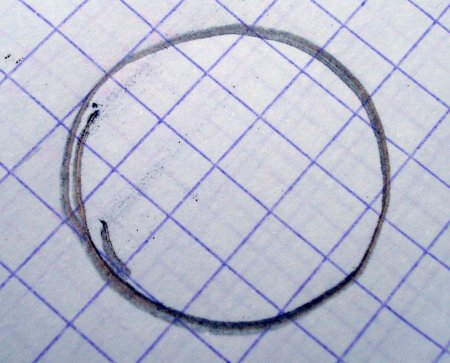
To test the copying quality, I drew (imperfectly) a circle on a sheet of Bloc Faf paper.
I then wet the paper revealing a rich cobalt blue:
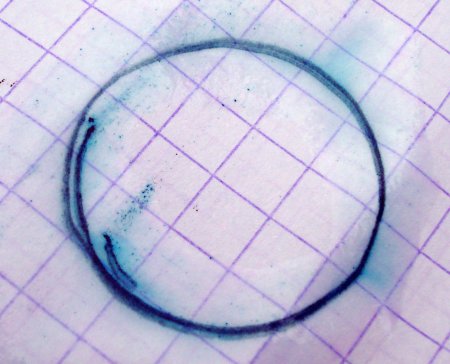
With tissue and other paper types, I’m afraid that I couldn’t pick up much more than a smudge of blue. I’m curious about the exact paper choices and water application techniques that would be required to use the pencil as a working copying pencil.
Do you use this pencil? What do you use it for, and how do you use it?
If anyone wants to sell some Sanford Noblot ink pencils, please email me at lanowlin@sbcglobal.net Thanks
Hi…. i am in need of this pencil. Want them in urgent, if anyone knows where i can get them, please mail me the required details.
I know this is a rediculously old article, but I use these pencils for scribing log homes. The Eberhard Faber ones are soooo expensive I use the Veritas and stabilo brands, they are still very expensive. I wish I could find the Eberhard ones for under $25 a piece.
Great post
And comment.
Personally I would add to the topic a word of caution when painting over old signs. Check the paint to be repainted first,waterbased paints over waterbased paints is normally dependable.
My experience with waterbased paints over oil based paints has results of a history of poor adhesion. It is also a well beaten path of trial and error,with a predictable outcome.
The ” bottle of ink in a pencil” is a great product with proper application. I would hope the user would appreciate the best uses of the 705 mentioned.
Using the pencil on the backside of a drawing and ironing over the drawing to transfer to another paper or cloth is one method I employ regularly. Its a great pencil for many uses.
Hello, I know this is an old article but still I wanted to comment on.
I still own two more of this pencils.
I used them for drawing, and watercolor. I used watercolor paper and I honestly treated it like a watercolor pencil all this time, still knowing that is ink what it has.
I show a recent watercolor drawing I did using this pencil.
Is funny I came across this article because I was searching for a place to buy more.
I love the No Blot for drawing really loose abstract shapes and then using a large wet brush to bring out the intense cobalt.
Michael, thanks for the contribution.
Hi, all,
I’m a novice prosthetist-orthotist and am looking for these pencils for my work. Is anyone still selling them, or know where I can get some?
Thanks!
I bought an old box of these pencils at an estate sale and have hung onto them for years. I have three unopened packs of twelve pencils each. I looked on ebay to discern their possible value and saw people selling one pencil for $29.95. Would you be interested in buying the lot of Noblot Ink Pencil Eberhard Faber U.S.A. 705?
C. Burse. If you still have these 705 Pencils I would be interested in purchasing. Please contact me.
If you have these pencils willing to buy
Just as a point of information, the Eberhard Fabre Noblot Ink Pencil is traditionally used by tattoo artists to transfer their artwork to a person’s body. A regular Mennen Speed Stick deodorant is applied to the skin and then artwork drawn on a piece of tracing paper is lightly pressed with the pencil toward the skin. And the artwork is transferred to the skin — after which the tattoo artist applies the ink over.
The art store, Carter Sexton in North Hollywood Carrie’s these pencils all the time. They are used by makeup artist as well as real tattoo artists to transfer artwork to the skin.