
Does anyone remember the Dixon Oriole?
The official product page calls them a “first-rate commercial grade woodcase pencil offered at an economical price”.
Hmmm, “commercial grade”.
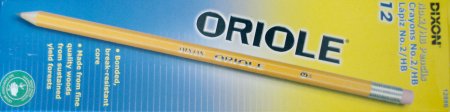
Well I ordered them online after finding a store that had some older US made stock. Or so I thought. I should have known what was coming – the photo and description were out of date, and I was sent newer Chinese made Orioles.
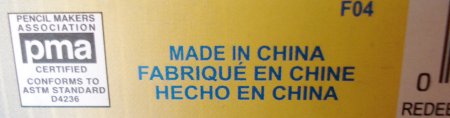
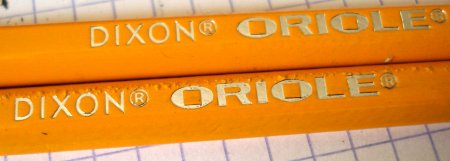
Unfortunately, the pencils seem quite third rate to me – the lead is very scratchy and rough, and the paint finish on some has ridges of bubbles which go beyond being a cosmetic problem – they make the pencil uncomfortable to grip. I do like the font.
Am I being harsh? Perhaps they aren’t meant for writing. They are certainly fine for rough marking purposes.
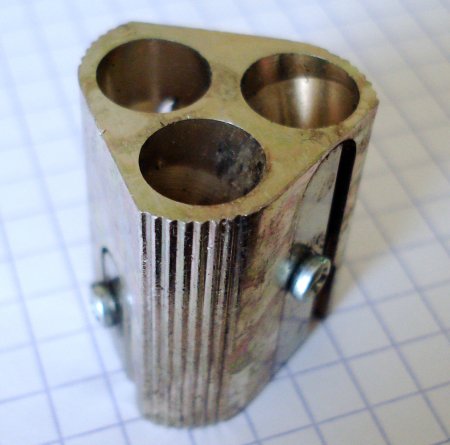
So about the sharpener. From Möbius + Ruppert we have a three hole sharpener in unfinished aluminum. Each opening has a different length blade. What is this sharpener for?
Take a look at this post at the Bundoki Stationery blog. I’m obviously not the only person amused or confused.
With the Oriole, I got a reasonable result in one opening, a lead corkscrew effect in another, and the third would not sharpen the pencil at all. (See top photo.)
Does anyone know the story behind this sharpener?
It seems to be doing the to your pencils what my KUM longpoint sharpener does to mine.May be it’s a two step long point sharpener – with a lead pointer for the bigger leads?
Henrik
I have this odd sharpener as well and the results of my experiments look similar. As for the corkscrew-like marks: These are produced by the corner of the blade where the lead leaves the sharpener so I assume that thinner leads won’t be damaged but are just freed from wood (which I assume is the function of the second hole). The third hole can be used to point the lead but I am not certain if that is its intended purpose.
I second Henrik. That looks exactly like what the Kum longpoint sharpener does. Start with the corkscrew one, then switch to the normal one to finish the lead.
Thanks, I will try further. I’m not used to handheld sharpeners requiring a manual.
I’ve got a few boxes of old US Dixon Oriole pencils – they are good commercial grade pencils. The only odd thing is the wood they are made of. It has a very visible pores, which makes the wood appear spotted in some way. But it sharpens up nicely, and the lead in the US made pencils is basic and functional – at least i don’t remember it being particularly bad, though not as good as say, the California Republic Paliminos. I think it was in the same category as the old Eberhard Faber Marigold, but stayed in production longer than the Marigold. During the time that I was seeing Orioles for sale, I believe Ebarhard Faber had already gone away as a brand name in the US, replaced by Faber Castell, (which in turn disappeared – and I still miss the Faber Castell Velvets….)
My guess is that the hole which makes the corkscrew lead is for stripping the wood from the lead for the purpose of creating thick or extra thick lines in drafting. At least that’s what I would do with it.
About 35 years or so ago, I would occaisionally accompany my mom to the local office supply store (remember those?).
She bought Orioles because the Ticonderogas were “just so expensive.” One day she astonished me by buying a dozen Ticonderogas. The difference in quality was quite noticeable even back then.
Don, thanks for the reminiscence.
I don’t see the Orioles around very much so I don’t use them regularly, but now and then I’ll stumble across one. I like the scratchiness/roughness of the lead… maybe that’s just me? It makes it seem more of a pencil to me, I guess. If I wanted something smooth I’d just a pen.
I am sorry that I don’t remember the details for the Möbius + Ruppert sharpener. I sold them when I worked in an art store three years ago. I am pretty sure the idea is that one is for lead holders, one is for a blunt finish and one for regular pencils.
That may not be right, since I sold a lot of different multi opening sharpeners. Also, a minor trick that I am sure you know, is adjust the screw hight. On cheap sharpeners this is really important.
Just wanted to say I bought a pack of the Orioles on Ebay and along with the packaging being quite different from yours (it’s a green gradient fading into white and there’s no MADE IN CHINA stamp), the pencil wood is also a bit pinkish(?) and smells amazing.
Audrey, good for you. Those must be a slightly older version you found.
The Dixon oriole is truly a disgrace to the Dixon brand. The brand was known for its U.S.A made pencils and high quality but they really screwed the pooch on the Oriole. I did a small test to find out which pencil brands were “best” (based on writing smoothness, eraser feel, and eraser job.) the Dixon oriole scored a 6 out of ten but I beleive it should have gotten a four, it was a terrible pencil
Acording to M+R, Möbius + Ruppert english catalog http://www.moebius-ruppert.com/download/m_r_katalog_09_e.pdf
this special sharpener is magnesium made, the first opening is for standard pencils, a general purpose sharpening until Ø 8.2 mm long cone -long cone referring to the woodcase not the point-, another for shaving wood casing only, not grphite and the third sharpens the exposed graphite only, the previous two openings work as the KUM®-Automatic®.
I think M+R brand is very good qulity, their roots are older than KUM both of them Made in Germany, now the corkscrew-like marks? better to ask M+R but good theories here.
Thanks Futural. (I coudn’t get the pdf to download, though.) Leadholder.com’s catalogue section shows that this sharpener has been sold for decades!
Yah, the new Oriole pencils are worthless junk. The older ones, not long ago, were made in the US and are good. New ones are Chinese. Might as well throw them away. They’re made from sawdust scraped off the floor from that furniture China-Mart er… Wal Mart sells.
The Dixon Oriole is a common feature in my school, and they really are pretty disposable. Don’t even bother keeping one I would say.
I have thrown away at least 100 of these Dixon Oriole pencils. They are unusable, I had 24 students buy 2 boxes each at our school supply sale. The lead falls out, they cannot be sharpened. My third graders decided they want to write to the company themselves. I’ll let you know if we receive response.
I recently bought some low cost Dixon (not Dixon Oriole) pencils and found them to be decent quality. The graphite is good for writing, sort of like the old “Eberhard Faber American 2 HB” pencils and they sharpen relatively well. This is on a sample of one, however. The wood is not cedar. Maybe basswood? Also, they have a standard diameter, as opposed to the Papermate brands which is a bit smaller diameter.
I have some older Oriole pencils made in Mexico which are okay, and some MUCH older Orioles (about 20 years) from USA, which are fine quality. I will not be buying any newer Chinese Orioles, or indeed ANY new Dixon pencils ever again. I buy quality products made in many different countries, but for political reasons, I refuse to buy or use ANY products made in China. Maybe everyone else already knew, but when I happened to pick up some Dixon Ticonderoga pencils in a drug store a few months ago and noticed they were made in China now, I was heartbroken and bitterly disappointed. The TICONDEROGA PENCIL, named after FORT TICONDEROGA IN NEW YORK, USA – is made in China now. Well, I put them back where I found them and rushed right out and bought myself some GENERAL pencils to show my support for a U.S. company that hasn’t sold out yet. Frankly, I feel that if a great company like Dixon is going to sell out like that, then LET THEM GO OUT OF BUSINESS. If they’re not quality pencils anymore, and they’re not even made in USA anymore, then what’s the point? I’d rather remember them for what they were, rather than be depressed at what they’ve become. AND IF GENERAL PENCIL EVER GOES THE SAME WAY, I’LL SAY GOODBYE TO THEM TOO. Fortunately, I’ve got enough older, quality pencils saved up that I’ll never have to buy another one again, if that should become necessary, which I fear – realistically – may be very soon, in the dark days ahead when China takes over the world.
Wow, I thought that Ticonderoga pencils were just made in Mexico.
I just would like to let you know that these are the very, truly worst pencils I have ever seen. My students use these pencils and they are breaking constantly. Much academic time is being wasted because these pencils break constantly. I have tried to sharpen these pencils myself and don’t have any luck. This is a major rip off of money.
Yeah, I agree. The non-Oriole Dixon pencils I bought kept breaking so I gave up on them. I’ll stick with my older U.S. made cedar pencil stash.
Regarding the three hole pencil sharpener.
The large hole is for the pencils that are fatter, such as an Eagle, wood, gold painted wood pencil I have here. Also, I use it for a fatter black wood pencil that says Dixon’s Market…….
One of the holes is for the standard size pencil. I am not certain about the other hole, but I believe that if you go to the manufacturer’s website you can likely find some information. IMF the Germans make the sharpener you can know that there is a valid and specific reason for all the features on the sharpener.
Also, regarding the pencils that do not sharpen well or pencils that have lead that breaks ……the reason is that these pencils are being made with incredibly poor quality materials. I was reading recently that in so many of the cheaper quality pencils, especially those made in China, the lead stick in the center of the pencil is such poor quality that it fractures inside the pencil when the pencil is dropped. Also, the lead core is often ill fitting inside the pencil leading to difficulty in sharpening.