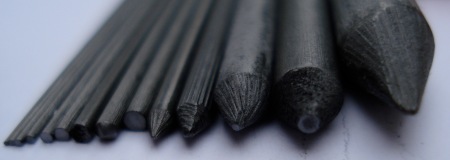
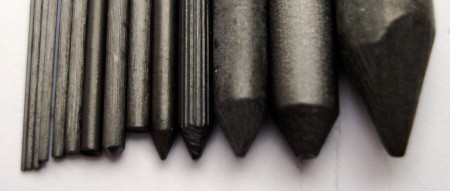
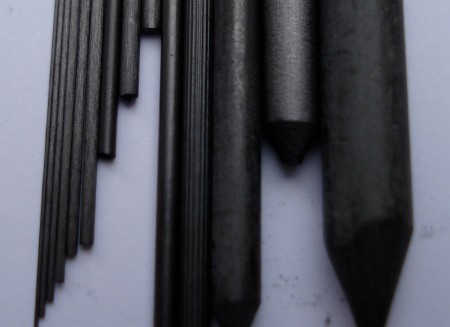
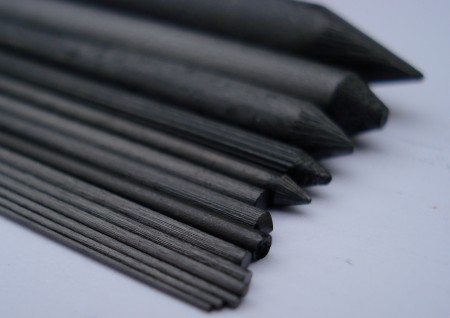
Photo (L-R): Leads in 0.2mm, 0.3mm, 0.4mm, 0.5mm, 0.7mm, 0.9mm, 1.18mm, 1.3mm, 1.4mm, 1.5mm, 2.0mm, 3.15mm, 3.8mm, and 5.6mm diameters
Mechanical pencil users have a lot of choice in lead diameters. Between thin leads used for drafting and wide leads used for sketching, most of us should be able to find something suitable.
0.2mm
That’s not a typo! Introduced by Pentel in 1973, the 0.2mm lead is used by the PG2 (or PG2-AD) Pentel pencil. It is extremely thin. Refilling a pencil with this lead is not unlike threading a needle. While I expected this diameter to be essentially unusable, I didn’t find any problems in practice. I’ll give some credit to Pentel here – it seems almost impossible to me that this lead wouldn’t continually break, but it didn’t.
0.3mm
For drafting, this is the thinnest lead made by a variety of manufacturers.
0.4mm
Also for drafting, this diameter is a Japanese specialty. Some ranges of drafting pencils are sold with this width in Japan, and without elsewhere.
0.5mm
The thinnest writing and general use diameter, it is also used for drafting.
0.7mm
A larger diameter also for writing and general use, as well as drafting.
0.9mm
Introduced in 1960, this was once the “standard” thin lead pencil diameter.
Today, it is used for drafting and a few general use pencils.
1.18mm
Prior to the 1960s, the standard lead diameter. Still used by Yard-O-Led, and a few others, including some companies that didn’t exist when this diameter was the norm!
1.3mm
Pentel and some other Japanese manufacturers have made light use of the 1.3mm diameter, and Staedtler recently introduced a pencil in the category.
1.4mm
The Faber-Castell Emotion was the only pencil using 1.4mm lead until Lamy changed their ABC from 3.15mm to 1.4mm. Still, an unusual lead.
1.5mm
The lead shown is a historical variant. (This example from Faber-Castell.) Fedra and others once made 1.5mm leadholders, but I’ve not been able to find one.
1.6mm
(Not Shown.) One of two in production diameters that I’m aware of that aren’t shown here. Faber-Castell Brazil makes 1.6mm pencils. (Brazil is also where the 1.4mm leads are made.)
2.0mm
The diameter of the lead in a standard woodcase pencil, 2.0mm is the beginning of ‘wide’ rather than ‘thin’ lead in many definitions. The standard for many drafting clutch leadholders made around the world, and carried in ‘big box’ stores, it is possibly the most available lead width apart from 0.5mm and 0.7mm.
2.5mm
(Not Shown.) Koh-I-Noor is the only modern manufacturer of this lead that I am aware of.
3.15mm
The outer realm of drafting lead diameters, this lead is today mainly used for sketching, though some drafting-syle clutch leadholders are still sold. The quite amazing Lamy Scribble introduced many of us to this format.
3.8mm
Used by Pilot, Caran d’Ache, and Koh-I-Noor, this diameter is also inside many art pencils (graphite, colour, and other). Strictly for drawing.
5.6mm
The largest standard lead that will be found in an art supply store, there are 5.45mm and 5.5mm subvariants. Very useful for sketching, pencils in this diameter continue to have a market.
There are a number of historic diameters not mentioned, but I think this list is correct at present. Let me know if I’ve missed something!
So, which lead diameter do you use?