Mitsubishi Uni M-552 drafting pencils

Mitsubishi Uni M-552 drafting pencils

The Mitsubishi Uni M-552 is another inexpensive drafting pencil.

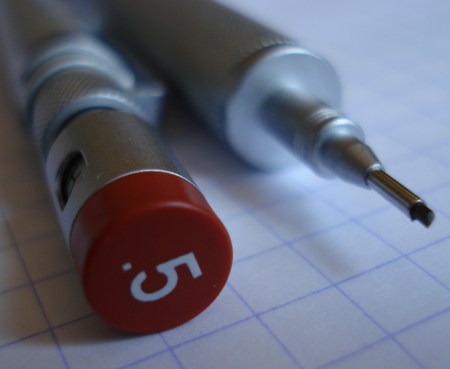
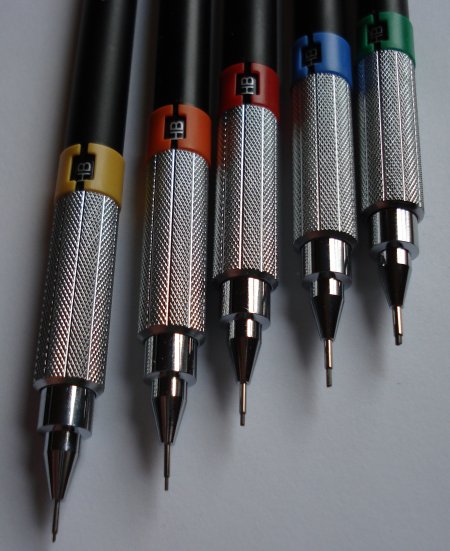
Lightweight at about 12.5g, they come in five lead diameters. I bought all five. I may soon regret this, as the 0.4mm pencil does not have refills available in Canada. On the other hand, it’s not too often that I’ve found myself saying that I need a 0.4mm pencil for a particular purpose.

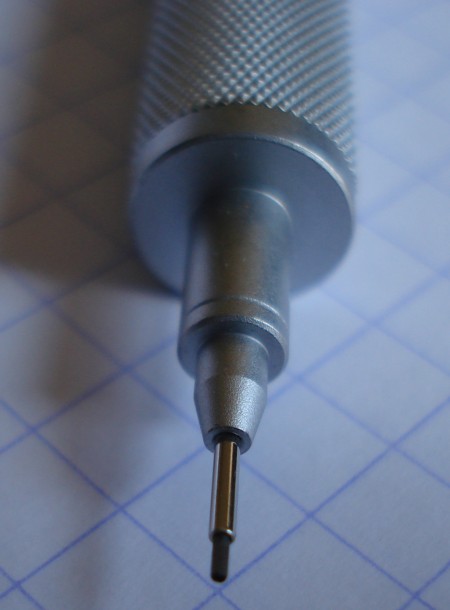
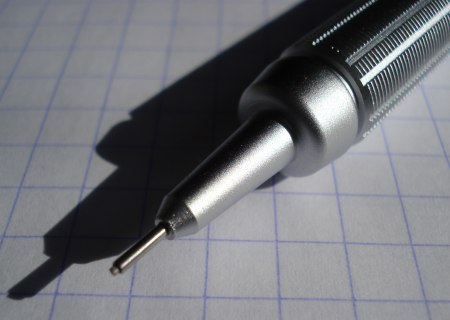
The tip, grip, clip, and cap are metal, and the barrel is plastic.

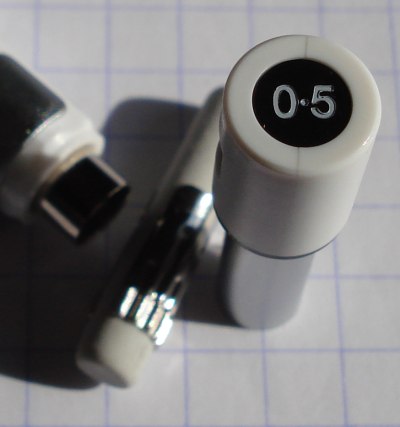
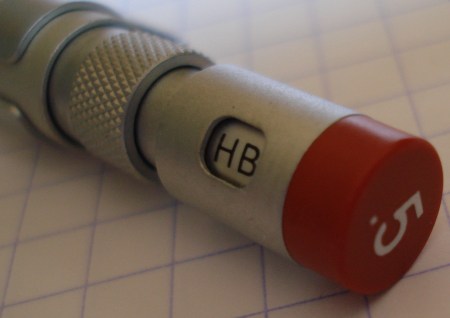
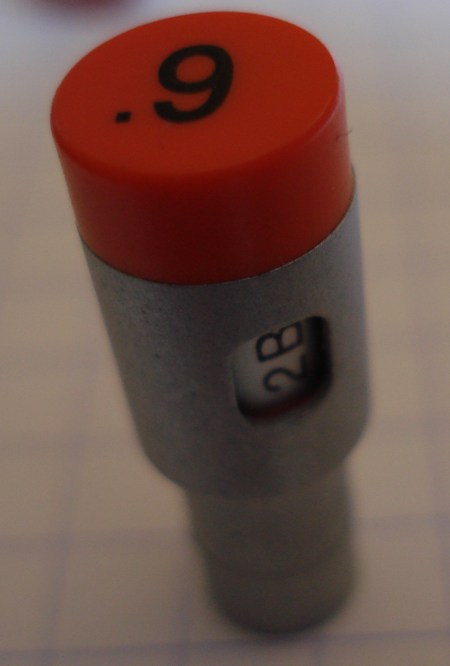
The lead advances by clicking the cap. A thin plastic ring, the pencil’s only colourful element, is the pencil’s lead grade window.

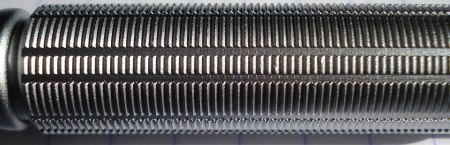
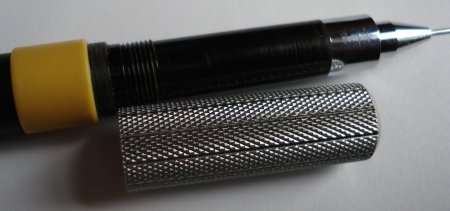
The grip, very lightweight, screws off of the plastic barrel (see photo). Why a removable grip? I’m not sure, but if the idea was to make available a choice of grips to suit individual preferences, that would have been an excellent offering.
Mitsubishi Uni M-552 drafting pencils

The grip superficially resembles that of some expensive drafting pencils – which is probably the intent. But it doesn’t at all have the smooth feel of the Staedtler 925 95, for example. In fact, I found the 552 quite unpleasant.

It seemed to be a pencil that had a lot of attention paid to the cosmetics. Unfortunately, the looks don’t achieve much in person, and I would rate it lower than the A120 – though there is a 0.4mm version, if that is important to you.
Craft Design Technology drafting pencil

Craft Design Technology drafting pencil

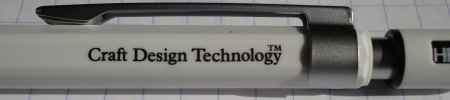
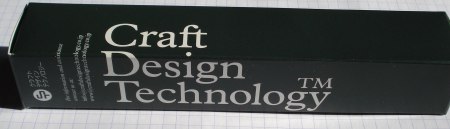
As well as woodcase pencils, the Craft Design Technology brand offers item 16, a 0.5mm drafting pencil.

The pencil is made for CDT by Pentel.

Craft Design Technology drafting pencil

The white plastic barrel is distinctive, with lettering in black. I’m not exactly sure what the tip, grip, and clip are made of. They appear to be another type of plastic, though finished to look like metal.

Craft Design Technology drafting pencil

At approximately 15.5g, it also feels substantial, and there seems to have been some effort exerted in creating a very comfortable balance and grip.

Craft Design Technology drafting pencil

The design seems much more evolved than the micro, for example, yet it’s still a usable and functional pencil. I tend to think the white will get discolored over time, but maybe not – Pentel probably knows what they are doing.

Craft Design Technology drafting pencil

At ?1,890 , there is some “design premium” in the price compared to similar plastic drafting pencils.

The lead grade window (in the cap) goes from 3H to B, but I’ve been using 2B. Who decided that 3H needed the space more than 2B? I didn’t mention it, but the 925 95 (featured last week) has a window that goes from 2H to 2B.

Craft Design Technology drafting pencil

The pencil is pleasant enough, and the design and colour scheme would be the main selling points. The pencil is packaged with a cardboard box, and could make a nice gift.

Kokuyo Kadokeshi U700 eraser

Kokuyo Kadokeshi U700 eraser

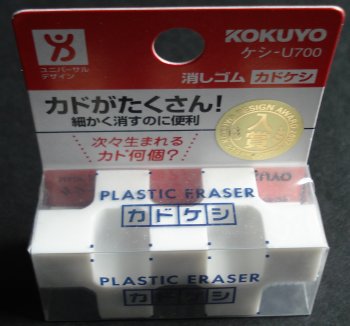
A fascinating eraser from Japan.

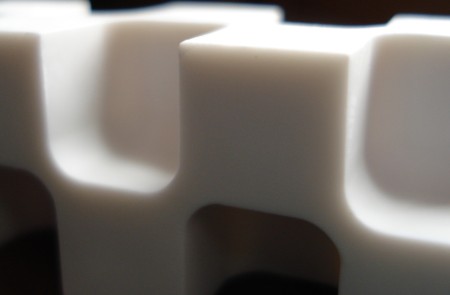
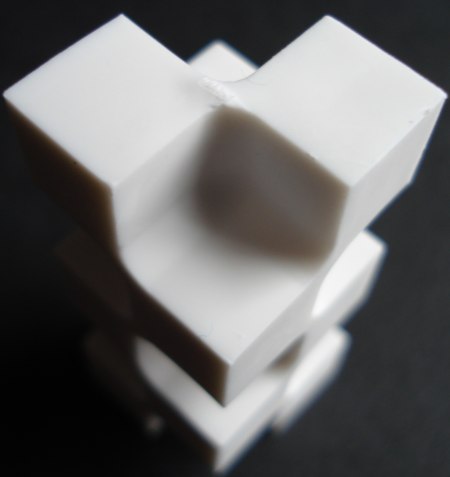
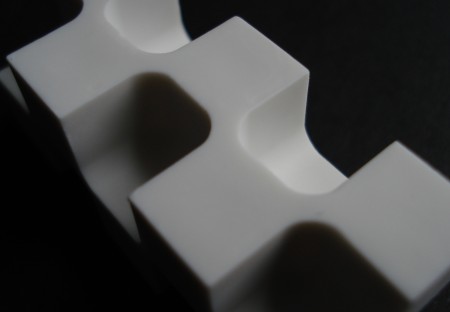
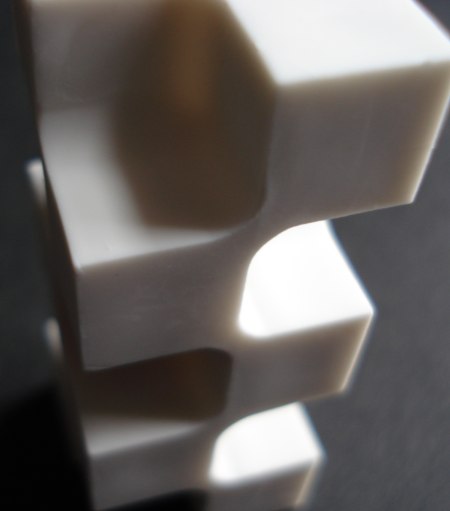
This eraser is a 2 x 2 x 5 block of 10mm sided cubes, with half the cubes scooped out.

Kokuyo Kadokeshi U700 eraser

There is apparently a “big brother” U800 with 15mm cubes, and a version with a strap, for attachment to a cell phone. I’m not making that up.

It is intriguing and geometric. The many corners and edges and scoops create interesting shadows, and make it very eye catching. Yet, it remains just an eraser.

Kokuyo Kadokeshi U700 eraser

Introduced in 2003, the eraser is part of the Museum of Modern Art’s permanent collection, and was featured in a 2004 exhibition, “Humble Masterpieces”.

The eraser was designed by Hideo Kanbara as an entry in a competition held by Kokuyo.

Kokuyo Kadokeshi U700 eraser

It is also a commercial success, having sold over 6.5 million erasers in the first three years after the launch.

Kokuyo Kadokeshi U700 eraser

The Kokuyo website says the eraser has 28 edges. Of course, they mean corners. External corners in particular.

I was curious about what else Hideo Kanbara has designed. While there are a few concept drawings on the web, an intriguing “plug pin” was the only other commercially offered item that I found.

Links:

Official Kadokeshi website
Kadokeshi in the Museum of Modern Art
The plug pin by Hideo Kanbara

Staedtler 925 95 drafting pencils

Staedtler 925 95 drafting pencils

While I didn’t mind the Pentel 120, the Mars micro was not to my taste. Drafting tools are supposed to be Staedtler’s turf, so I thought I would try something else from them. A little bit of research indicated that the 925 95 series is highly regarded, though sometimes tricky to find.

The inner workings of Staedtler Inc. aren’t known to me, but it’s clear that their division in Japan seems to produce some good stuff – like the 925 95.

Staedtler 925 95 drafting pencils

The entire pencil, except for a plastic end-cap indicating lead diameter, is metal. A push advance drafting pencil, it is suitable for many tasks.

Staedtler 925 95 drafting pencils

It is a ferocious and scary instrument. Never mind pocket-safe. It’s not safe, period. At 21g (approximately), with an untapered tip (as well as sleeve), it could be used for nefarious purposes.

Staedtler 925 95 drafting pencils

The pencil has two special features: A lead degree indicator, and the capability to adjust the lead advance mechanism.

The lead degree indicator is okay, with the window changed by holding the metal cap portion, and rotating the plastic portion. But, if you ever find that you fiddle with the cap, the setting is easily lost.

The advance adjustment is a rotating ring below the cap. From the point of view of the cap, clockwise rotation causes the lead to be dispensed in decreasing amounts. The range seems to from about 1.5mm (counterclockwise extreme) to too small for me to measure (clockwise extreme). If you care about how much lead is advanced per click, you may like this feature.

The clip is looser than I might expect – though while clipping the pencil to documents, it was the easily removed cap that I feared might become lost.

The grip felt very comfortable to me. While always a personal preference, the 925 95 seems to offer a very nice fine milled knurl.

Staedtler 925 95 drafting pencils

The weight is in the grip, and this somehow makes sense.

The best recommendation I have is to replace the default lead with the Lead Cup winning Ain. That really made the pencil excel, producing rich, dark lines.

So where can I get the 0.7mm version?

Steno pencils: pencils with a job

Steno pencils

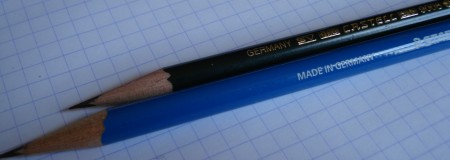
Faber-Castell and Staedtler each make a specialty extension to their premier lines – a “steno pencil”, aimed at shorthand practitioners. They are round versions of the Castell 9000 and Lumograph 100.

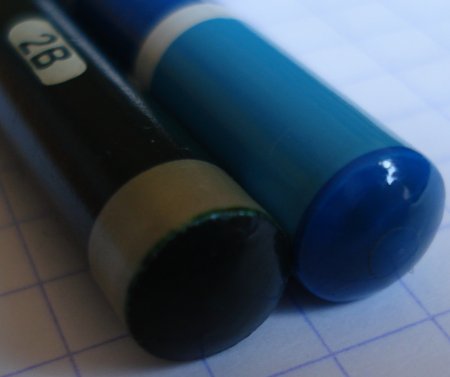
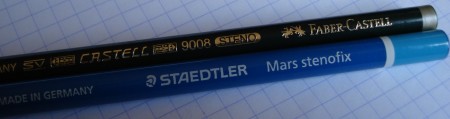
Staedtler’s entry is the Mars Stenofix, model 101. A round version of the Lumograph 100 (a Lumograph 101?), it is dark blue, but with the cap in turquoise rather than black. My thanks to Dave for providing this pencil. It is unfortunately not locally available to me.

Steno pencils

Faber-Castell’s offering is the 9008 Steno, corresponding to the Castell 9000 series. In appearance, it looks just like a round 9000.

Each is a high quality pencil, and I couldn’t detect any difference between the lead used in the mainstream pencils and the steno versions.

Steno pencils

The Stenofix is available solely in HB, while the 9008 is offered in HB, B, and 2B.

There is one other practical difference – the Stenofix has a full size diameter at about 7.45mm, while the 9008 has a thinner 7.25mm diameter.

They are interesting, quality pencils, and it’s unfortunate that they aren’t more widely available.