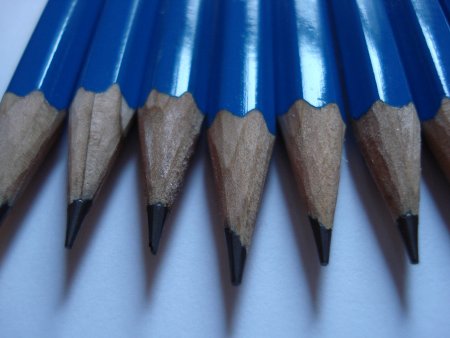
The Staedtler Mars Lumograph 100 is an icon of a pencil. When a movie depicts an artist sketching, often as not it’s the familiar blue Mars Lumograph 100 the actor is holding.
It’s also a marketing success. It’s sold in art supply stores, it’s sold at Staples, and it’s sold at the last independent stationer in my neck of the woods. Art supply stores typically stock two or three pencil lines – and one of them is always the Staedtler Mars.
Staedtler is a non-profit corporation, whose mission is to fund “German polytechnics and universities, in particular the Friedrich-Alexander University of Erlangen-Nuremberg“. (A famous graduate is Hans Geiger, inventor of the Geiger counter.) The company has ancient roots. Members of the Staedtler family are known to have worked in the pencil trade in the 17th century, and J. S. Staedtler founded a pencil factory in Nuremberg in 1835.
The Mars brand was registered in 1900, making this truly a pencil with a history.
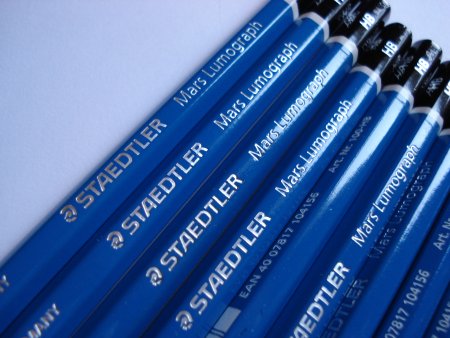
The pencils we’re looking at today are the current (2006) version of the Staedtler Mars Lumograph 100. We’ll look at the standard HB grade. I mentioned a couple of weeks ago that I wanted to move towards a more quantitative approach to discussing pencils. Well, I’ve already learned a few things that I’ll try and share.
First, and I don’t know why this surprised me, there is some difference in the weight of pencils from the same box. I’ll presume this is due to wood being a natural product, and different pieces of wood having slightly different densities. I tried to weigh each pencil with the same method, and label and re-weigh the pencils at different times to see if this was reproducible. It was. These pencils had a mean weight of 3.8 grams, and ranged from 3.6 to 4.1 grams. I tried other brands of pencils as well, and they had similar variations. (Incidentally, a few vintage pencils I weighed were all 5 to 6 grams. Pencils were more definitely more substantial some years ago.)
This amount of variation suggests that we had better be careful claiming that a particular pencil brand is heavier than another, unless a good number of samples have been tried. Since this may be the world’s most available quality pencil, I’m going to call 3.8g a reference pencil weight for comparison with other brands in the future.
The shape is hexagonal, the distance between opposite pencil sides is 7.45mm, and the pencil is a standard 175mm length. It is sold pre-sharpened.
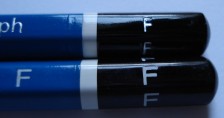
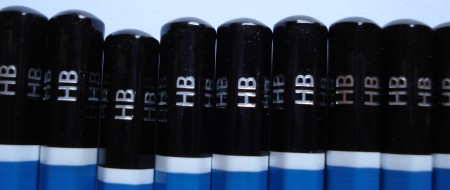
The exterior, blue with a white band and black cap, is marked:
Obverse (silver): MADE IN GERMANY STAEDTLER Mars Lumograph
Reverse (white): [bar code] EAN 40 07817 104156 Art. Nr. 100-HB
All six sides of the black cap have the grade, HB, written in silver.
The finish is a disappointment – the Mars is a classic, and the 2006 update weakens the depth of the blue finish, and narrows the white band. The famous white on black pencil grades on the cap have been replaced with smaller letters in silver. The bar code and long serial number on the reverse side also add design clutter. Compared with other top pencils, the lacquer seems just a bit thin.
(A Staedtler press release indicates that the pencil differs from the predecessor version in having improved break resistance.)
The micrometer and scale also reveal that the pencil is a fraction thinner and lighter than it was two years ago (approximately .1mm and .2g).
These particular pencils were C$1.69 each at an art supply store (a good price – they are typically $1.99 around here). Zellers, a discount chain just walking distance from the art supply store, offers 24 of their house brand for C$2.49 – that’s $0.10 each. I know they’re not by any means the same pencil, but that’s a huge price difference from a consumer perspective.
The pencil writes very nicely. I compared it with two other Staedtler offerings in HB – the Mars Ergosoft 150, and the Triplus Slim 118. It seemed similar to the Ergosoft in line darkness and writing smoothness, but much smoother than the Triplus, though similarly dark. Comparing it with a Tombow Mono 100, which many professionals would claim is the ultimate pencil, the lines are not nearly as rich or smooth. While rating good to excellent, it isn’t a real competitor to the Tombow.
Erasure testing led to the same ranking – a Mars plastic 528 50 eraser on Rhodia paper erased the Tombow lines most cleanly, and did the worst job on the Triplus.
I tried to look at smudging, but didn’t discern a noticeable difference between these pencils.
Sharpening with a Dux sharpener was trouble free. Like most good pencils, the lead did not crumble or break while writing.
The wood – let me know if you have any information. Staedtler is a global company, and does state that they use cedar and jelutong, but I don’t find anything stated about specific products. The pencils do not seem to have the red/pink hue of cedar.
The wide availability, plus the range of hardnesses, is a major advantage of this pencil. The problem with a specialty pencil is that a fresh supply may not be there when you need it. With the Staedtler, this will not be a problem.